The next three weeks will be a bit like waiting for pandas to have sex. It isn’t going to happen on camera. But deep in the bamboo forest, there are a whole series of political courtships going on.
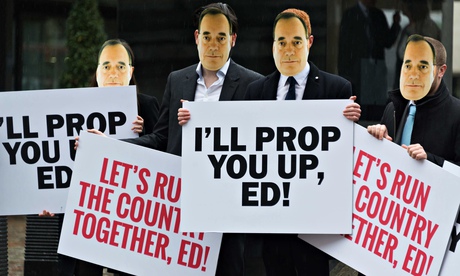
Nick Clegg is rather spoiling it by being out there touting for business, offering a coalition of conscience (with the Lib Dems, obviously) instead of what he says is the alternative, a coalition of grievance with either the SNP or Ukip. But it’s in his interests to call the bluff of the two main parties as they carry on trying desperately to assemble enough votes to win a working majority, some number – any number – greater than the absolute minimum of 323 seats (allowing for Sinn Fein not taking their seats). Both parties look at least 40 seats away from that target.
They know, as they have feared for months now, that to be in power, each is likely to need some form of partnership with another party or parties. The parties would prefer us to believe it’s not on their minds at all. Yet, judging from the churn in voting intentions that is disguised by the way the headline figures for Labour and Conservative are stuck in the mid-30s, many voters don’t know what they want, or at least, not how to get it.
The biggest difference between now and 2010 is that there has been five years of coalition. The coalition worked, in the sense that it has lasted, government business proceeded and each of the two parties managed to hold together throughout, just.
The upshot of that, however, is not that the parties eagerly anticipate pulling off the same trick, but that the Conservatives – the party, if not the leadership – do not want it to happen again (the Liberal Democrats know they will be lucky to get the chance).
Whatever the result on 7 May, David Cameron will face a meeting of his backbenchers immediately after the weekend. The stakes are high, maybe as high as they were at the original backbenchers meeting which gives the committee its name, when the party rebelled against being in coalition with Lloyd George. There is no appetite in Tory ranks for getting back into bed with the Lib Dems.
It is often claimed that the Lib Dem rank and file are equally reluctant. Even if a majority of those who hold their seats – maybe between half and two-thirds of the 57 seats they won in 2010 – were prepared to accept the idea in principle, any arrangement could be vetoed. But much of the party’s left-leaning support has gone. People who tell pollsters they’ll vote Lib Dem are happy at the idea of another coalition.
And Nick Clegg and David Laws, chief negotiator last time round, sound as if they at least are ready to try again. The clue is that neither will say that the EU referendum to which Cameron is committed would be a red line, while Vince Cable, who may still fancy his chances as an alternative leader to Clegg, hints that it would be.
But look at the five front-page pledges that Clegg says are non-negotiable, and there is nothing there that the Tories would find indigestible. More austerity – although Clegg insists the cuts cannot come from welfare, or at least not £12bn of them – a higher tax threshold for lower rate taxpayers, that £8bn for the NHS, more money for education, climate change targets – those are areas where Cameron’s Tories could find common ground.
Now put behind you any bitter memories of tuition fees and nuclear power, the headline pledges abandoned in 2010 – the negotiations then weren’t all one way. Some policies close to Tory hearts were sidelined in 2010 that cannot be shelved again. Think Trident and the European court of human rights. There is sparse common ground here, and no appetite for another compromise in either party.
Most of all, it doesn’t look as if the sums will add up for a deal. The idea of any kind of pact with Labour might seem unimaginable, but then that is what people thought last time about a deal with the Tories. Those Lib Dem red lines could be less of an issue – Labour might be happy to divert a final decision on Trident into another inquiry – but the idea that the kind of personal chemistry that got Cameron and Clegg through some hard times would work between Clegg and Miliband verges on the unbelievable. Miliband’s Labour really isn’t the same as Blair’s in 1997 when he and Paddy Ashdown discussed a realignment of the left.
So Labour will, at least sometimes, need the SNP. The press oligarchs portray this as a catastrophe. Here’s why it isn’t. First, these political courtships are not, or will not be in this case, any kind of a marriage of equals. Even if the SNP wins 50 seats, Labour will have something around six times as many. Labour will not be in the SNP’s pocket. Alex Salmond – not the leader of the Westminster party, but likely to be the chief tactician – could make life very difficult for a minority Labour government. But if the SNP thought Labour was too fiscally constrained on its budget, for example, would they really vote with the Tories to defeat it, and bring the government down?
The record shows that the last minority Labour government, from 1976-1979 did well enough to look like winning the election, until the winter of 1978. Minority governments can work. As we may be about to find out.