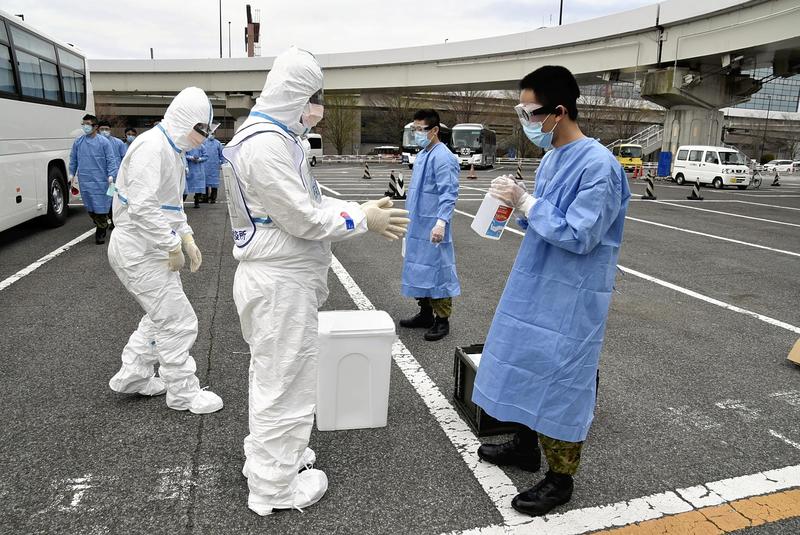
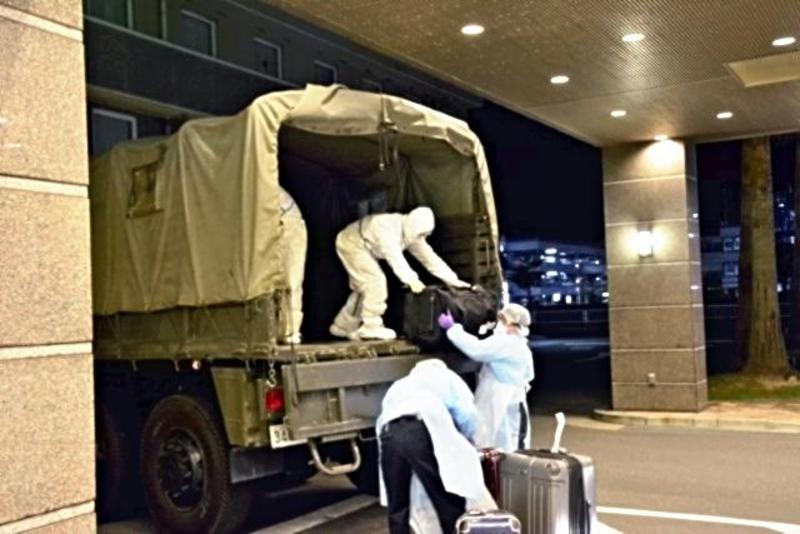
To prevent the spread of infections with the new coronavirus, the Self-Defense Forces are carrying out such tasks as testing returnees from abroad at Narita and Haneda airports, and transferring them from the airports to accommodation facilities for self-isolation.
In February and March, SDF personnel were also engaged in assisting the cruise vessel on which mass infections broke out.
How does a former officer of the SDF view this utilization of SDF personnel and the challenges involved? Yomiuri Shimbun Staff Writer Takeo Maeda recently interviewed Koichi Isobe, a retired lieutenant general of the Ground Self-Defense Force, who handled crisis management tasks at the time of the 2011 Great East Japan Earthquake.
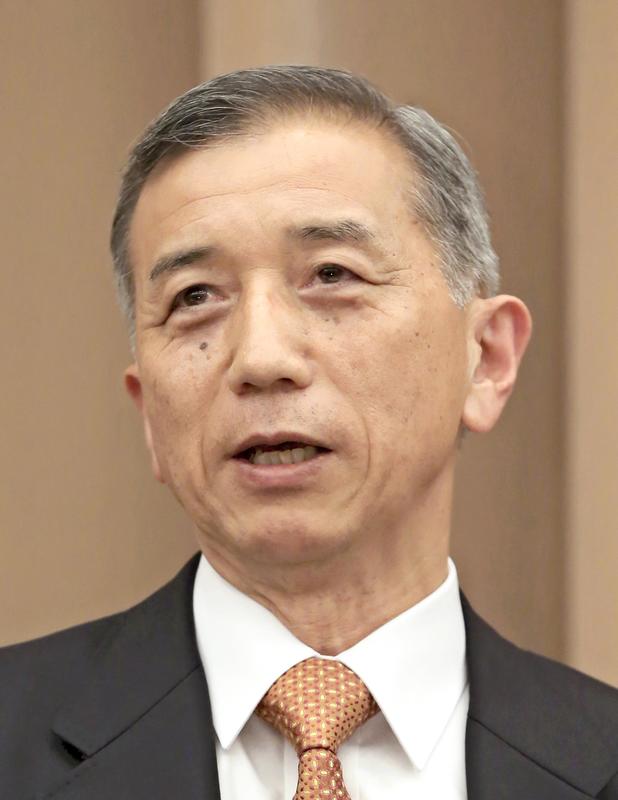
The Yomiuri Shimbun: The Self-Defense Forces were mobilized, on the order of the defense minister for disaster relief deployment, to conduct relief operations for the cruise ship and at the airports, in a "discretionary dispatch," which can be done without waiting for a request from a prefectural governor.
Koichi Isobe: First of all, I would like to compliment the SDF's swift and professional response. In his speech at the commencement ceremony for graduating students of the National Defense Academy held in March, Prime Minister Shinzo Abe referred to the fact that the SDF medical officers [senior officers with a medical license] collected samples from more than 2,200 people in a matter of just 10-plus days, while seeing no infections among the SDF personnel. He praised them for their perfect execution of their duties.
Yet the latest dispatch has been an extremely rare case of its kind. Arguments will crop up in the future such as whether the principle of requiring a request from a governor in dispatching SDF personnel -- as stipulated in Article 83 of the Self-Defense Forces Law (see below) -- can really work well if a situation occurs where there is an urgent need for the dispatch even though a governor has not made such a request yet.
Q: What are the roles required of the SDF?
A: As infections spread further, it is conceivable there will be a situation in which the number of hospital beds is insufficient. U.S. forces have gathered medical officers and army medics on reserve, and dispatched reinforcements to medical facilities in New York State and elsewhere.
In Japan too, if the number of people infected with the virus increases rapidly in the days ahead, it will become necessary to implement such measures as sending personnel from the SDF's medical service divisions to medical institutions to assist them.
The roles required of the SDF, and the roles that the people expect them to play, have become greater than ever and more wide-ranging. On the other hand, the national security environment of Japan has become more severe. We cannot neglect our preparedness in national defense.
Our neighboring countries are always keeping watch on the SDF's activities and proficiency. When disaster relief dispatch continues for a protracted period, with a large number of units and command organs engaged in such operations, defense training will stagnate as a result.
With regards to the disaster relief dispatch of the SDF, it is necessary to get back to the three requisites: public nature, urgency and irreplaceability. In particular, irreplaceability means it is desirable to reduce the breadth of the SDF's tasks to those only the SDF can do.
This is a period when it is not thought to be unusual for a landslide disaster or a flood triggered by a large-scale typhoon, or a massive earthquake, to occur any time. It has become necessary for the public and private sectors to act together in preparing for and dealing with earthquakes and other disasters, with the strengths of the whole country combined through self-help, mutual help and public help.
Watch China, N. Korea, Russia
Q: North Korea has not stopped developing and testing missiles, while China continues its military buildup and maritime advances.
A: The intrusions into the contiguous zones around the Senkaku Islands by Chinese government vessels from January to March this year increased by 50 percent from the same period last year. Earlier this month, six war vessels of the Chinese Navy, including the aircraft carrier Liaoning, sailed between Okinawa Island and Miyako Island and into the Pacific Ocean.
North Korea launched ballistic missiles as many as four times in March. Russian forces in the Far East also remain active. Despite the coronavirus pandemic, the military activities of China, North Korea and Russia remain almost unchanged, or rather have become more vigorous. We saw a similar situation at the time of the Great East Japan Earthquake.
Yet another matter that needs to be noted is the readiness of the U.S. forces, our allied forces. The spread of infections with the new coronavirus has hindered U.S. aircraft carrier operations in the Indo-Pacific region. Joint drills between the United States and its allies in Asia, including Japan, have been canceled one after another. We have to face the fact that the deterrent effect of the Japan-U.S. alliance has also weakened at the moment.
Q: The current circumstances make us ponder how the country should deal with an emergency.
A: I dealt with the accident at the Fukushima No. 1 nuclear power plant when I was the director of the Defense Plans and Policy Department of the Joint Staff at the Defense Ministry. At that time, I realized that this was the biggest crisis Japan had ever faced since the end of World War II.
To me, the latest calamity of the coronavirus seems to pose, in many respects, the same sorts of difficulties as the nuclear disaster nine years ago. In the battle against an invisible threat, there is no knowing how the threat will attack us. This can be considered as a "quasi-emergency." This time, the coronavirus may exert a greater impact than the 2011 quake on the economy, society and even how people live life in the future.
Under U.S. protection, Japan has enjoyed peace and economic prosperity in the postwar years. Many Japanese people may have thought things like: We don't want to think about any emergencies or wars. It's just fine to leave [difficult] things up to the government and the SDF. And maybe U.S. forces will come to help us.
Yet the course of things has apparently changed. We have come to a time when we have to drastically reconsider our preparation for crises.
Article 83 of the Self-Defense Forces Law
A provision under which a prefectural governor or other officials, in the event of a disaster, can ask the defense minister or an individual designated by the minister to dispatch SDF units. Section 2 of the article stipulates that the defense minister or other officials can dispatch units when it is deemed necessary. It also stipulates that when the situation is deemed "particularly urgent" and there is "no time to wait" for a request from a governor, relief units can be dispatched as an exceptional case under the framework of "discretionary dispatch."
Read more from The Japan News at https://japannews.yomiuri.co.jp/