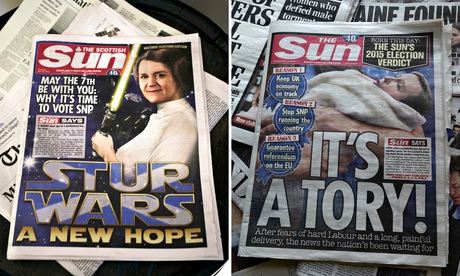
It’s hard not to scoff. Here’s the world’s supreme media power broker (alleged), the mogul wot wins it for fawning politicians. He’s deploying the nearest thing to a tactical nuke in his armoury, the monstrous Bun missile. But Houston, we have a launchpad problem. If we’re backing General Cam in the south, how can we be supporting the Magnificent Sturge in the north? This is more confusing than Game of Thrones.
Only cool examination makes things clearer. The Sun does not win elections. It mostly, like many other Murdoch papers, appends itself to whatever side the polls say is winning, then claims a certain swirl of credit later. This is because newspapers, especially in their modern, somewhat diminished, condition, do not move electoral fortunes much, if at all. Four weeks of April blasting from all sides confirms that. The barons on Olympus hurl thunderbolts, but the Earth does not move. Voters – whether from Yorkshire or not – are much savvier than the spinners suppose.
And the polls this time are of no help to Rupert. They don’t tell him whether Dave or Ed will come through in England: but since Ed has defined himself over five forthright years by condemning the Murdoch empire and threatening to carve it into pieces, the case for Labour support may not seem overwhelming down Rupert way. Meanwhile, the polls make an irresistible case for backing the SNP in Scotland. They portend something close to Labour and Tory wipeout. Why go down with a sinking ship? Much of the supposed Murdoch magic, here as in many other regions, is really cynical pragmatism: the calculation of the player, not the joy of the crusader. So stop the derision, slice the Bun and pass the marmalade.
But ponder more broadly, too. This is high season for newspaper endorsements, the moment when editors give voters sage (or onion) advice. Some of it is infinitely predictable. The Mirror will always back Labour. The Telegraph, after a few Ukip twitches, will always back the Tories. Both readership profiles make that inevitable. Other papers are slightly less predictable. Mr Richard Desmond lavishes Express millions on Nigel Farage. The Mail might embrace Nigel if only he could recruit a less scummy crew. But things get a little more unpredictable the further you go.
Two other editors made their choices last week. The FT – which might have opted for Labour, putting its fears over a European referendum first – chose another Con-Lib pact in the name of economic consistency. The Economist, quite separately, came to much the same conclusion. Neither move mountains of readers: indeed, the FT only sells just over 40,000 copies a day in the UK these days. But both have a potent international and web presence. They don’t really tell readers what to do on occasions like this. Rather, they brood over the issues that shape a decision among themselves, clustered in the editor’s office.
That’s useful for readers, too. They become part of the experience. They look deeper inside the paper they’re reading. They see how it works. OK: perhaps some conclusions are obvious. The Guardian, after a Lib Dem moment in 2010 that many readers rejected, is back in the Labour column. The Times – now edited by a former editor of its Sunday sister, a paper that invariably votes Tory – will endorse Cameron. The Indy, though keeping a certain traditional distance, sits on Labour’s side of the fence. But there is still a time and a reason for explicit choice: one definition of the difference between a private news organisation and the broadcasters. Newspapers have to choose. It’s part of their job.