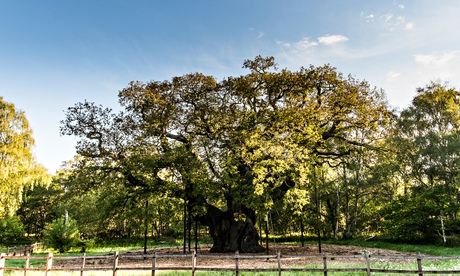
On Thursday, the most popular tree in Europe will be unveiled in a contest that has pitted the Czech Republic’s Dragon pine against France’s Bread tree and an ancient oak reputed to have sheltered Robin Hood. It’s the Eurovision of trees, says the self-styled treehunter Rob McBride.
McBride has just finished an odyssey to visit 11 of the 14 finalists of the European Tree of the Year, clocking up thousands of miles by train to pay homage to these ancient and distinctive trees and the communities that love them.
He has admired Spain’s black poplar, stood beneath Slovakia’s white mulberry – which locals call “the lighthouse of history” – and tracked down Italy’s magnificent silvery olive tree, which is 2,000 years old.
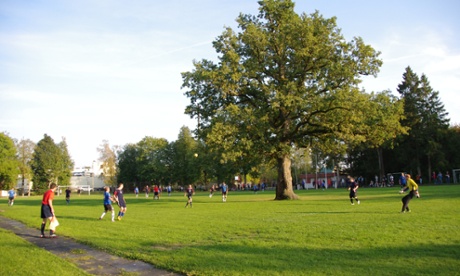
So, which is his favourite? “I started out liking the Lonely tree in Wales, because that’s the one closest to my home, but the people of Wales don’t seem to have got behind it, voting-wise,” says McBride. “Obviously the Major oak, with its Robin Hood connection, has done well, but my favourite would be the Football tree in Estonia.”
This is an old oak in the middle of a football pitch; footballers play around it, and even use it for one-twos. “I said that the tree was passing the ball more accurately than 90% of the England team – the Estonians liked that,” says McBride.
McBride’s tree odyssey showed him just how much ancient trees are cherished in communities across much of Europe – his pilgrimage saw him treated like a celebrity in many places – but he’s disappointed that so few British people have voted for their own trees in the first year that trees from England, Scotland and Wales have entered the contest.
“It’s a cultural difference,” he thinks. “In eastern Europe they are still more connected to the soil.”
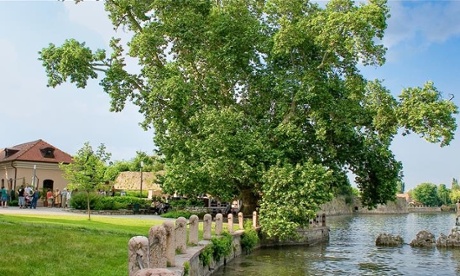
He tips the great plane of Tata in Hungary to win, not least because the Hungarians have entered the competition for many years and cannily choose a tree guaranteed to garner lots of local votes. “It’s going to be very, very tight, and Poland are coming up on the rails,” he says.
McBride hopes the competition will bolster the Woodland Trust’s Very Important Tree campaign, with the charity urging the government to create a national register of ancient and special trees. “It’s about cultural connection with communities and raising the profile of special trees across Europe. Lots of trees across Europe are on a government register,” says McBride. “We really need a national register of VITs.”