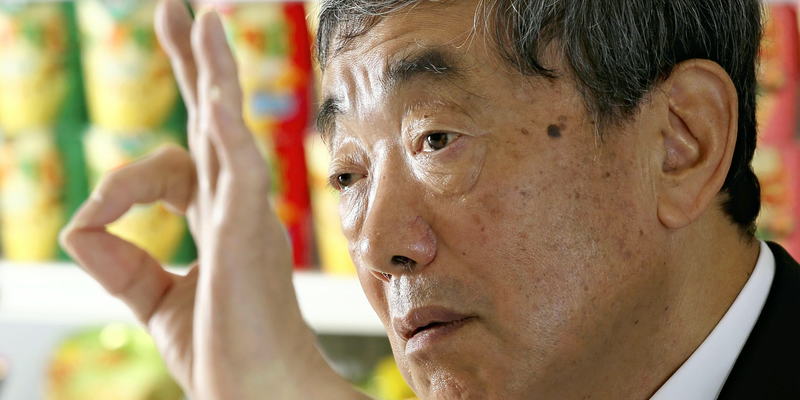
Japanese snack maker Calbee, Inc., known for favorites such as its Kappa Ebisen shrimp-flavored fried snack and its potato chips, has steadily increased its performance despite the maturing market it operates in. What is the secret? For this edition of "The Leaders," a column featuring corporate management and senior executives, The Yomiuri Shimbun asked Calbee Chairman of the Board and Chief Executive Officer Akira Matsumoto for his insights.
A lot of people say, "If it's a good product, it will sell," but that's not how it works. The important thing is how a product is sold.
Our company has a cereal called Frugra. I had to do a lot of work in the United States when I worked at a trading firm, and would often have breakfast at hotels where I was staying. They would have cereal with milk on it. This doesn't taste good.
At the time, I thought, "There's no way Japanese people would eat something like this," but when I joined Calbee in 2009, we were selling it ourselves. Thinking, "What kind of ridiculous thing are we doing here?" I tried it, and realized it was completely different. I could eat it every day and not tire of it.
Wondering why something so good wasn't selling well, I decided to see what could be done about it.
The first thing we looked at was the name of the product. In Japan, McDonald's is commonly known as Makku, Starbucks as Sutaba and the celebrity Takuya Kimura as Kimutaku. To shorten the name [of Fruit Granola], we changed it to Frugra in 2011.
The next thing was to clarify who exactly we were selling it to. I said, "Let's try targeting working women in their 20s to 50s." This demographic responds quickly to new things.
What does this demographic worry about and need? The answer is saving time. They don't even have time to use the restroom in the morning and they face more issues with constipation. We promoted the fact that this breakfast could be prepared in just one minute and that it contained as much fiber as four bananas, and annual sales climbed from 3 billion yen to 10 billion yen.
Every Sunday morning, I visit around 10 supermarkets and convenience stores near my home. I just look at the sales floors. I'm careful not to be mistaken for a shoplifter.
When you look at these places every week, you really understand. You get a feel for the price movements, what kinds of things sell well and what happens when things go on sale. Calbee puts out quite a few new products, so I also see things I wasn't aware of. When they are lined up on display at the stores, however, I know in an instant whether or not they will sell. It's in the balance between the content and the price. And the packaging. Product names written in Roman letters don't sell well.
We were poor when I was a child. Not extremely poor, but we weren't well off. I grew up in Kyoto Prefecture, and I would go to a department store with my parents about twice a year, but they would never buy me anything. I don't have any memories of us eating at a restaurant, either. I was happy when we would go there, though. It's good to be poor. Wanting things makes you proactive.
I attended college right in the middle of the [nationwide university campus] disputes. With no lectures and enjoying life, I ended up staying on for graduate school without any ambitions. However, everyone there was smart, unlike me. "This doesn't feel right," I thought, and I decided to start looking for a job.
A recruiter for trading company Itochu happened to come to the university, so I asked, "Would you take someone like me?" Actually, I didn't even known what it was that Itochu did at that time, but once I joined, I realized this was my true calling. You just have to ensure that the products sell well. Normally, a trading firm will have departments divided by product category, with each department responsible for selling certain products. However, in my case things were different. I would find a customer and then find what it was that they needed and sell it to them.
I befriended the chairman of a shipping company and said, "Anything you need, please buy it from me." In addition to a ship, I sold everything from real estate to equipment for golf courses. There is no doubt it was frowned upon at the company.
I changed from being a mere section manager to an administrative management role. The company was on the brink of bankruptcy, but we were able to increase sales by a factor of about 10 over six years.
That's when I started to think, "Running a company is fun." However, there was zero chance of me becoming Itochu president. "In that case, I'll have to look elsewhere," I decided, and left the company.
I had quite a succession of invitations from medical equipment companies -- 23, I believe. I chose the Japanese subsidiary of a major U.S. company, Johnson & Johnson. A senior executive from the medical equipment department came over from the United States and convinced me directly.
I worked as company president for a long time, but decided to leave at the age of 60. It was around then that I met Masahiko Matsuo, a member of Calbee's founding family and the president of the company at the time, at a group study meeting. I was invited by him to become an external director. Later, I was asked to serve as company president -- an offer I turned down, and instead offered to serve as chairman of the board, which was accepted.
Go where the customers are
Growing a company requires expanding your market, innovating, or acquiring a majority market share. These are the only three options.
With the number of children in Japan decreasing, it is difficult to expand the market. Innovation is easy to talk about, and it is easy to apply the pressure to innovate, but actually achieving it requires either luck or the work of a genius.
Calbee was originally responsible for the launch of hit snacks such as Jagarico and Jagabee, but this was thanks to the presence of people like the founder, who was extremely talented and put a lot of energy into product development, and his sons. That DNA does not exist within the company anymore.
It is impossible to manage the company relying solely on innovation. Japanese people by nature don't really excel at innovation. You can talk about how Sony invented the Walkman, but they only made an existing product smaller. The inventor of the tape recorder itself was more of an innovator.
However, market share can be expanded and products can be sold based on how they are made, even if you can't invent something new. There are a myriad of ways to accomplish this. Even now, I still believe I am the best at this company at selling things.
When we marketed Frugra to the 50-and-over upper middle-aged demographic -- which cares significantly about health -- as an everyday breakfast option that is lower in sodium, sales of the product increased to 30 billion yen. I would like to increase this to 50 billion yen.
It is important to stand in the customer's shoes. Long ago, we always had "customer-oriented" philosophies, but that alone is not enough. That is not truly assuming the customer's point of view. What issues do the customers have in their lives? If we don't start there, we won't be able to sell products in the current era.
This is why diversity, including the active role of women, is important. Not because I'm fond of women.
Work style reforms are also a given. We cannot hope to succeed if we simply keep doing things the way we have always done them. I tell people to stop having unnecessary meetings and creating so many documents, and instead spend more time going to where the customers actually are. Our efforts at the company will be meaningless if we don't perform well and profit.
As the current CEO, it is my job to take responsibility. I try to create an environment in which it is easy for everyone to do their job. If it doesn't go well, it's entirely my responsibility.
-- Profile
Akira Matsumoto was born in 1947 and raised in Kyoto Prefecture. In 1972, he obtained a master's degree from the Graduate School of Agriculture at Kyoto University and joined Itochu Corp. After serving as company director at Itochu's medical equipment subsidiary, Century Medical, he joined Japan's Johnson & Johnson Medical (now Johnson & Johnson) in 1993, where he served as company president. Matsumoto entered his current position in June 2009.
-- Key Numbers: 1 trillion yen
Calbee's consolidated sales for the business year ending March 2017 were 252.4 billion yen, an increase of about 70 percent over the business year ending March 2010. The company's goal is to increase overseas sales to reach a consolidated total of 1 trillion yen in the future. The company, founded in 1949, holds a 54 percent share of the Japanese snack and confection market as a whole, and a 72 percent share in the Japanese potato chip market (as of the business year ending March 2017). The company employs about 3,860 people.
Read more from The Japan News at https://japannews.yomiuri.co.jp/