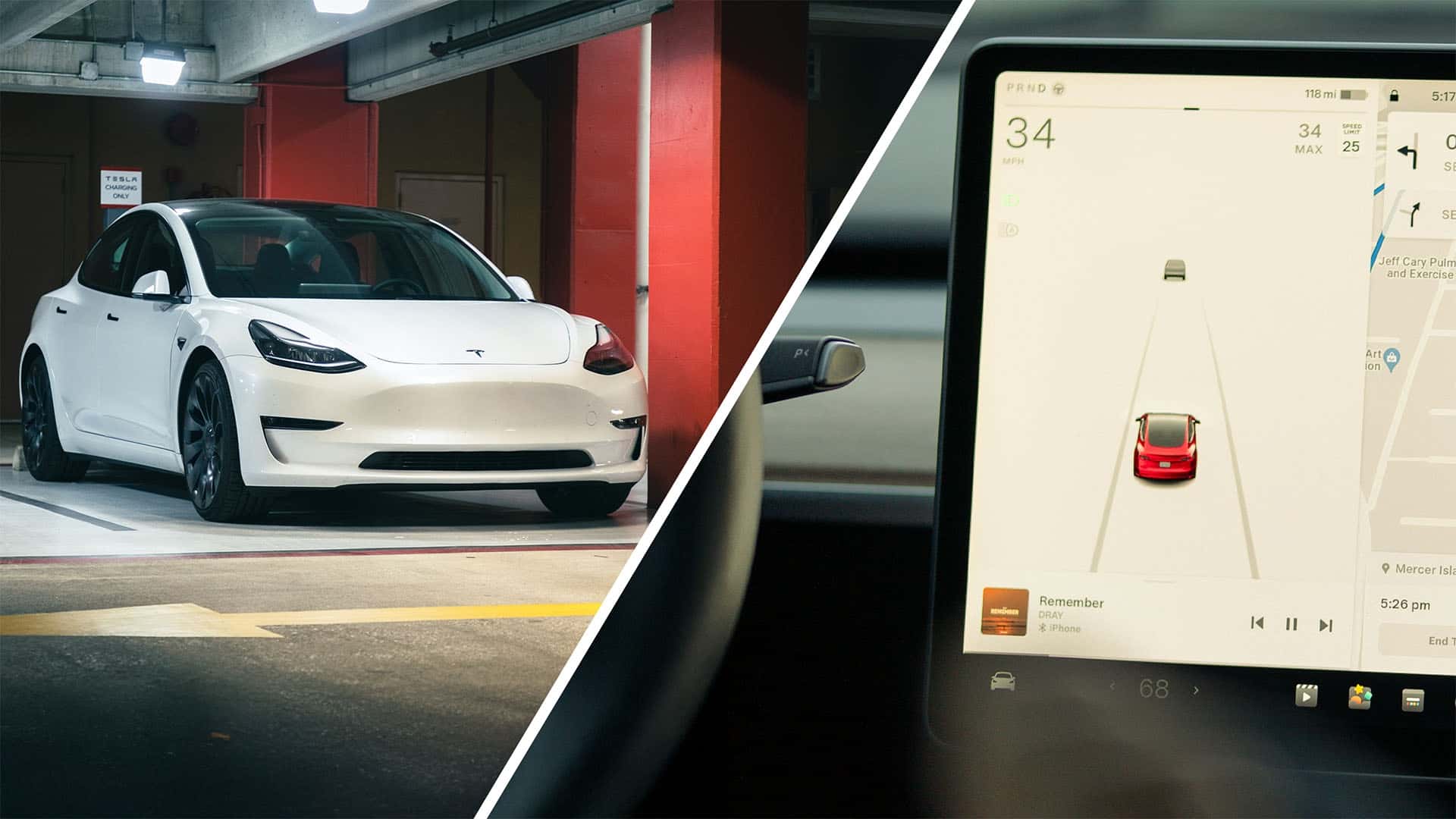
Tesla’s Full Self-Driving Safety Score has turned driving into a video game, and not the fun kind. Think less Mario Kart, more “tiptoe your Model 3 through life to avoid angering the algorithm.” And as a viral TikTok jokingly suggests, some owners will go to almost absurd lengths to keep that score at 100.
In a viral clip from TikTokker Jeremy Judkins (@jeremyjudkins2) we get a humorous look at how little care it seems some Tesla drivers have for the world outside of their software-operated vehicle. Intermixing video of Ariana Grande behind the wheel with dashcam footage of a pedestrian collision, the stitched clip plays on a familiar trope: Tesla owners portrayed as ruthless road warriors willing to do almost anything to protect their perfect Full Self-Driving Safety Score. The joke works precisely because the culture around that score has become so intense.
Judkins’ clip is obviously satire, but it taps into something real. The Tesla Safety Score, first introduced in 2021 and detailed on Tesla’s official support site, served as the gatekeeper for owners seeking access to the then-experimental FSD Beta program. If you didn’t have a high score close to 100, you simply didn’t get in. That early dynamic created a sense of scarcity, competition, and even a bit of paranoia among owners.
Some owners even reported avoiding certain roads, traffic patterns, or times of day to reduce their chances of dinging their score.
Tesla later loosened access requirements as FSD was rolled out more widely, but the culture never fully relaxed. A perfect “100” still carries a certain cachet that’s part bragging right, part badge of honor, part proof of being a True Believer in the FSD vision.
Tesla FSD: What Really Goes Into the Safety Score
Despite the viral video’s suggestion, the Safety Score is not tracking Ariana Grande driving habits or punishing owners for the existence of pedestrians. Instead, Tesla’s algorithm monitors a handful of quantifiable inputs: Forward Collision Warnings, hard braking, aggressive turning, unsafe following, and Autopilot disengagements. Tesla publishes all of these scoring factors publicly, including the weighted formula it uses to calculate an overall average.
In practice, that means the car is watching you more closely than any passenger ever could. A slightly rushed stoplight? Hard braking. A quick merge to escape a tailgater? Aggressive turning. A moment where Autopilot nags you for not keeping enough torque on the wheel? Forced disengagement.
OWNERSHIP STORIES
Viral stories from across the web
Our team of experts tracks what owners are saying about car-shopping, repairs, the daily driving experience and more on social media.
Owners often describe the system as “fair but unforgiving,” and the data backs that up. Several creators have documented their attempts to maintain high scores, showing how a single unexpected event can tank an otherwise perfect profile.
It’s not that the system is punitive; it’s simply literal. And literal systems tend to produce anxious humans.
This is where the TikTok satire hits closest to home. Maintaining a 100 Safety Score means driving with an almost meditative level of calm. Owners have described coasting toward every intersection as if they’re carrying a pot of boiling water, letting entire lanes of traffic pass to avoid unsafe following distances, and choosing routes with fewer stoplights to reduce the odds of a hard-brake penalty.
There’s also the psychological component. The Safety Score updates daily, creating a sense of gamified accountability. Owners check it the way fitness buffs check steps or heart rate zones. Some even keep spreadsheets.
If it all sounds a little obsessive, that’s because it is. The Safety Score is one of the few public-facing metrics Tesla offers its owners: An explicit number that appears to measure how well a human and a semi-autonomous system work together. It’s no wonder people get attached.
The Score Matters Less, But Still Matters
With Full Self-Driving now available more broadly and no longer gated behind perfect scores, the practical need for a 100 has diminished. Tesla still uses the Safety Score to estimate insurance risk in certain states through its usage-based insurance program, but even there, owners report that a range of scores is acceptable without dramatically affecting premiums.
And yet, the obsession persists. Chalk it up to cultural inertia. Tesla fandom has always been partially built around stats such as range, efficiency, charging speeds, and acceleration times. In that sense, the Safety Score is just another leaderboard. A perfect 100 signals something beyond safety. It signals devotion, mastery, and a kind of synchronized harmony between car and driver that only the most committed owners achieve.
To be clear, Tesla’s Safety Score system is based on real-world crash statistics and is rooted in the company’s push to reduce collisions across its fleet. Its calculations mirror the sort of metrics insurers and transportation agencies use every day. It’s a serious tool.
But the culture around it is something uniquely Tesla. It’s what happens when driving, data, and fandom meet.
And that’s why the TikTok works. It exaggerates the truth just enough to highlight the absurdity.
Because at the end of the day, you don’t need to channel Ariana Grande or sacrifice pedestrians to keep your Tesla Safety Score at 100. You just need patience, smooth braking, and the humility to drive like someone is silently grading your every move.
InsideEVs reached out to Judkins via direct message and a comment on the post. We’ll be sure to update this if they respond.