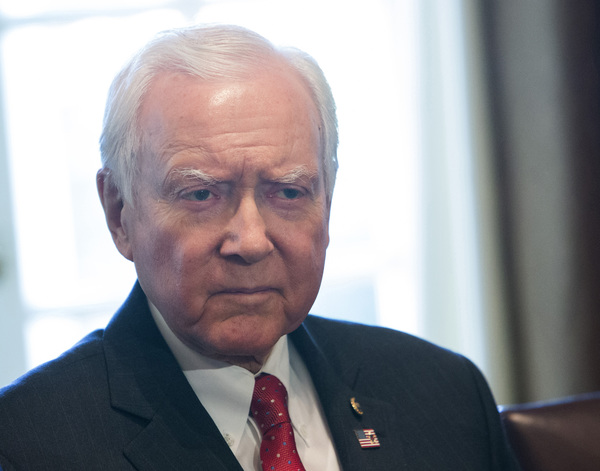
WASHINGTON _ Much of the talk after GOP Sen. Orrin G. Hatch's announcement that he will retire from the Senate after serving Utah for more than four decades will focus on whether Mitt Romney will seek to succeed him.
But on Capitol Hill, the Finance chairman's pending departure when he still has time left under conference rules to wield the tax writing panel's gavel also raises questions about who will lead the Senate GOP on taxes, trade, health care and entitlements.
The Senate has always given deference to seniority, meaning that if the GOP holds control of the Senate, the focus will be on Judiciary Chairman Charles E. Grassley, with the caveat that the forthcoming scenarios assume the GOP retains the majority in the Senate after 2018.
The Republican from Iowa took to his Twitter account Tuesday to wish Hatch well.
"Sen Hatch is a friend for 37 yrs while serving together in US Senate. He serves Utah & USA w tremendous success as effective as can be & deserves credit 4 doing so," wrote Grassley.
Grassley has served for decades alongside Hatch at both the Finance and Judiciary panels, arriving in the Senate just four years after the senior senator from Utah.
The Iowa senator previously served as chairman of the Finance panel from 2003 until the Democrats gained the majority in 2007, working closely with Democratic Sen. Max Baucus of Montana. Grassley was also the chairman in 2001, during the brief period of a deadlocked 50-50 Senate, until Sen. Jim Jeffords of Vermont switched caucuses and swung the majority to the Democrats.
The view of the Senate Republican Conference has been that terms of service in a leadership role lasting less than a full two years should not be counted against internal term limits, which only allow for three two-year terms as chairman.
A move back to leading the Finance panel in the final two years of President Donald Trump's first term could be appealing to Grassley, but he might well opt to continue at the Judiciary Committee, with the potential for additional Supreme Court nominations to consider, as well as scores of appellate court seats to fill.
Should Grassley go to Finance, it would be Sen. Lindsey Graham on deck at the Judiciary. A former campaign adversary of Trump, the South Carolina Republican has emerged as among the most supportive voices of the president. He also brings a legal background as a former military lawyer, serving as an instructor for the Air Force Judge Advocate General school and as a judge.
He has also become a frequent golfing partner of Trump at the president's course in Northern Virginia and elsewhere.
If Grassley were to opt to remain atop the Judiciary Committee, the next person in line at Finance would be Michael D. Crapo of Idaho. The current Banking chairman would likely be replaced in that role by Pennsylvania Sen. Patrick J. Toomey.
As for Romney, the 2012 Republican presidential nominee thanked Hatch for his years of service in a Facebook post. Romney did not indicate whether he would run for Hatch's seat, though he is widely considered to be a potential candidate.
Hatch's decision came the first day candidates could declare their intent to gather signatures, one of two paths to the ballot in Utah.
Waiting until the final hour essentially froze the rest of the GOP field, said LaVarr Webb, a GOP consultant and publisher of UtahPolicy.com.
"It's really late in the year, late in the cycle, for anyone who is not independently wealthy or famous, someone with great name ID, to get into the race and be a credible candidate," Webb said.
Romney fits the bill across that particular board. Webb noted Romney could face some pushback from Trump supporters or far-right conservatives who view Romney as too moderate, but it's unclear who would be willing to challenge the former Massachusetts governor and 2012 GOP presidential nominee.
In that race, Romney became the first Mormon to lead a major party's presidential ticket. Mormons make up about 55 percent of Utah's population and Romney won it in 2012 with 73 percent of the vote.
Webb also said there are more mainstream Republicans in Utah who have appreciated Romney's willingness to speak out against Trump.
In making his retirement announcement, Hatch, 83, highlighted some of his own legislative accomplishments.
"I've authored more bills that have become law than any member of Congress alive today. I played a central role in the creation of the modern generic drug industry, the passage of the landmark Americans with Disabilities Act, and the confirmation of every current member of the United States Supreme Court. Just last month, I helped lead the effort to pass historic, comprehensive tax reform," Hatch said in a video.
Hatch was one of the lead authors of the Children's Health Insurance Program along with Democratic Sen. Edward M. Kennedy of Massachusetts, and its stalled reauthorization is poised to be a key priority for Hatch in his final year as a senator.
Among his other endeavors for 2018 is an effort with Tennessee Republican Lamar Alexander to update payments to songwriters in the age of digital and streaming music. Hatch is himself a songwriter and musician.
Hatch had been encouraged to run again by Trump, with whom he had a close relationship.
He once tried running for president himself, a rather quixotic campaign in 2000, in which he finished last in the caucus field in Iowa.
Beyond his record on legislation and nominations, Hatch serves as the president pro tempore of the Senate, which is a constitutional office in the line of presidential succession.
By custom, the office is held by the most senior member of the majority party. Next in line is Senate Appropriations Chairman Thad Cochran.
The Mississippi Republican has been plagued by health challenges lately, and his aides have denied any plans for an announcement of an early retirement. But some senators think that Cochran may step aside sooner rather than later.
In line to be the president pro tempore after Hatch and Cochran? Once again, it's Grassley.