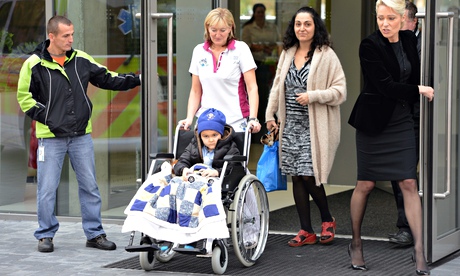
Good news that Ashya King, the child with a brain tumour whose parents took him to Prague for treatment, is now cancer-free. Does this happy result vindicate the parents in their spirited quest to defy UK doctors? Does it prove that the NHS cannot offer world-class service? Is it a victory for David over Goliath? Or for patient choice over medical hegemony? I don’t think it is any of those things, although I’m very pleased that he’s doing so well.
A parent whose child is diagnosed with a brain tumour is terrified and will obviously want the best for them. Speaking from experience your instinct is to trust no one. The local hospital may not seem equal to the task and it is only natural to wonder whether something better exists “out there”. There must be a newer, better, less damaging treatment your child is being denied because the NHS is skint. There is such a loss of control when your child is ill. To take control, even if it means charging across Europe, may seem preferable to passively accepting what is on offer.
As a GP, I have patients who choose to reject the NHS options I put to them. One man with advanced prostate cancer went to Bulgaria to have high-intensity focused ultrasound (HIFU). It’s only available in the UK as part of a clinical trial and he didn’t fit the criteria. HIFU won’t be widely available until and unless the results show that it is effective, safe and better than the alternatives. This man felt he couldn’t wait.
Other men diagnosed with early prostate cancer are advised to have regular follow-up but no active treatment. The rationale is that treatment won’t alter the outcome, which is generally very good. But it is hard to be told you have cancer and that there is nothing to do about it. Little wonder that some have pursued active treatment, often in the private sector.
Another of my patients, who had been newly diagnosed with Parkinson’s, was disappointed that he wasn’t offered brain surgery, which had reportedly helped the actor Michael J Fox. He felt this was an option for American celebrities but not on the NHS. But the truth is that, fortunately, he wasn’t bad enough to need it. If and when he is, treatments such as deep brain stimulation are available in the UK.
Another family, who had to cope with the devastating news that their child had a rare brain tumour, showed me an article about a child who had gone to the US for treatment not available in the UK. They did have trust in Great Ormond Street hospital, where their child is being treated, but wondered if they were letting them down by not exploring more radical options. All they really wanted was reassurance that doctors here are aware of treatments available elsewhere. And we generally are.
Patients are now better informed than ever before. Doctors acknowledge this and good ones welcome it. Knowledge can mean you access better, safer treatment for yourself. It also can mean you interrogate the professionals caring for you so that they pay more attention to you and your options. But as the Thalidomide disaster showed, harms may not be immediately apparent. There is no substitute for adequate testing and careful follow-up.
The NHS stands accused of being slow to adopt new treatments. When Lord Maurice Saatchi’s wife died of ovarian cancer, he campaigned to change the law so that doctors could treat patients dying of cancer and other diseases with new and innovative treatments, without waiting for official sanction. But medical professionals lined up to disagree, saying that there is scope within the current system without experimenting on the dying.
People differ in their approach to serious illness. Some want to know everything, be in control, listen to experts and then make their own choice about treatment, even if it runs counter to the experts’ advice. Others want to know very little. As a patient told me: “When my car’s broken, I drop it off at the garage and leave them to fix it. I want you to do that for me.”
Most people lie somewhere between the two. They want objective information, choices explained if there are any to be made, and an honest opinion from the expert as to what they would do in the same situation.