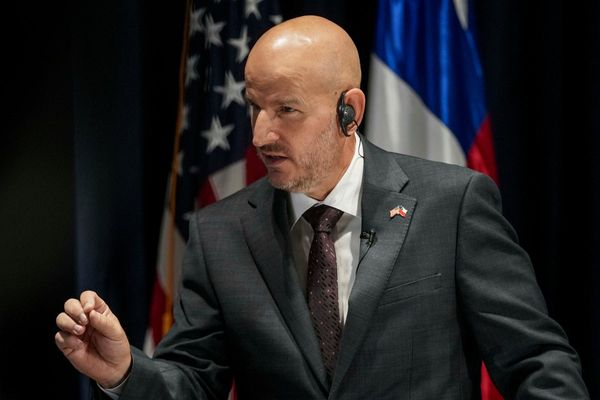
Mask wearing and social distancing will need to be more heavily relied on to contain Covid transmission as Australia starts to reopen because of Sydney's overwhelmed contact tracing system, ACT Chief Minister Andrew Barr has said.
Mr Barr believes the outbreaks in Sydney and Melbourne have challenged one of the crucial assumptions in the contentious Doherty Institute modelling, which underpins national cabinet's four-step plan to end lockdowns and reopen Australian to the world.
He said rising case numbers meant leaders would no longer be able to base decisions around easing restrictions on the assumption that there would be "optimal" capacity to manage outbreaks through testing, tracing, isolation and quarantine (TTIQ).
NSW reported another pandemic record 1218 cases on Sunday, as the number of infections which contact tracers have been unable to link to known sources continues to surge.
Victoria recorded a further 92 cases - its highest daily number since its deadly second wave last year.
With contact tracing under immense strain, Mr Barr said public health measures combined with the "principal weapon" of vaccination would be relied on to manage outbreaks as restrictions eased under the national plan.
He said the implications of the Delta outbreaks on the Doherty Institute modelling were discussed extensively at Friday's national cabinet meeting.
"It's clear that we can't base our decisions on optimal TTIQ, that that will not be possible with very high case numbers. So we need to look at TTIQ as being partially effective rather than being optimally effective."
"That's a fact - something we will have to deal with."
The Doherty Modelling looked at the effect of vaccination rates and public health measures on containing Covid transmission, in separate scenarios which assumed either "optimal" or "partial" testing, trace, isolation and quarantine.
Under the "partial" scenario, low and medium public health restrictions - which could include stay-at-home orders - would be needed to contain the virus' spread even when 70 per cent of the population was fully vaccinated.
Under the "optimal" scenario, which Mr Barr believes is no longer achievable, only low-level public health restrictions would be needed to suppress the virus' spread at 70 per cent vaccination coverage.