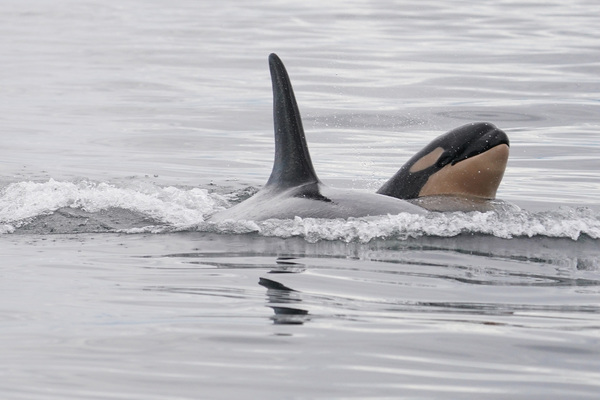
SEATTLE _ Tahlequah's new calf is a male, the Center for Whale Research has confirmed.
The young whale was seen the evening of Sept. 22, near Point Roberts, Whatcom County, where photos taken from a whale watch boat and examined by center researchers documented the young whale is male.
The whale is believed to have been born Sept. 4 to mother orca Tahlequah, who raised worldwide concern when she did not let go of her last calf, which died shortly after birth. She swam with it for 17 days and 1,000 miles.
This calf is feisty. He's been seen rolling, spyhopping, and swimming alongside his mother as she forages for food, according to the center.
J57 is the second viable calf born to Tahlequah. Her first is J57's brother, J47, born in 2010.
The southern residents J, K, and L pods are endangered, with only 73 members in all, counting the new baby. Hopes were high for a female.
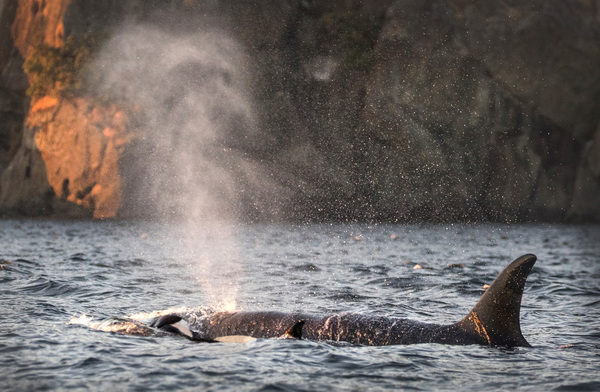
"Girls can be mothers," said Ken Balcomb, founding director of the center. "And obviously you don't need that many boys when you have two males that have fathered most of the offspring in this population."
In a 2018 paper Mike Ford, director of the conservation biology division at the National Oceanic and Atmospheric Administration's Northwest Fisheries Science Center in Seattle, Balcomb and other researchers documented not only the small number of males fathering the young in the southern resident pods. But also that the southern residents do sometimes interbreed within their own family line.
A skew toward male offspring could be one more consequence of the small population of southern resident orcas. "It becomes more likely that you get skewed gender just by chance," Ford said Wednesday. And that, too, can be another survival challenge.
"The rate the population can increase is limited by the number of females in the population."
Nonetheless the birth of J57 is something to cheer, Balcomb said. "We celebrate the fact that they can still reproduce," he said of the southern resident orcas. "We look forward to him maybe being a breeder of the future. But we are looking 22 years away before that happens."
Today there are 39 females and 33 males in the southern resident population, according to data provided by Ford, and one baby of unknown gender, L124 born early in 2019. There are 27 reproductive age females (age 10 to 42) and 17 potentially reproductive males.
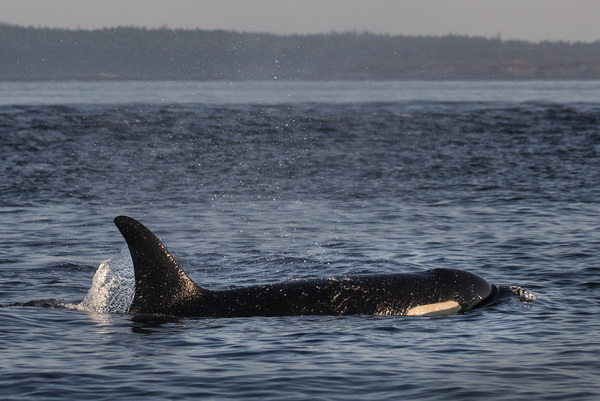
The three pods include a total of eight older females past reproductive age, Ford noted. The oldest southern resident orca by far is L25, estimated to have been born in 1928.
Southern resident orcas younger than 10 skew male, by 7:4. The older animals, according to Ford, skew female largely because the females simply live longer.
The southern resident population faces three main threats: vessel noise and disturbance; pollution; and lack of readily available, quality food, especially the orcas' preferred diet of chinook salmon.
The orcas need to eat about 4% of their body weight every day in salmon to be healthy, Balcomb said. For the new baby, that means by the time he is a sexually mature, 10,000-pound adult, he will need about 400 pounds of salmon a day.
Chinook overall have declined throughout the range of the southern resident orcas, and noise makes the fish harder to catch, because the orcas use sound to hunt.
The Washington Department of Fish and Wildlife is seeking public comment through Oct. 23 and holding virtual public hearings Oct. 7 and 8 on the state's first licensing requirements on whale watching in Washington waters.
The rules are intended to protect the southern residents with a number of strategies, including limiting the number of boats present with the whales at any one time; the duration the tour boats may be present; and requiring licenses for commercial tour operators.