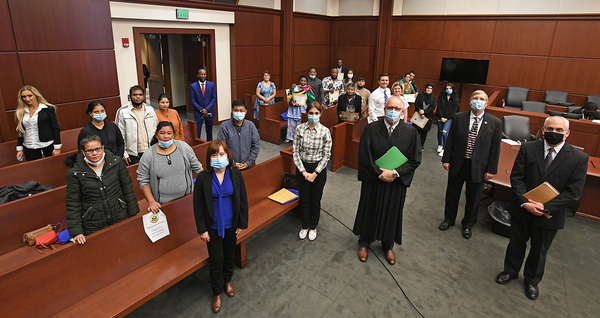
MIAMI — U.S. legal permanent residents who apply for citizenship through naturalization on or after Dec. 1 will face a more challenging test — in which immigrants must prove they can read, write and speak basic English, and have essential knowledge of U.S. history and government.
U.S. Citizenship and Immigration Services, or USCIS, announced Friday the implementation of a revised version of the citizenship civics test for naturalization applicants with a filing date (also known as a receipt date) of Dec. 1 and beyond.
The test will evaluate an immigrant's knowledge of American history, government and civic values, said the immigration agency, which a year ago announced the creation of a working group to review and update the test questions.
"USCIS has diligently worked on revising the naturalization test since 2018, relying on input from experts in the field of adult education to ensure that this process is fair and transparent," said USCIS Deputy Director for Policy Joseph Edlow in a news release.
The much-feared naturalization test is one of the key requirements for obtaining U.S. citizenship through naturalization. There is the civics portion of the test — which encompasses questions and answers — and the language proficiency section.
According to a policy alert published Friday on USCIS' Policy Manual titled "Civics Educational Requirement for Purposes of Naturalization," there are two main changes in the new test for U.S. citizenship.
_Increases the number of questions and answers to be studied: The exam approved by the authorities in 2008 — and until now in effect — includes the study of 100 questions and answers as part of the immigrant's preparation to take the test The 2020 version of the civics test increases the general bank of civics test questions to 128.
_Doubles the number of questions to be answered during the interview: Until now, public officials who administer the exam during the final interview with USCIS, asked a total of 10 questions from the list of 100, and the applicant had to satisfactorily answer six of those 10 questions to pass.
Although the passing score will remain at 60%, on the revised test, USCIS officers will ask applicants 20 questions instead of 10, so the immigrant must satisfactorily answer 12 to pass.
Furthermore, in the previous test, if an immigrant answered six questions correctly before reaching the last one, this component of the exam ended. In the revised test, even if the person answers 12 questions correctly, the officer must continue to ask all 20.
There is one exception: USCIS' policy alert clarifies that the agency will continue to administer 10 questions, with six correct answers needed, to immigrants who qualify for special consideration because they are age 65 or older and have been lawful permanent residents for at least 20 years.
The test items and study guides can be found on the Citizenship Resource Center on the USCIS website, said the Department of Homeland Security agency.
There, legal permanent residents have access to government-endorsed study materials that prepare them for the civics and linguistics portions.
The English test will not change. English language proficiency is determined by the applicant's ability to read, write, speak and understand English. To sufficiently demonstrate the ability, the person must correctly read one of three sentences and write one of three sentences.
The ability to speak English is determined by the USCIS officer conducting the interview.
"USCIS piloted the test with community-based organizations and volunteers across the country in summer 2020," said the agency, which used the collected data to "make determinations about the language and grammatical structure of individual test items."
Immigrants sometimes make mistakes when they submit naturalization petitions but don't meet the requirements, which include the following:
An applicant must:
_Be at least 18 years old at the time of filing.
_Live in the United States as a permanent legal resident for five continuous years, or three if he or she got a green card through a U.S. citizen spouse.
_Show physical presence in the United States for at least 30 months during the last five years, or 18 months if married to an American citizen.
_Show good moral character. This means a clean criminal record for the previous five years, and not submitting false information as part of any immigration form or procedure. (A person with an aggravated felony is ineligible for naturalization.)
_Be able to read, write and speak basic English, and show knowledge of U.S. history and government.
_Be willing to support and defend the United States and the U.S. Constitution.