
Israel sent a team to the nuclear talks with Iran in Vienna for the first time on Tuesday in a last-ditch effort to make its concerns heard.
Foreign Ministry Deputy Director-General for Strategic Affairs Joshua Zarka and Atomic Energy Commission Deputy Director-General for Policy Gil Reich joined Ambassador to the International Atomic Energy Agency David Nussbaum and his deputy in Vienna. They met with IAEA Director-General Rafael Grossi and Russia’s envoy to the Iran nuclear talks, Ambassador Mikhail Ulyanov.
They plan to meet with all of the delegations at the talks – China, the EU, France, Germany, the UK and the US – except for Iran.
Ulyanov tweeted a photo from the meeting, and Zarka thanked him for a “frank and important discussion.”
Iran’s Nour News, an outlet connected to the Supreme National Security Council, tweeted its dissatisfaction with the meeting.
“Unexpected presence of Zionists in Vienna is undoubtedly a deterrent to progress of #ViennaTalksalks in current situation,” it said. “Dialogue between representatives of #Israel with [Grossi and Ulyanov], with any purpose, is a step toward playing destructive role of this regime.”
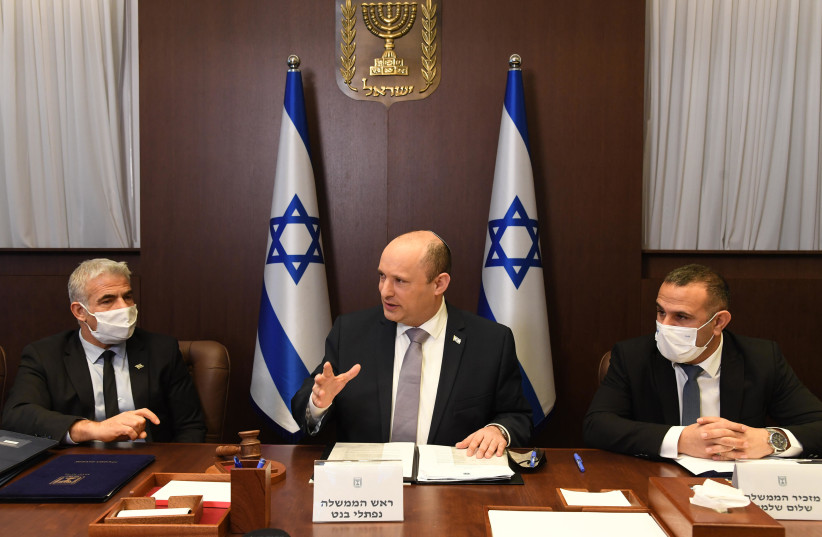
The Israeli appearance at the Vienna talks came as most of the delegations have said the negotiations are in their final stages.
Jerusalem is concerned that a restored Joint Comprehensive Plan of Action, the 2015 nuclear deal between world powers and Iran, would fall far short of the original goal of keeping Iran a year away from nuclear breakout, and keep it less than six months away from that point, while lifting sanctions and allowing the regime in Tehran to transfer even more funds to its proxies throughout the region.
World powers have been conducting negotiations since April, with several breaks, for Iran and the US to return to compliance with the JCPOA, which restricted Iran’s enrichment and stockpiling of uranium until 2030.
The US left the deal in 2018, citing evidence Iran hid details of its nuclear program and malign Iranian behavior in the Middle East, including proxy warfare and its ballistic-missile program.
Iran has since enriched uranium to 60%, higher than any country that does not have nuclear weapons. Weapons-grade uranium is 90% enriched.
Iran walked away after two months of talks, citing its presidential election, and only returned to Vienna more than five months later at the end of November. Days later, Iran launched a new class of advanced centrifuges.
Since then, the US and the E3 – France, Germany and the UK – have warned that there are only weeks left to restore the JCPOA’s nonproliferation benefits and lamented the slow pace of talks.
The negotiations have been indirect, with the E3, Russia, China and EU representatives shuttling between the Iranian and American delegations because Iran refuses to talk directly with the US.
The US and E3 have also accused the Iranian side of not deciding if it really wants to reach a deal.
Saudi Arabia’s government on Tuesday said it supports “US efforts to prevent Iran from acquiring a nuclear weapon,” state news agency SPA reported.