OFRA, West Bank _ Amid protesters' cries of "Jews don't expel Jews," hundreds of Israeli police officers on Tuesday enforced a Supreme Court order to evict residents from nine homes illegally built on private property belonging to Palestinians in the occupied West Bank.
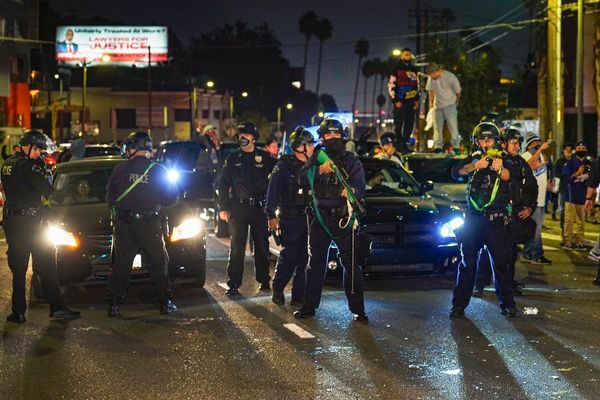
Protesters at the Ofra settlement carried banners blaming Prime Minister Benjamin Netanyahu's right-wing government for enforcing the court's orders, and some demonstrators scuffled with police as officers dragged dozens of people out of the homes.
The evacuation dealt a second blow in less than a month to Israel's powerful movement supporting Jewish settlers. It came weeks after Israel carried out a rare removal of several hundred settlers at the nearby Amona hilltop outpost.
Although the settler lobby has been emboldened to press for settlement expansion and annexation because of President Donald Trump's apparent recent step back from endorsement of a Palestinian state, the evacuations highlight Israel's continuing trials over how to handle thousands of settler homes built on Palestinian property.
"This is a fight for all of Judea and Samaria," said protester Raphael Rosenfelder, 19, referring to the territories of the West Bank by their biblical names. "Last month they kicked out 40 families at Amona. Now it's these nine houses. Next it will be a settlement with thousands of families."
Some protesters had crowded inside and on the roof of one of the houses.
To block future court-ordered settlement evacuations like those at Ofra and Amona, Israel's parliament, the Knesset, passed a law in February allowing for the retroactive legalization of outposts and settlement homes built on property belonging to Palestinians.
The law, which opponents say legalizes land theft and marks a de facto annexation of West Bank land, stirred criticism from Palestinians, some Israelis and the international community. Israel's attorney general is refusing to defend the legislation when the Supreme Court considers an appeal against the law.
Supporters of the law say it is necessary to prevent legal challenges brought by a minority of human rights groups seeking to reverse government policies.
Yesh Din, an Israeli human rights group that petitioned the Supreme Court in 2008 with landowners from the village of Ein Yabrud, welcomed the implementation of the demolition order.
"It is unfortunate this was not done before the houses were inhabited," it said in a statement.
Outside each of the nine houses, protesters hung giant banners with portraits and the names of each family. The banners also were critical of the government, using sarcasm with a statement reading, "This is a right-wing government."
Minutes after police escorted him out of his home of the last nine years, Netzach Brodt, a 32-year-old lawyer, stared blankly at the ground while vowing to build a bigger house elsewhere in the settlement for his wife and three young children. The family likes Ofra, which has a population of several thousand people, he said.
Brodt said he was unaware of a legal challenge when he bought the two-story house.
"We're going to take a (financial) hit ... . We're scarred from the whole situation," he said. "We have hard feelings toward successive Israeli governments, who, since the Six-Day War, hasn't had the courage to say what the policy is in Judea and Samaria."
Palestinians and much of the international community consider all Israeli building in the occupied West Bank and East Jerusalem as illegal. In recent months the United Nations, the U.S. and European countries warned that settlement expansion was rapidly endangering prospects for peace through a two-state solution for Israelis and Palestinians.
"This is a long time in the making and an excruciating process for the landowners. It took many years," said Hanan Ashrawi, a senior official in the Palestine Liberation Organization. "They shouldn't have been allowed to settle there in the first place."
There was significantly less resistance in Ofra than at the Amona evacuation, which attracted thousands of protesters who barricaded themselves in mobile homes, chained themselves together and resisted police over two days.
A police spokesman said that 100 people were carted out of Ofra on buses and that 11 officers suffered minor injuries. Hundreds of protesters joined the families in the houses to make the evacuation more difficult.
"We left crying," said Naama Shtern, an 18-year-old high school student who said she joined the families in the houses to disrupt the evacuations.
"The land of Israel is dear to us. It hurts that a right-wing government is doing this."
By dusk, Israeli heavy machinery began demolishing the houses. Watching police struggle with protesters, Nissim Slomiansky, a lawmaker from the pro-settlement Jewish Home party, said he hoped the new legalization law would help prevent such scenes in the future.
"I hope these will be the last places evacuated," he said. "In a modern and democratic country, those who determine policy is the Knesset, which is the sovereign, and not the court."