David Cameron has become one of the first world leaders to congratulate Netanyahu.
PM: Congratulations to @netanyahu on election result. As one of #Israel’s firmest friends, UK looks forward to working with new government.
— UK Prime Minister (@Number10gov) March 18, 2015
Summary
Now that the results of the election is clear we are going to bring the blog to a close. Here’s a summary:
- Israeli prime minister Benjamin Netanyahu’s rightwing Likud party has scored a dramatic election victory surging past its main rival, the centre-left Zionist Union, to win most seats in the Knesset. Exit polls had suggested the Zionist Union and its leader, Isaac Herzog, were neck and neck with Netanyahu, but by Wednesday morning official results had stretched to a decisive six-seat lead for Likud.
- Likud said it it expects to form a government over the next two to three weeks. It has spoken to parties likely to be part of the new ruling coalition, including Kulana, the centrist party of former finance minister Moshe Kahlon, and a series of smaller right wing parties.
-
The opposition Zionist Union, which secured 24 seats, has conceded defeat. Its leader Isaac Herzog said the party would continue to be an alternative to Netanyahu’s right-wing Likud.
- There has been muted international response to Likud’s victory. Iran said it expects business as usual under Netanyahu’s next government. One of Europe’s most senior diplomats, Sweden’s Carl Bildt, said the result risked a “profound crisis on the Palestinian issue”.
- Netanyahu declared a “great victory” after exit polls had earlier predicted that the result would be tie. He also struck a conciliatory note in a late-night speech, promising to protect the interests of Israelis “Jewish and non-Jewish” and touching on social reform.
- Voter turnout surpassed 2013 levels before polls closed, with 71.8% of Israel’s 5.8 million eligible citizens having voted, the most since 1999. An estimated 67-68% of Israeli-Arabs voted, up from 54% in 2013.
Back in early February Netanyahu’s opponents “looked to be a team facing an open goal and poised to miss”, according to the Guardian’s Jonathan Freedland. And so it proved.
After a trip to the opposition party, he wrote:
A visit to their HQ suggested a low-energy campaign, lacking the sheer hunger necessary to oust a bare-knuckle fighter like Bibi. Herzog has a version of Ed Miliband syndrome: the smart scion of Labour aristocracy who just doesn’t look like a prime minister. The Haaretz political correspondent Barak Ravid says Herzog is leading a “bad campaign, that’s disorganised, lacking in creativity and with nothing on the ground”. He has failed to capitalise on the inequality issue or to channel the public’s deep frustration, despite promoting several leaders of the 2011 protests to Labour’s senior ranks.
But the problem goes deeper. “Bibi is still the authentic voice of the majority of Israelis,” says the author Tom Segev. The one thing no Israeli ever wants to be is afreier – a sucker, a naive fool who’s taken in. Even if Israelis dislike Netanyahu and despise his wife, they don’t fear that he will be a freier in negotiations with the Palestinians or anyone else. An Israeli electorate still on its guard, still anxious about personal security – however irrational that may seem to people far away – might well conclude that it’s safer with Bibi than with the untested freier-in-waiting they detect in Herzog.
Many in Britain’s Labour party have expressed despondency at Likud’s victory.
Shadow health secretary Andy Burnham said Netanyahu’s victory was “depressing”.
Depressing news coming out of Israel. Netanyahu elected on pledge to build more settlements. Palestine will need more international support.
— Andy Burnham (@andyburnhammp) March 18, 2015
MP Barry Sheerman said there was no prospect of a change in leadership.
Pity about Israel election result @BBCNews No prospect of change in the region under this leadership!
— Barry Sheerman MP (@BarrySheerman) March 18, 2015
Sarah Sackman, who is standing as Labour candidate in London’s Finchley and Golders Green, a constituency with one of the highest Jewish populations, said it was “blow for peace”.
Deflated & disappointed that Bibi's fear-mongering, anti-Arab attacks & failure to tackle israelis econ issues won the day. Blow for peace.
— Sarah Sackman (@sarahsackman) March 18, 2015
Similarly Adam Hug, deputy leader of the Labour group at Westminster council and policy director at the Foreign Policy Centre, tweeted that the result was “grim”.
Grim final results in Israeli election seems likely a government without saving graces After Bibi's statements UK/EU will need to get firmer
— Adam Hug (@AdamHug) March 18, 2015
Iran predicts no change
Iran expects business as usual under Netanyahu’s next government.
In a frosty reaction, Iran’s foreign ministry spokeswoman Marzieh Afkham said all of Israeli parties had an “aggressive nature.”
State funded Press TV quoted her saying:
The Israeli parties are the same and they are all accomplices in their crimes against the Palestinians and in their acts of aggression.
Updated
Some historical context from Peter Beaumont ...
The 2015 Israeli elections and Binyamin Netanyahu’s unexpected win appear, the morning after, to be as significant as two previous historic wins for Israel’s right.
The first in 1977 saw Likud’s Menachem Begin defeat Labour to become prime minister for the first time after a wait of 28 years since Israel’s founding.
Then, as in in Netanyahu’s first victory in 1996, it marked a profound change in direction for Israel both in terms of its internal and external policies.
If 1996 was similar to Tuesday’s election, it was because Israelis then – like today – went to bed expecting a different result: then a win for Shimon Peres. Like today Israelis went to sleep expecting one result and got another in 1996 as commentators said at the time Israel “went to sleep with Peres winning and woke up to a Netanyahu victory.”
Analyst Janine Zacharia summarises Netanyahu’s record on political surprises.
Bibi unreal. '96 went to bed thinking Peres won, woke up to PM Bibi; 2009 Livni got more votes but PM Bibi. Now, Bibi trailed but prevailed.
— Janine Zacharia (@janinezacharia) March 17, 2015
Updated
One of Europe’s most senior diplomats, Carl Bildt, the former prime minister of Sweden has expressed alarm about Netanyahu’s victory.
In a tweet he said it risked a “profound crisis on [the] Palestinian issue”.
A new @netanyahu government in Israel risks profound crisis on Palestinian issue. Difficult to see any credible political path forward.
— Carl Bildt (@carlbildt) March 18, 2015
Chemi Shalev in Haaretz argues that Netanyahu’s victory comes at a heavy international price:
The term “to burn your bridges” comes from the days of Roman conquests, when generals such as Julius Caesar would burn the bridges and set fire to the boats on which their soldiers traveled, in order to prevent them from contemplating retreat. Without the bridges and boats, of course, it was very difficult to resupply the legions after the battle had been won. Today, if you burn your bridges, you are severing contacts that you might very well need somewhere down the line.
That’s what Benjamin Netanyahu did on the way to his surprise victory over Isaac Herzog on Tuesday.
Netanyahu burned his bridges with the Arab minority with racially tinged Election Day exhortations hitherto reserved for rabble rousers to his right. He set fire to the ships that carry the load of Israel’s ties to the international community, especially the Obama administration, when he suddenly reneged on his agreement in principle to a Palestinian state.
He set fire to the tent in which the half of Israel that didn’t vote for him resides, by depicting them as pawns in some vast and ludicrous conspiracy that involves malevolent anti-Semites, nasty-minded NGOs, cigar-chomping tycoons, greedy Citizen Kane-type publishers and, inexplicably, sly subversives from Scandinavia.
In recent days, Netanyahu even took a page from the GOP’s Southern Strategy, as enunciated in 1970 by Nixon aide Kevin Phillips: “The more Negroes who register as Democrats in the South, the sooner the Negrophobe whites will quit the Democrats and become Republicans.”
That’s what Netanyahu did when he railed against the Arabs voting “in droves” on Tuesday, a statement that turned out to be false but potent nonetheless.
Netanyahu succeeded in mobilising those alarmed by the prospect of a left wing victory in last stages of the campaign, according Gil Hoffman in the Jerusalem Post.
He looked like he was panicking (and he was) but the public got the message.
Many who considered staying home or for voting for one of the Likud’s satellite parties hurried to the polling stations to cast ballots for Likud. People who have not voted-in years- or at least not for Likud- felt the need to save Israel from the Left, Iran and from a hostile international community.
The reason why the result is something of a surprise is that the opinion polls got it so wrong, as Peter Beaumont explains.
The failure of Israel’s pollsters to predict the surge to Netanyahu was striking. Taking the worst case scenario for Likud on Friday - when polls closed - and the final result, pollsters were adrift by 10 seats out of 120, an error of over 8 percent.
Even the exit polls, which had Netanyahu and Herzog tied at 27 seats each, appeared - in their spread - to have missed the real voting trends by some 5%.
The process of forming a new government could take up to three weeks, according to Likud after it emerged as the party with 29 seats. In a party statement, quoted by Ynet, it said Netanyahu had spoken with the leaders of all parties likely to feature in the coalition. They including Habayit Hayehudi (eight seats), Kulanu (10 seats), Yisrael Beytenu (six seats), Shas (seven seats) and United Torah Judaism (six seats).
Taken together the parties mentioned would control 66 seats in the Knesset – comfortably over the 61 seats necessary to form a government.
A chart from Vox sums up Knesset arithmetic based on the exit polls. The results turned out to be even better for Netanyahu.
Why the Israeli election results are great news for Netanyahu, in one chart http://t.co/3jAnyshdGD pic.twitter.com/vy7SmNb9wp
— Vox (@voxdotcom) March 17, 2015
Updated
Herzog has made his concession phonecall to Netanyahu. This from Peter Beaumont:
Israel’s opposition leader, Isaac Herzog, said on Wednesday he had spoken with Prime Minister Benjamin Netanyahu to congratulate him on his election victory.
“A few minutes ago I spoke with Prime Minister Benjamin Netanyahu and congratulated him on his achievement and wished him luck,” Herzog told reporters.
He said his leftist Zionist Union party would continue to be an alternative to Netanyahu’s right-wing Likud.
Updated
Peter Beaumont has been up early and is sending us his analysis of Netanyahu’s spectacular turnaround in fortune.
We will have the full version up in a while – meanwhile here’s a taste of Peter’s take on things:
Netanyahu might head up the next government but even he must know that he is not a leader of all of Israel as he has tried to claim.
That will increase pressure on him to persuade Moshe Kahlon, the former Likud minister turned leader of the centrist Kulanu party who campaigned on socioeconomic issues, to join his coalition.
What seems certain is that at the end of a tense and difficult year which saw war in Gaza, widespread unrest in occupied east Jerusalem and Israel’s increasing isolation on the international stage – including in its relations with the US – the country faces a febrile and tense period ahead.
With no peace process with the Palestinians - which collapsed a year ago - it will be difficult for Netanyahu to disavow his remarks in recent days promising he would not allow the creation of a Palestinian state, comments that will set him on a further collision course with the US administration of Barack Obama and the EU.
In the immediate future, Palestinian leaders have made clear they plan to go with a raft of cases against Israel to the international criminal court. With Israel already blocking tax receipts to the Palestinian Authority for formally joining the international court of last resort, that move would trigger US Congress to order the freezing of US aid to the Palestinian Authority, a large part of which goes to supporting security forces.
Updated
And here is the BBC veteran correspondent Jeremy Bowen’s take on that result
In the end #Netanyahu scored a much bigger victory than incorrect polls suggested. Showed his political skill, and mastery of scare tactics.
— Jeremy Bowen (@BowenBBC) March 18, 2015
Our Jerusalem correspondent Peter Beaumont has just filed his update on the result:
Most Israelis had gone to sleep on Tuesday night with three television exit polls showing the two main parties tied at around 27 seats each in the 120 seat Knesset and expecting weeks of horse trading between the Israeli parties to try and negotiate a government.
But by early on Wednesday morning it was becoming clear that the exit polls had underestimated turnout for Likud which had mobilised support in recent days.
Despite the sense of euphoria on the right the result would seem to set a Netanyahu led Israel on a collision course both Palestinians and the international community.
So words so far seen that describe Netanyahu’s victory:
Associated Press: “Resounding”
Reuters: “Surprise”
Jerusalem Post: “Sweeping”
Haaretz: “Decisive”
New York Times: “Clear and sound”
Guardian: All of the above
The Jerusalem Post reports a statement from Netanyahu calling for parters to begin immediate coalition talks:
“The reality isn’t waiting on us,” Netanyahu said just hours after it became clear that his Likud party had scored a decisive victory over Zionist Union in Tuesday’s poll. “Reality isn’t taking a break. The citizens of Israel expect us to quickly put together a leadership that will work for the sake of the country’s security, economy, and society as we promised to do, and that is what I will do.”
Reuters has just put out its morning file on the result and calls it pretty much like us. Here’s a taster:
Prime Minister Benjamin Netanyahu’s right-wing Likud party swept past its main rival, the centre-left Zionist Union, after nearly all votes were counted in Israel’s election on Wednesday.
Israeli media described the showing as a “huge win” for Netanyahu, with the formation of a government still dependent on coalition negotiations among the country’s diverse political parties.
Official results gave Likud 29 seats compared with 24 for Isaac Herzog’s Zionist Union in the 120-member parliament, a gap wider than the one projected in exit polls and likely to ease Netanyahu’s way towards building a governing coalition.
On the basis of the exit polls alone, which indicated the hard-fought race had ended in a dead heat, Netanyahu swiftly claimed victory late on Tuesday, while Herzog said “everything is still open”.
By morning, with results in from 99 percent of polling stations, Likud had powered past the Zionist Union and Netanyahu seemed set to get the nod from Israel’s president to try to put together a coalition.
A fourth term for Netanyahu would make him Israel’s longest serving leader. He can tap far-right and religious parties - his traditional allies for support - but will also need to enlist centrists who have been non-committal.
Netanyahu pulled off the feat with a pitch for ultranationalist votes in the final days of the hard-fought campaign, using tactics that could deepen a feud with the White House.
For a pretty good summary of what happened while you were asleep (or awake if you are in the global east) have a look at our earlier roundup.
Updated
It’s fair to say that a Netanyahu victory will not be greeted with universal joy in the White House. He had managed to anger Barack Obama (again) by using a speech to congress to try to derail delicate nuclear negotiations with the Iranians.
But it is also his last minute attempt to persuade the extreme right to sign up to his cause – by rejecting outright a Palestinian State – that will worry many.
The New York Times has no doubt where this leaves Netanyahu. Its editorial here is scathing.
Prime Minister Benjamin Netanyahu’s outright rejection of a Palestinian state and his racist rant against Israeli Arab voters on Tuesday showed that he has forfeited any claim to representing all Israelis.
His behaviour in the past six years — aggressively building Israeli homes on land that likely would be within the bounds of a Palestinian state and never engaging seriously in negotiations — has long convinced many people that he has no interest in a peace agreement. But his statement this week laid bare his duplicity, confirmed Palestinian suspicions and will make it even harder for him to repair his poisoned relations with President Obama, who has invested heavily in pushing a two-state solution.
Updated
It may well be there will be an inquest into the pre-election polls after today. Indeed there is already considerable discussion about why they were so off the pace.
Some point out it could have been an accurate reflection of opinion at the time – and that opinion was fickle.
There may not have been a error. Last week's polls could have been an accurate snapshot when they were made and caused a massive backlash /1
— Anshel Pfeffer (@AnshelPfeffer) March 18, 2015
Others are less forgiving
Likud somehow manages to pull off landslide victory over Zionist Union in #IsraElex. All polls were way off.
— Ilån Bεn Zıon (@IlanBenZion) March 18, 2015
Updated
Nice simple visualisation here of the extent of the Likud victory – as well as where most of the other parties stand.
Final results, based on over 96% of votes (Still without soldiers etc..) - Over 4 million votes. pic.twitter.com/5FwocD0M82
— Nehemia Gershuni A. (@Nehemia_G) March 18, 2015
Updated
Summary
With almost all votes counted in Israel’s election, here is what we know so far:
-
Likud leads with 29 Knesset seats, pulling firmly ahead of the Zionist Union, which has 24. The Joint Arab List comes in third with 14 seats, followed by
Yesh Atid on 11
Kulanu 10
Habayit Hayehudi 8
Shas 7
United Torah Judaism 7
Yisrael Beiteinu 6
Meretz 4
- Prime minister Binyamin Netanyahu declared a “great victory” after exit polls had earlier predicted that he and rival Isaac Herzog would finish in a virtual tie of 27 seats each.
- Herzog refused to concede after the exit polls, telling supporters it was “still an open game” to build a coalition for “socioeconomic” reform.
- Netanyahu struck a conciliatory note in a late-night speech, promising to protect the interests of Israelis “Jewish and non-Jewish” and touching on social reform. Analysts suggest Netanyahu’s Likud party likely has an easier path to creating a right-leaning coalition than Herzog’s more liberal Zionist Union party.
- Netanyahu and Herzog immediately began courting potential kingmaker Moshe Kahlon, leader of the centrist Kulanu party, whose estimated 10 seats could prove decisive in giving one man victory. Kahlon told Netanyahu he remains undecided and will wait until all votes are counted.
- Arab Joint List leader Ayman Odeh vowed to prevent a rightwing government from returning to office, possibly signaling that he his party’s estimated 13 seats would back Herzog.
- Netanyahu finished a final ferocious push to win rightwing partisans away from the parties of his erstwhile allies, Naftali Bennett and Avigdor Lieberman. “The rightwing government is in danger,” he told voters, “Arab voters are coming out in droves to the polls.”
- Voter turnout surpassed 2013 levels before polls closed, with 71.8% of Israel’s 5.8 million eligible citizens having voted, the most since 1999. An estimated 67-68% of Israeli-Arabs voted, up from 54% in 2013.

Updated
Unsurprisingly, given the figures below, media in Israel is now calling this election for Netanyahu:
right, I think we can call this. Netanyahu wins a 4th term. http://t.co/bGHvlhhKiK
— Anshel Pfeffer (@AnshelPfeffer) March 18, 2015
The prime minister’s Likud party currently tops the poll and will now try to build a coalition to govern.
Haaretz has declared victory for Netanyahu:


Haaretz reports that with 99.5% of votes counted, Likud leads with 30 Knesset seats. Zionist Union has 24.
The Joint Arab List comes in third with 13 seats, followed by:
- Yesh Atid 11
- Kulanu 10
- Habayit Hayehudi 8
- Shas 7
- United Torah Judaism 7
- Yisrael Beiteinu 6
- Meretz 4
With over 90% of votes counted, the energy of this election is swinging back towards Netanyahu.
Of Friday the polls were nearly unanimous that Netanyahu was down by 4 seats. 100 hours later after 90% counted he's up by 6. What a swing!
— Anshel Pfeffer (@AnshelPfeffer) March 18, 2015
We'll never how much of the 9% swing was down to massive polling error & how much Netanyhu's fear mongering endgame. Either way astonishing!
— Anshel Pfeffer (@AnshelPfeffer) March 18, 2015
With just 40,000 votes left to tally, Likud crushes Zionist Union with a nearly 180,000 vote lead. #IsraElex
— Ilån Bεn Zıon (@IlanBenZion) March 18, 2015
Updated
With 90% of votes counted, the latest tally is:
- Likud 30 seats
- Zionist Union 24
- Joint Arab List (Hadash) 13
- Yesh Atid 11
- Kulanu 10
- Jewish Home 8
- Shas and UTJ (United Torah Judaism) each on 7
- Israel Beitenu 6
- Meretz 4
- Yahad 0
Updated
80% votes counted: Likud on 30 seats; Zionist Union 24
Some 80% of votes cast have now been counted, putting Likud on 30 seats and Zionist Union on 24.
Centre-left Yesh Atid currently has 11 seats, just ahead of Moshe Kahlon’s centrist Kulanu on 10.
Updated real results - above 80% pic.twitter.com/GsSIZaa0uT
— Project 61 פרויקט (@Project_61_IL) March 18, 2015
Updated
A reminder from the editor of the UK’s Channel 4 News that exit polls don’t always get it right:
In 1996 was @SkyNews. Exit polls said Peres had won. Netanyahu won by 29k votes,<l%. "went to sleep with Peres, woke up with Netanyahu.
— bendepear (@bendepear) March 17, 2015
So far, the count seems to be showing a larger lead for Likud over Zionist Union than exit polls predicted, but some commenters think the gap could close:
@speechboy71 Don't worry about low show for left. Big cities where left is strong closed ballots late. Left's show will rally toward morning
— Haviv Rettig Gur (@havivrettiggur) March 17, 2015
Another update from the count:
w/ over 3m votes tallied in #israelex, Zionist Union continues rally. Now at 19.3% to Likud's 24.1%. Yesh Atid at 9% in 3rd place
— Ilån Bεn Zıon (@IlanBenZion) March 18, 2015
Election returns show Likud with lead on Zionist Union, unike 2 exit polls that showed them tied: 24% of vote compared to 19%
— joshmitnick (@joshmitnick) March 18, 2015
My colleague Jonathan Freedland flags up this analysis from Associated Press,
predicting “international isolation” for Israel after this election result:
Israel’s election has yielded a fractured parliament and no clear winner, setting up a horse-trading phase that seems likely to leave prime minister Binyamin Netanyahu in place and in ever deeper confrontation with the world. To govern, his Likud party would need to depend on ultranationalists – a recipe for neither stability nor bold moves toward Mideast peace.
There are also other scenarios: the outcome could be a joint government with moderate challenger Isaac Herzog. And there is the slimmest of chances that Herzog, through machinations, still ends up on top.
Much is in the hands of Moshe Kahlon, a relative newcomer to the big leagues of Israeli politics. Breaking away from Netanyahu’s nationalist Likud two years ago after a falling out with the premier, he has adopted a vaguely centrist platform and flirted heavily with Herzog’s Zionist Union. If he is non-aligned as he claims, then according to all the exit polls he holds the balance of power between the two traditional blocs …
In recent days Netanyahu has said that he would not allow the creation of a Palestinian state if elected. The Palestinians have already said they would take their case against Israel to war crimes tribunals and other international bodies. A campaign to boycott Israel seems poised to gain traction. Netanyahu’s relations with the US administration of President Barack Obama are frosty at best.
International isolation looms.
Netanyahu knows the complications of all this and may try to draw in Herzog, to give his government a more moderate character. But he has promised, in his final appeals to his base, not to do this – and Herzog would probably demand a rotation in the premier’s post as his price.
Kahlon seems to dislike Netanyahu intensely, and he certainly has the power to crown Herzog, a mild-mannered lawyer and scion of a venerable family of Zionist founders. Kahlon’s platform is moderate, as are top lieutenants in his party, and despite his Likud roots he has supported the idea of peace talks. It is not inconceivable that the left’s desire to unseat Netanyahu extends to offering Kahlon a rotation as prime minister.
With 71.8% of Israel’s 5.8 million eligible citizens having voted, the count is approaching halfway:
Just over 2m votes counted: Likud 24.6%, Zionist Union 18.8%, Yesh Atid 8.7%, Joint List 8.3%, Kahlon 7.6%, Jewish Home 6.2% #IsraElex
— Ilån Bεn Zıon (@IlanBenZion) March 18, 2015
Pictures are arriving of the party leaders following the exit polls. Prime minister Binyamin Netanyahu told Likud supporters that the party had scored a “great victory”:

Isaac Herzog – whose Zionist Union party is in a dead heat with Likud according to exit polls – said he would wait for the final results before deciding his next move:

The man who could be kingmaker - Moshe Kahlon, leader of centrist party Kulanu, which won an estimated 10 seats. Alliance with Kulanu could be crucial to the party leader trying to form a government:

Some exit polls have the Arab Joint List finishing third, with an estimated 13 seats. While the coalition of Arab parties – led by Ayman Odeh – is unlikely to join a government, they could work to block Netanyahu:

Updated
What happens now?
This is Claire Phipps taking over the blog from my colleague Alan Yuhas. We will have ongoing live coverage from tonight’s momentous election as results continue to be counted.
Reuters has put together this analysis on the numbers and negotiations that will now follow in the wake of tonight’s predicted dead heat:
Difficult coalition talks still lie ahead. Isaac Herzog, Netanyahu’s chief opponent and head of the centre-left Zionist Union, said “everything is still open” and that he already had spoken to party leaders about forming a government.
Binyamin Netanyahu could have the easier path to forming a cabinet, which would put him on course to becoming Israel’s longest serving leader.
An exit poll for Channel 2 TV gave Likud 28 seats and Zionist Union 27 in the 120-member parliament. Channel 10, revising its survey several hours after voting ended, put that margin at 27 seats for Likud to 26 for Zionist Union. Channel 1 had both parties tied at 27.
Final results are not expected until early on Wednesday [in Israel].
A new centrist party led by former communications minister Moshe Kahlon could be the kingmaker in coalition talks. After the balloting ended, he said he did not rule out a partnership with either Likud or Zionist Union.
The exit polls gave right-wing and religious parties (Netanyahu’s traditional partners) about 54 seats, and left-leaning factions, 43 – both figures still short of a governing majority in the 120-seat parliament.
Turnout was around 72%, higher than the last election in 2013.
No party has ever won an outright majority in Israel’s 67-year history, and it may be weeks before the country has a new government. Netanyahu will remain prime minister until a new administration is sworn in.
Naftali Bennett, leader of the ultranationalist Jewish Home party, said he had spoken with Netanyahu within minutes of the exit polls and agreed to open “accelerated” coalition talks with him.
“The nationalist camp won,” Bennett, who advocates annexing parts of the occupied West Bank, told supporters.
But Zionist Union could find a lifeline from Kulanu and from Arab parties that united for the first time in a joint list of parliamentary candidates and came in third in the exit polls. While they are unlikely to join a government, the Arab parties could give a centre-left coalition tacit support and create a block against Netanyahu.
If the centre-left is to assemble a government, it will also need the support of ultra-Orthodox parties, which the polls said would win 13-14 seats.
After the final results are in, and following consultations with political parties, it will be up to President Reuven Rivlin to name the candidate he deems best placed to try to form a coalition. The nominee will have up to 42 days to do so. Rivlin has called for national unity, signalling he favours a government that would pair both Likud and Zionist Union.
Summary
A quick summary as the clock strikes 1am in Israel, the politicians head home and the exit polls continue to adjust their counts.
- Prime minister Binyamin Netanyahu declared a “great victory” after he and rival Isaac Herzog finished in a virtual tie, each with an average 27 seats according to the first exit poll. The Arab Joint List appears to have finished third, with 13 seats, and secular Kulanu party with 10, according to poll estimates.
-
Herzog refused to concede, telling supporters it’s “still an open game” to build a coalition for “socioeconomic” reform. Netanyahu struck a conciliatory note in a late-night speech, promising to protect the interests of Israelis “Jewish and non-Jewish” and touching on social reform. Analysts suggest Netanyahu’s Likud party likely has an easier path to creating a right-leaning coalition than Herzog’s more liberal Zionist Union party.
- Netanyahu and Herzog immediately began courting potential kingmaker Moshe Kahlon, leader of the centrist Kulanu party, whose estimated 10 seats could prove decisive in giving one man victory. Kahlon told Netanyahu he remains undecided and will wait until all votes are counted, which may take days.
- Arab Joint List leader Ayman Odeh vowed to prevent a rightwing government from returning to office, possibly signaling that he would add his party’s estimated 13 seats would back Herzog. Parties have already begun jostling in the fight to build a coalition.
- Netanyahu finished a final ferocious push to win rightwing partisans away from the parties of his erstwhile allies, Naftali Bennett and Avigdor Lieberman. “The rightwing government is in danger,” he told voters, “Arab voters are coming out in droves to the polls.”
- Voter turnout surpassed 2013 levels before polls closed, with 71.8% of Israel’s 5.8 million eligible citizens having voted, the most since 1999. An estimated 67-68% of Israeli-Arabs voted, up from 54% in 2013.
Updated
Netanyahu promises to protect 'Jewish and not'
Prime minister Binyamin Netanyahu is delivering a speech to Likud supporters, who are showering him with adoration.
“You’re all important, your’e all important to me. Now we must form a stable coalition that will ensure our security,” he says.
“Every family, soldier, citizen, Jewish or not are important to me. We’ll form a a strong government to work for them,” he continues.
The crowd shouts back “No to unity!” in rejection of a unity government with the center-left Zionist Union. President Reuven Rivlin, of Likud, has suggested he supports such an option.
Netanyahu again declares victory this a Likud victory “against all odds”, repeating his statement earlier today, but now says he’ll look out for the interests of “Jewish and non-Jewish”.
“There are great challenges ahead of us: diplomatic, economic, social. We will lower housing prices and the cost of living,” he says, making promises to confront the main campaign issues of Herzog and the Zionist Union.
“I spoke with all party leaders in the nationalist camp, called on them to join me and form a government without delay,” he says.
Netanyahu, in speech at Likud, talks of being proud of all citizens, Arab and Jewish. Clearly trying to strike conciliatory tone.
— Sheera Frenkel (@sheeraf) March 17, 2015
Updated
Netanyahu is now taking the stage at the Likud headquarters for his own post-election speech.
BIBI To address likudniks now pic.twitter.com/oYfQehEFQ1
— joshmitnick (@joshmitnick) March 17, 2015
Netanyahu is literally walking across the stage and waving like Miss America
— Lahav Harkov (@LahavHarkov) March 17, 2015
Zionist Union won’t declare victory yet, a la Likud’s Binyamin Netanyahu, co-founder Tzipi Livni tells Bloomberg’s Elliott Gotkine, who intercepted party leadership on their way out of the party’s subdued election headquarters.
Grabbed quick word w/Herzog: did he win? "We r working on it. We definitely have a v good chance." #IsraelElections pic.twitter.com/1T4Hsoba4j
— Elliott Gotkine (@ElliottGotkine) March 17, 2015
“A long and nail-biting story” of bargains and bickering is what Guardian Middle East editor Ian Black (@ian_black) predicts for the next chapter of Israel’s future.
On the basis of normally accurate exit polls – and the mood in party headquarters – Israeli analysts said it was more likely that the Likud’s Binyamin Netanyahu, the current prime minister, will end up again getting the top job, over the Labour leader, Isaac Herzog, who had run as head of the new Zionist Union list – and campaigned on a slogan of “change and hope”.
Beyond that, multiple combinations are possible. The 13-seat showing for the United Arab List of Ayman Odeh suggested it won wide support from the non-Jewish 20% of Israel’s population, but not enough to guarantee a Herzog-led coalition.
Other medium-sized parties or smaller factions now find themselves in a pivotal position. The new Kulanu (All of Us) movement of the populist ex-Likudnik Moshe Kahlon, with an estimated 10 MPs, could be an indispensable kingmaker for Netanyahu – or, even more dramatically, as some pundits predict – break with him and join a centre-left bloc. Yair Lapid’s Yesh Atid will be a vital supporter for Herzog. Two ultra-Orthrodox parties lean to the right and would not easily sit in a coalition that included the militantly secular Lapid.
“Another distinct possiblity is a national unity government,” Ian continues, “a broad-based coalition that includes the big parties and excludes the extremes of right and left. In the past such governments have seen a ‘rotation’ of top jobs for agreed terms and policies of the lowest common denominator.”
The shape of Israel’s next government will clearly make a difference to future prospects for peace in the Holy Land – however slim they appear. Netanyahu’s eve of poll pledge that he no longer believed in a two-state solution to the conflict is not necessarily his last word on the subject – though his previous committment to it was extemely vague and highly-qualified. “Netanyahu’s promises mean nothing,” commented Nahum Barnea, the country’s best-known political commentator. “They were written on ice on a very hot day.”
While there is no doubt that the Palestinians, Arab and western governments – including the US and EU – would be happier with Herzog. It will be some time yet before they can be certain of exactly what the future holds.
You can read the full piece here.
Kulanu’s Moshe Kahlon has also delivered a few remarks, possibly suggesting he will step back into Likud’s fold with a new Netanyahu government.
Kingmaker @KahlonMoshe hints he prefers unity gov't over narrow one w/ ultra-right parties: "a time to unite, not to split apart" #IsraElex
— Ido Benbaji (@IdoBenbajiEN) March 17, 2015
ZIonist Union leaders now on stage singing Israeli national anthem #israelelections pic.twitter.com/2UT1IOVOPN
— Elliott Gotkine (@ElliottGotkine) March 17, 2015
Adjusted polls now suggest that the conservative Yahad party may have enough votes to make it in the Knesset – crossing the minimum threshold to win four Knesset seats (3.25% of the electorate).
If Yahad wins four seats, Netanyahu has a much easier path to building a conservative government.
This is how close the Israeli elections are: new poll shows Yishai's party just getting in w/ 3 seats, enough to ensure Netanyahu is PM.
— Sheera Frenkel (@sheeraf) March 17, 2015
Herzog refuses to concede: 'still an open game'
Isaac Herzog is delivering his first remarks since exit polls reported a virtual tie with Binyamin Netanyahu’s Likud party, which likely has a better chance of forming a coalition to retain control of the government.
“Bravo, bravo,” he tells the crowd, “today we scored an extraordinary achievement.”
“We’ll wait for the final results, the public wants true change. I call all social parties to join my government,” he adds, meaning for one the undecided parties of Moshe Kahlon and Shas.
“I intend to make every effort to form a real social government,” he says, “it’s still an open game.”
Breaking Herzog does not concede race: Calls on parties to form a "socioeconomic reconcilitation government" led by him.
— Gil Hoffman (@Gil_Hoffman) March 17, 2015
“Some parties are still on the Knesset threshold,” he adds, and “no decision will be made tonight. You can sleep.”
He thanks the crowd effusively: “I intend to make every effort to form a government.”
Party co-founder Tzipi Livni says “Tonight I can look at my children and say I did everything I could for your future.”
Updated
Palestinian leaders plan to press on with their charges that Israel committed war crimes, saying they will bring the case forward in the International Criminal Court. The Associated Press translates comments from Saeb Erekat:
“We call upon the international community to support our efforts to join the international treaties and our effort in the ICC,” said Erekat.
“What Netanyahu is doing and stating are war crimes and if the international community wants peace it should make Netanyahu accountable for his acts,” he said.
He said the Palestinian leadership will meet Thursday to discuss its next steps, around which time Israel will report official, final results from the election.
Should he reconstruct a coalition and retain power, Netanyahu’s recent surge to the right on issues such as the Palestinian territories could mean a newly exacerbated era of strained relations and partisan divides between Israel and its allies.
If Netanyahu forms a coalition w/right-wing parties, US/EU will have to react to his comments that he would not allow a Palestinian State.
— Sheera Frenkel (@sheeraf) March 17, 2015
Netanyahu must choose: Stable right wing coalition w no intl legitimacy or unstable moderate gov that could prevent further isolation.
— Michael Shuval (@MichaelShuval) March 17, 2015
President Reuven Rivlin has indicated he will seek a national unity government – of Likud and Zionist Union – contra the wishes of both Netanyahu and Herzog, my colleague Peter Beaumont reports from Jerusalem.
Rivlin, whose constitutional role is to invite the leader most likely to form a stable coalition, said: “I am convinced that only a unity government can prevent the rapid disintegration of Israel’s democracy and new elections in the near future.”
Of Kahlon, he reports that the “received wisdom suggests that Kahlon, a popular former Likud finance minister credited with breaking up the country’s mobile phone monopoly, has ambitions to be prime minister himself in the long run which would probably require him to return to Likud at some point.”
Political analyst Avrahan Diskin of the Hebrew University predicted that the most likely outcome would see Kahlon come out in support of a Netanyahu government.
“It is quite clear Kahlon is the key person,” he said. “What has happened is that we had the atmosphere of a neck-and-neck race. And we we know that when you have a neck and neck race it increasing the turn out for the two leading parties with them gaining power from the other satellite parties.”
The Joint List meanwhile continues to inch toward formally joining the left, he continues:
Ahmed Tibi, who was standing on the Arab Israeli Joint List, which has brought together four parties representing Palestinian citizens of Israel, said: “It is disappointing that the public did not want to change the reality.” He added that the Joint List would sit down with left-leaning and centrist parties to see if there was a coalition to keep Netanyahu out of power.
You can read the full wrap of the day’s events here.
Intent to continue the drama, Netanyahu and Herzog will soon stage competing speeches from their respective, awkwardly close base camps.
Herzog & Netanyahu expected to give speeches before midnight - roughly 10 mins from now. Their elxn night HQs are next door to each other.
— Sheera Frenkel (@sheeraf) March 17, 2015
Summary
A quick summary of the Israeli election in the aftermath of the first exit poll results.
- Prime minister Binyamin Netanyahu and rival Isaac Herzog finished in a virtual tie, each with an average 27 seats according to the first exit poll. Netanyahu and his Likud party declared it a “great victory” and likely have an easier path to creating a right-leaning coalition than Herzog’s more liberal Zionist Union party.
- Netanyahu and Herzog immediately began courting potential kingmaker Moshe Kahlon, leader of the centrist Kulanu party, whose estimated 10 seats could prove decisive in giving one man victory. Kahlon told Netanyahu he remains undecided and will wait until all votes are counted, which may take days.
- Arab Joint List leader Ayman Odeh vowed to prevent a rightwing government from returning to office, possibly signaling that he would add his party’s estimated 13 seats would back Herzog. The alliance of disparate Arab parties looks set to become the third-largest party in the Knesset, and it and other parties have already begun jostling in the fight to build a coalition.
- Netanyahu finished a final ferocious push to win far-right partisans away from the parties of his erstwhile allies Naftali Bennett and Avigdor Lieberman. “The rightwing government is in danger,” he told voters, “Arab voters are coming out in droves to the polls.”
- Herzog, who campaigned to fight economic inequality fostered under Netanyahu, refused to bow before Netanyahu’s presumptive victory announcement. He told voters hours before to “join the upheaval” and vote for “a prime minister who cares for civilians, who doesn’t incite … so we don’t get a radical government with Netanyahu.”
- Voter turnout surpassed 2013 levels before polls closed, with 71.8% of Israel’s 5.8 million eligible citizens having voted, the most since 1999. An estimated 67-68% of Israeli-Arabs voted, up from 54% in 2013.
Updated
Metaphor.
Awkward traffic jam as Likud and Kulanu supporters try to get into lot both events share. An omen?
— Niv Elis (@TelANiv) March 17, 2015
Horse trading and incompatible personalities are already in the equation for Netanyahu and Herzog as they court and shun their colleagues in the Knesset.
The BBC’s Michael Shuval says Shas’ handful of seats could be in play for either party – but that he’s heard Netanyahu doesn’t want to work with former journalist Yair Lapid.
Netanyahu & Herzog called Shas' @ariyederi & asked to meet w him tomorrow. He agreed to both requests. #IsraeElex
— Michael Shuval (@MichaelShuval) March 17, 2015
Deputy transport minister @TzipiHotovely to BBC: No unity gov & I don't think Netanyahu wants @LapidAtid in his coalition. #IsraeElex
— Michael Shuval (@MichaelShuval) March 17, 2015
Netanyahu is working in earnest now to solidify a conservative bloc, reports Haaretz’s Noga Tarnopolsky.
Netanyahu says he is talks to form right-wing-orthodox coalition, reports @idobenbaji. Spoke with Bennett, Dery, Litzman, Kahlon.
— Noga Tarnopolsky (@NTarnopolsky) March 17, 2015
American-Israeli historian Gershom Gorenberg has written a brief analysis on Twitter, along with a word of warning, summarized below.
“Exit polls show Likud fear campaign succeeded in pulling massive number for other parties of right, tied or one ahead of Labor,” he writes, point out that the Zionist Union fight is not yet over, since the “Left [bloc] has 56 or 57 in exit polls” but Kahlon “holds balance of power”.
A “huge difference,” he says, will be “in whether exit polls are right that far-right Yahad didn’t get in.”
“Tie may shift to lead for Labor or Likud in tomorrow morning’s count of real votes – and then we wait for soldiers’ votes.”
Warning: These exit polls are very rough estimates based on vote until 8:30 pm, 90 min before voting ended.
— Gershom Gorenberg (@GershomG) March 17, 2015
In addition to the high turnout of more than 70%, another thing for Americans to consider.
The next Knesset will have a record 30 women according to the polls, calculates @amit_segal. Congress can only dream of being 1/4 women.
— Gil Hoffman (@Gil_Hoffman) March 17, 2015
With the election shifting quickly into a phase of backroom deals and contentious phonecalls, my colleague Peter Beaumont (@petersbeaumont) supplies a refresher course on the parties in play:
The last government was an awkward team of rivals: an electoral alliance between Netanyahu’s Likud and the largely Russian immigrant constituency represented by the pugnacious minister Avigdor Lieberman. This time round Lieberman’s Yisrael Beiteinu is no longer in alliance with Netanyahu and suffering badly at the polls after the revelation that police are investigating widespread allegations of corruption.
Lieberman ended up with five seats, according to the early exits, and has declined calls from both Herzog and Netanyahu so far, according to Israeli media.
Netanyahu’s Likud has won itself a tie with rival Zionist Union, led by the Labour leader, Isaac Herzog, after trailing it by four seats in the last polls before the election.
The electoral maths of Israel’s coalition-building suggests Netanyahu can potentially form a right/far-right coalition with Naftali Bennett (whose Jewish Home party represents the religious right and settlers) and the ultra-orthodox parties, reaching the key parliamentary threshold of 61 seats.
Netanyahu appears to have taken four seats from the Jewish Home party, but Bennett has been quick to accept a proposition to reconstruct a coalition, reportedly.
A second big question will be whom several smaller parties decide to recommend to form a government the day after polling. Lapid and Moshe Kahlon – a former Likud minister now heading his own party – are expected to be the kingmakers. While Lapid has said he will not back Netanyahu, Kahlon has not given any indication who he might favour in a coalition.
Another wild card is the Israeli-Arab joint list led by Ayman Odeh, which has united four rival parties parties for the first time and which polls suggest could be the third-largest party in the Knesset. Last week, Odeh told the Guardian his party’s main priority was to prevent Netanyahu’s re-election.
You can read the full piece here.
Turnout turned out large after all.
MT @AmichaiStein1: #Israel: final Voter turnout reached 71.8% - up 4% from 2013 #IsraelElections"
— Asaf Ronel (@AsafRonel) March 17, 2015
Of that, “Israeli-Arab voter turnout was at about 67-68%,” Mairav Zonszein tweets, “up from 54% in 2013.”
Updated
Haaretz political analyst Chemi Shalev refuses not understate the importance of Kahlon, colorfully.
Kachlon is the fat lady, if he'll excuse me, and until he sings, it ain't over (e.g. demanding national unity WITH ROTATION)
— Chemi Shalev (@ChemiShalev) March 17, 2015
Kachlon tells Herzog and Netanyahu: Let's wait for final results. Even if he winds up with Bibi, he's going to make him sweat.
— Chemi Shalev (@ChemiShalev) March 17, 2015
Without Kachlon, Netanyahu and Herzog have nothing but each other.
— Chemi Shalev (@ChemiShalev) March 17, 2015
Reuters’ Dan Williams has the first comment from Naftali Bennett, whose far-right Jewish Home Party suffered losses at Netanyahu’s gain:
"The nationalist camp won!" @NaftaliBennett tells supporters, adding he agreed with @Netanyahu to enter accelerated Israeli coalition talks.
— Dan Williams (@DanWilliams) March 17, 2015
Haaretz’s Asaf Ronel finds this odd.
Bizzare. @naftalibennett praises his camp (religious-zionists) for not voting for him but for @netanyahu
— Asaf Ronel (@AsafRonel) March 17, 2015
Updated
Arab Joint List leader Ayman Odeh has vowed to keep Netanyahu out of office, saying “we will prevent the right from forming the next government” – although to do so he may have to join a coalition with Herzog’s Zionist Union, against his earlier promise to stay out of any coalition.
Israeli Arab voter turnout at 67-68% up from 54% in 2013, according to what a Joint List spokesperson has told Mairav Zonszein. The Joint List appear to be the third-largest party in the Knesset, according to the early exits.
Meanwhile foreign minister Avigdor Lieberman, leader of the rightwing Yisrael Beiteinu, has refused to take calls from Netanyahu and Herzog, according to reports.
Updated
Netanyahu: polls are 'great victory'
Prime minister Binyamin Netanyahu has declared the early exit poll results “a great victory”.
Against all odds:a great victory for the Likud. A major victory for the people of Israel!
— בנימין נתניהו (@netanyahu) March 17, 2015
Netanyahu’s Likud party, which is in a dead heat with opposition the Zionist Union at about 27 seats each in the early exit polls, stands a better chance of building a coalition than the Union because of a natural fit with rightwing parties in the Knesset.
Opposition leader Isaac Herzog counters that the election is not over, and both Netanyahu and Herzog are vying to win over important centrist elements.
Quite how incumbent Netanyahu claims a "great victory" ending neck and neck with his main rival is a bit beyond me.
— peter beaumont (@petersbeaumont) March 17, 2015
AFP’s Jonah Mandel reports that Moshe Kahlon, whose party could prove a deciding factor in whether Herzog or Netanyahu ultimately prevails, that he remains undecided.
Israeli kingmaker Moshe Kahlon told Netanyahu, Herzog he'd make his decision (who he'll go with - either or both), once final results are in
— Jonah Mandel (@mandeljonah) March 17, 2015
Final results may not be known until as late as Thursday.
Updated
“People are singing, ‘Bibi, King of Israel,’” the Jersualem Post’s Lahar Harkov says – even though there remain hours before votes are fully counted and possibly weeks before Netanyahu can cement a coalition that keeps him in power.
Netanyahu supporters popping champagne at Likud election HQ #IsraelElection #Israel (via @brunonota) pic.twitter.com/1hCtaw5eY8
— Alexander Marquardt (@MarquardtA) March 17, 2015
The Zionist Union have not given up hope, the BBC’s Michael Shuval says. Herzog has said he will speak in about an hour.
1st reax from @ZionistUnion: Likud is misleading. Right bloc shrunk. All open until final results come in & we'll know what gov we can form.
— Michael Shuval (@MichaelShuval) March 17, 2015
At the Likud headquarters an almost entirely opposite reaction has set in.
Breaking: The cars are about to leave @Netanyahu's official residence for the victory party in Tel Aviv. He wants an early victory speech.
— Gil Hoffman (@Gil_Hoffman) March 17, 2015
The Jerusalem Post’s Niv Elis suggests that Netanyahu still has a challenge ahead.
The loss of 4 seats for Yishai complicates Bibi's path to a coalition. He needs to please a lot of parties.
— Niv Elis (@TelANiv) March 17, 2015
And journalist Mairav Zonszein points out that the odds of coalition building are against Herzog’s Zionist Union compared to the more natural (and conservative) blocs with which Netanyahu’s Likud can work.
Netanyahu will be the next Prime Minister. Zionist Union claims there is still a chance Kahlon's Kulanu will choose to support it instead
— Mairav Zonszein (@MairavZ) March 17, 2015
Netanyahu will be the next Prime Minister. Zionist Union claims there is still a chance Kahlon's Kulanu will choose to support it instead
— Mairav Zonszein (@MairavZ) March 17, 2015
Haaretz’s Anshel Pfeffer reports that Netanyahu has moved on from calling the leader whose party he won over and will now try to persuade free agent Moshe Kahlon and his centrist Kulanu party.
Netanyahu calls Bennett in what was likely a short and sharp consolation. Next call to Kahlon is going to be much trickier and inconclusive.
— Anshel Pfeffer (@AnshelPfeffer) March 17, 2015
This stage of the game in summation:
At this point, with Likud and ZU probably tied what matters more is now is how smaller parties do- they will determine who becomes PM.
— Sheera Frenkel (@sheeraf) March 17, 2015
The fight for Kahlon begins.
— Ruth Margalit (@ruthmargalit) March 17, 2015
Updated
The gears of coalition building are in motion, the Jerusalem Post’s Gil Hoffman reports.
Breaking: @Netanyahu is calling @naftalibennett right now to ask him to form a right-wing govt says source outside Netanyahu's office door!
— Gil Hoffman (@Gil_Hoffman) March 17, 2015
Centrist (and former Likud member) Moshe Kahlon is now a pivotal player.
The Zionist Camp HQ has turned into Kulanu, with half the supporters smoking outside and debating if he'll support Herzog or not.
— Gregg Carlstrom (@glcarlstrom) March 17, 2015
And with the very early autopsy:
Netanyahu gained by devouring Bennett. He keeps the largest party in the Knesset, but the smaller right is an obstacle to strong coalition.
— Gregg Carlstrom (@glcarlstrom) March 17, 2015
Updated
The early result of 27 seats for Netanyahu is being hailed as a major victory for his campaign. Haaretz’s Barak Ravid:
Netanyahu fought like a lion, Herzog played naively and weakly. It's a tie
— Barak Ravid (@BarakRavid) March 17, 2015
The Atlantic’s Jeffrey Goldberg:
Bibi is pretty good at what he does, it has to be said.
— Jeffrey Goldberg (@JeffreyGoldberg) March 17, 2015
The Wall Street Journal’s Nick Casey predicts a sleepless night.
A virtual tie between Netanyahu and Herzog, 27-27. A long night is upon us in Israel.
— Nick Casey (@caseysjournal) March 17, 2015
Buzzfeed’s Middle East correspondent Sheera Frenkel predicts more than one.
Either Netanyahu or Herzog could form coalition at this point. Stressful weeks of negotiations ahead before Israel ha a new government.
— Sheera Frenkel (@sheeraf) March 17, 2015
Updated
First exit polls report virtual tie
Israeli media’s first exit polls are coming in, and they are close and not altogether consistent between the various channels.
Channel 1 – Channel 2 – Channel 10
Zionist Union (Isaac Herzog): 27 – 27 – 27
Likud (Binyamin Netanyahu): 27 – 28 – 27
Kulanu (Moshe Kahlon): 10 – 9 – 10
Joint Arab List (Ayman Odeh): 12 – 13 – 13
Yesh Atid (Yair Lapid): 12 – 11 – 11
Jewish Home (Naftalis Bennett): 9 – 8 – 8
Shas: 7 – 7 – 7
United Torah Judaism: 6 – 6 – 7
Meretz: 5 – 5 – 5
Yisrael Beiteinu (Avigdor Lieberman): 5 – 5 – 5
Channel 10: Right bloc: 56 – Left bloc: 54 (Likud 27 – Zionist Union 27)
Exit polls a mess - Channel 10 calls tie 27-27/ Channel 1 25-22 to Herzog/ Channel 2 28-27 to Likud
— peter beaumont (@petersbeaumont) March 17, 2015
(There was a graphic mistake on Channel 1 that initially reported the 25-22 result.)
Updated
The BBC’s Michael Shuval and Haaretz’s Anshel Pfeffer are at Likud’s headquarters, where the mood has turned cheery.
5 mins ahead of exit polls. Smiling faces at Likud headquarters in Tel-Aviv. #IsraeElex pic.twitter.com/xPn33lox47
— Michael Shuval (@MichaelShuval) March 17, 2015
Getting ready for the exit polls at Likud HQ. Everyone seems very certain Netanyahu is winning a 4th term. pic.twitter.com/e6K9xblVYT
— Anshel Pfeffer (@AnshelPfeffer) March 17, 2015
Even as time on the clock has run out, Netanyahu has pressed to prevent voters from defecting from his Likud party to centrist factions, Peter Beaumont (@petersbeaumont) reports from Jerusalem:
The political parties continued to maneuver in the last few hours of the campaign for ways to leverage a last few seats in a tightly fought campaign with Binyamin Netanyahu’s Likud condemning a decision by the Israeli electoral commission to block a live press conference he had planned to give late afternoon.
With just under an hour to go before voting ends, Netanyahu continued to try and shore up his Likud base amid anecdotal evidence that former supporters in a number of areas had been defecting to the new centrist Kulanu party led by former Likud minister Moshe Khalon.
Despite that Likud and other right wing parties appear to have mounted an impressive effort to get out their core voters against dire warnings that the right was in danger of losing its control of the government.
Even an hour before exit polls were released the result seemed still to close to call, he continues:
Despite predictions earlier in the day of a higher than usual turn out – which analysts suggested could count against Netanyahu – the pace of voting slowed during the afternoon with the number of voters apparently only slightly ip on the last election in 2013. According to the central elections committee the voter turn out four hours before polls closed was up just under 2%.
A key issue is likely to be which way undecided voters swing, with some 15% of voters still undecided going into the day of the election.
In a sign of the bitterness that has characterised the campaign opposition leader Isaac Herzog accused Netanyahu of “panicking,” accusing him of”liying” on the final day of campaigning which he charged proved was he was “hysterical, divisive, inciting prime minister.”
In a Facebook post on Tuesday, Herzog urged voters on his Facebook page to “join the upheaval” and remove Netanyahu.
Updated
As we tick down along the final minutes before polls close, Peter Beaumont (@petersbeaumont), the Guardian’s Jerusalem correspondent, offers a briefing on the main issues on voters’ minds.
- Cost of living: Wealth inequality, too, has been steadily growing to the point that Israel’s economic divisions are approaching levels in the US. Polls have consistently found that more than 50% of voters believe social and cost-of-living issues were most important, placing security in second place at between 24% and 28%. That concern has helped catapult two of the leaders of the 2011 social protests to high slots on Herzog and Livni’s joint list. It is also one of the reasons so much political significance was attached to the official state auditors’ report accusing Netanyahu and his wife of excessive spending of state money.
- Security: Netanyahu and Likud have relied heavily on playing the security card. Netanyahu’s insistence on speaking to the US Congress on the proposed nuclear deal with Iran two weeks before Israel goes to the polls was widely perceived as being as much about domestic Israeli politics as about Iran (and the inevitable spat with Obama playing well with his rightwing base). That speech, however, failed to deliver a lasting bounce to Netanyahu’s lacklustre campaign.
- Military service: Social tension between more secular Israelis and the ultraorthodox manifests itself on the issue of military service, which the haredi (ultraorthodox) have historically sought to avoid. Despite the passage of a new law in the last parliament, Netanyahu has told haredi parties – whom he may need to form a coalition – that he would not insist on jail time for draft dodgers.
- Palestine: Israelis know that whoever is prime minister after March will have to deal with a growing series of problems around this issue on the international stage. In an attempt to woo the settler vote, Netanyahu has suggested he sees no possibility of movement towards a two-state solution in the foreseeable future. But with the US promising to push for the reopening of peace talks, Herzog and Livni have said they will assess the attitude of the Palestinian leadership, should they win with a view to re-opening a dialogue.
- Netanyahu: Now Israel’s longest-serving prime minister since David Ben-Gurion, most commentators appear to agree that the key issue is whether Netanyahu should get another term in office. In recent weeks, voters have turned away from Netanyahu, not least over his failure to engage with the key issues Israelis care about while constantly reverting to the subjects of security and Iran. Opposition focus groups have also identified a rising concern over the issue of Israel’s growing international isolation under Netanyahu which has seen a raft of former senior security officials, including two former heads of Mossad, weigh in against the prime minister.
Updated
Let the predictions begin.
I will make just one prediction before the exit polls. Tonight/tomorrow morning we will have 2 victory speeches and no coalition.
— Anshel Pfeffer (@AnshelPfeffer) March 17, 2015
Here's my prediction: An Ashkenazi male who went to high school in the north-east of the U.S. will win.
— Lahav Harkov (@LahavHarkov) March 17, 2015
(Both Netanyahu and Herzog are Ashkenazi. Netanyahu lived near Philadelphia and went to high school in Cheltenham, Pennsylvania; Herzog lived in New York and went to high school on the Upper East Side.)
Summary
Before polls close and exit numbers begin to trickle in, a summary of Israel’s snap election as it’s happened so far.
- Prime minister Binyamin Netanyahu spent nearly all Tuesday in a final ferocious push to win over conservative partisans and disaffected supporters of his Likud party. “The rightwing government is in danger,” he told voters, “Arab voters are coming out in droves to the polls.”
- Isaac Herzog, Netanyahu’s main rival and co-leader of the center-left Zionist Union party, also campaigned on election day, telling voters to “join the upheaval” and vote for “a prime minister who cares for civilians, who doesn’t incite … so we don’t get a radical government with Netanyahu.”
- Voter turnout surpassed 2013 levels before polls closed, with 65.7% of Israel’s 5.8 million eligible citizens voting as of 8pm local time. Polls close at 10pm local time (4pm ET; 8pm GMT), at which point exit numbers will begin to be announced.
- Economic inequality and the high cost of living joined national security and the Palestinian territories on voters’ list of concerns, with Herzog and Netanyahu seizing on the economy and security, respectively, as their primary issues.
- Israelis voted by party for who they want to have a majority in the 120-seat Knesset, which vote will determine by percent how many seats each party wins – and the math of building a coalition and selecting a prime minister. Final polls projected a four-seat advantage for the Zionist Union over Likud, but both parties would need to ally with centrists and unaffiliated parties to build a new government. President Reuven Rivlin will decide which party leads the building effort.
- Parties such as the Arab Joint List, Kulanu and Yesh Atid maneuvered behind the scenes as potential kingmakers for Likud and Zionist Union. Joint List leader Ayman Odeh urged Israeli-Arabs to vote and said Israelis should treat the election as a referendum on Netanyahu, who is seeking his fourth term as prime minister.
Updated
In contrast to the nervous optimism at the Zionist Union headquarters, nary a Likud official in attendance at the Likud’s base campe, says Buzzfeed’s Sheera Frenkel.
At Likud Party headquarters hundreds of journalists and not a politician in site. Lots of the media interviewing the media.
— Sheera Frenkel (@sheeraf) March 17, 2015
Journalist Gregg Carlstrom from within the base of the Zionist Union as the clock winds down on the polls.
Zionist Camp HQ: bad dance music, crowds of people standing awkwardly in the middle. It's basically a bar mitzvah. pic.twitter.com/1xOkSwrqQg
— Gregg Carlstrom (@glcarlstrom) March 17, 2015
“It’s the falafel, stupid!” might be the Israeli equivalent of an American political strategist’s famous maxim about how voters vote.
More than Gaza, Iran or Netanyahu himself, inequality and the soaring cost of living are on many Israelis’ minds, the Guardian’s Peter Beaumont (@petersbeaumont) reports from Jerusalem.
Wearing an Adidas sports cap, Ronen Ratner says he has two jobs. On the minimum wage, he says: “An hour’s work is enough to buy a plate of falafel. The basic problem is the cost of living. It is very expensive to live here.”
Hillel Konigsberg, a driver who injured his arm two and a half months ago and become unable to work, has struggled to make ends meet and feed his wife and baby. “We are all facing the same problems,” he says, disclosing he has begged for food on Facebook.
Government statistics released last week underline the scale of the problem, and not just for Israel’s poorest, but for its battered middle class too. According to the central bureau of statistics, 41% of Israelis are in a constant state of overdraft with more than a third owing at least 10,000 shekels (£1,650), and most blaming the high cost of living.
As a hard-hitting report by the state comptroller revealed last month, house prices have rocketed in the last six years by almost 55% and rents in the same period rose 30% even as wages have remained largely stagnant.
Herzog and the Zionist Union have made social justice their primary plank, and two smaller centrist parties, Yair Lapid and Kulanu, have followed suit to success that may bear fruit today.
Netanyahu’s response has been either to attempt to avoid the issue or distract from it. Following the report on high housing costs, he was widely lambasted for responding on Twitter with remarks about Iran. “When we talk about housing prices, about the cost of living, I do not for a second forget about life itself. The biggest threat to our life at the moment is a nuclear-armed Iran.”
Whoever wins, Peter writes, faces a monumental challenge: “The feted ‘startup nation’ is burdened with defence costs as a proportion of GDP far higher than many of its competitors, while it has subsidised the development of settlements in occupied Palestinian territories at the cost of spending inside Israel.”
You can read the full piece here.
Voter turnout passes 2013 levels
As of 8pm local time – with plenty of time left for Israelis to vote – voter turnout has reached 65.7% and surpassed its corresponding level in 2013, of 63.9%.
Turnout is now at its highest since the 1999 election, Tablet’s Yair Rosenberg points out, and the Jerusalem Post’s political correspondent Gil Hoffman shames Americans a little for their lack of electoral enthusiasm.
Voter turnout passes up turnout from 2 years ago at this time. Already 65.7%. That # will never happen in the US! And there's 2 hours left!
— Gil Hoffman (@Gil_Hoffman) March 17, 2015
The White House has kept mum on the election in Israel, in line with the policy that kept President Obama from meeting Netanyahu earlier this month in Washington DC – and that fueled speculation about bad relations between the two leaders.
Josh Earnest toed that line again today, declining to comment even on the fact that Herzog’s policies are far more amenable to Obama’s than Netanyahu’s, which now include rejections of both a two-state solution and a proposed deal over Iran’s nuclear program. “I’m going to refrain from opining on that admittedly relevant observation,” he said.
Earnest instead insisted that Obama and the US will have a strong relationship with Israel and “whomever the Israeli people choose”.
Other Americans have been less timid. In a Facebook message, conservative actor Jon Voight urges Israelis to vote for Netanyahu and proclaims that “President Obama does not love Israel” but rather wants “to control Israel, and this way he can be friends with all of Israel’s enemies.”
“Much love to you,” whoever you are out there, Voight signs off.
Seventy-five-year-old actor Chuck Norris has also posted a personal missive to the Israeli people online, asking that they vote for Netanyahu and “stand up to the evil forces that are threatening not only Israel but the United States”.
Sheldon Adelson, the rightwing casino billionaire and political backer of many a conservative cause in the US, is Netanyahu’s biggest political supporter. It was on a website owned Adelson that Netanyahu declared on Monday that he no longer supports a two-state solution to resolve the conflict between Israel and the Palestinians.
Updated
There are less than two hours left before polls close, and Likud and the Zionist Union are pleading with Israelis to vote while they still can.
The BBC’s Lyse Doucet reports that Israeli media are suggesting this could be the closest election in years and that nerves are fraying.
#Israel Ch 2 says Zionist Union worried about @netanyahu 11th hour media blitz. Did more interviews than in last 6 yrs. #IsraelElections
— lyse doucet (@bbclysedoucet) March 17, 2015
#Israel Ch 2 already saying estimations point to very tight race Likud & Zionist Union #Israelelections
— lyse doucet (@bbclysedoucet) March 17, 2015
How could the election shake out? My colleague Alberto Nardelli parses the math(s) of a few possible outcomes for coalition building. Netanyahu’s Likud or Herzog’s Zionist Union would need 61 seats to form a new government.
On the right, there’s economy minister Naftali Bennett’s Jewish Home, a fervently religious, pro-settler party with 12 seats predicted; foreign minister Avigdor Lieberman’s Yisrael Beiteinu, a secular and hawkish party with five seats predicted; and Yachad, a rightwing party made up of defectors of the other groups with five seats predicted. With this bloc Netanyahu would have 43 seats, believing the polls.
Kulanu, the centrist party of former finance minister Moshe Kahlon, is expected to win nine seats and could back Netanyahu’s coalition.
The religious parties Shas, with seven, and United Torah Judaism, with six, could also lift Netanyahu to a narrow majority.
Herzog, on the other hand, has to bolster his likely alliance of Meretz, with five, and center-left party Yesh Atid, with 12, by wooing those same center and religious groups that Likud wants to win over. The Arab Joint List, with 13 seats predicted, could prove pivotal, although it has said it will not join a coalition.
Does this mean Netanyahu will definitely be returned as prime minister?
Not necessarily. With so many moving parts, the election result remains uncertain.
First, there are three parties polling near the threshold to enter parliament – Lieberman’s Yisrael Beiteinu, the Yehad party, and Meretz – the final figures and balance of power could be greatly affected if a combination of these parties fails to win the four seats needed to enter parliament.
Second, potential blocs of support and post-election deals are not set in stone. A scenario where Lierberman and/or the centrist Kulanu don’t support Netanyahu is not, for example, inconceivable. This could translate into a minority Herzog government, as outlined here by the Economist.
For once, it is correct to say that the vote is too close to call.
You can read the full piece here.
Of Israel’s 5.8 million eligible voters, 1.7 million are Israeli-Arabs. In 2013, 67.8% of the total population turned out to vote; of eligible Israeli-Arabs, 56% voted.
Israel's @Channel2News reports a slight rise in average Israeli Arab voter turnout thus far - but nothing dramatic
— Mairav Zonszein (@MairavZ) March 17, 2015
Israel has a little more than eight million people in all, a few hundred thousand fewer than the population of New York City.
Updated
Netanyahu has opted for a bit of last-minute theatrics, posting a provocative message on Facebook about Arab voters “heading to the polling stations in droves” and being stymied in his attempt to broadcast a press conference, after Israel’s elections committee stepped in. Mairav Zonszein (@MairavZ) reports from Jaffa for the Guardian.
Following reports that 10 % of Israeli Arabs had already voted by noon, compared with 3% at the same time in 2013, Prime Minister Binyamin Netanyahu posted a panicked and incendiary status on Facebook late morning on Tuesday, urging his constituency to go out and vote. “The right-wing government is in danger. Arab voters are heading to the polling stations in droves” he wrote. “Left-wing NGOs are sending them over in buses.”
By midday there were already lines out the door at polling stations in the northern Israeli Arab towns of Sakhnin and Arraba, as well as in Jaffa, near Tel Aviv, with some reporting a significant rise in Israeli-Arab voter turnout compared with the previous election.
Around 5,000 students studying in Jordan and the West Bank city of Jenin organized buses to drive them back home in the last 24 hours so they could vote. However, there was no indication that Israeli Arab turnout was any higher than national levels, so it is still too early to tell.
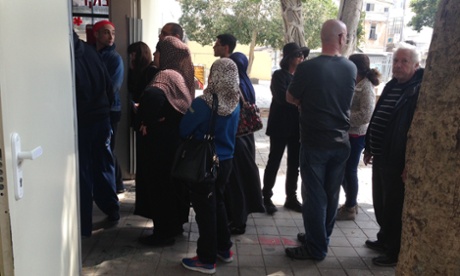
Many voters in Jaffa told Mairav that they’d voted for the Joint List: “‘I want there to finally be an Arab minister in government,’ said Abu Din Muhammad, 51, indicating his hope that if Yitzhak Herzog is the next prime minister, he will invite the Arabs to join the coalition, something that has never happened in Israeli history and which Herzog indicated he will not do.”
Michael Aboromanh, a Christian Arab from Jaffa in his 30s, voted for Herzog. “The country needs change and the only way to guarantee that change is to vote Buji [Herzog].”
There were also some first time voters. A 26-year old resident of Jaffa who preferred to remain nameless said he had never voted before because it “wasn’t interesting. It’s good they joined up, it’s worth voting now.”
Updated
Turnout is about 1% lower than in 2013 with only a few hours left of open polls, Haaretz columnist and American-Israeli historian Gershom Gorenberg reports.
Turnout as of 6 pm: 54.6%. Bit below 2013, higher than any other year since 1999. Possible will climb after sundown on excellent picnic day
— Gershom Gorenberg (@GershomG) March 17, 2015
Haaretz’s Anshel Pfeffer reports that Israeli-Arabs may not have come out to vote in as large numbers as predicted.
Surprisingly, turnout so far slightly lower than average and despite all the Joint List hype no signs of higher turnout among Israeli-Arabs
— Anshel Pfeffer (@AnshelPfeffer) March 17, 2015
Who is Isaac Herzog, the man poised to prevent Binyamin Netanyahu from his fourth term as prime minister of Israel?
“The scion of a powerful and wealthy political dynasty,” writes Guardian Middle East editor Ian Black (@ian_black), Herzog is a Labor-party veteran with experience as minister of housing and social services – and a foil to his “ security-obsessed” and effusively conservative opponent, Netanyahu.
Bland, bespectacled, and smartly suited, Herzog is handicapped by a reedy voice and a geeky and uncharismatic manner, not helped by his nickname – Booji – which his mother Aura has explained referred to his doll-like appearance as a child.”

“Herzog’s Zionist Union alliance with a small party led by the former foreign minister, Tzipi Livni, straddles the centre-left ground of a fragmented political system and a divided society. It has little appeal, as the name suggests, for Israel’s Palestinian minority.
“In a country where national service is mandatory for Jews and military experience still matters, Herzog recently tried to burnish his image by mobilising former comrades-in-arms to tell stories of his time in an intelligence unit in the late 1970s, when he rose to the rank of major.
“Unlike Netanyahu, Herzog is committed to a two-state solution to resolve Israel’s conflict with the Palestinians,” Ian continues, “though it is hard to imagine a ground-breaking approach to the perennially thorny issues of settlements and Jerusalem.”
You can read the full profile here.
Updated
Ayman Odeh, leader of the Arab Joint List party, having cast his ballot at the polls. In an interview last week with the Guardian’s Peter Beaumont (@petersbeaumont), Odeh said Netanyahu’s government has “undermined democracy and increased incitement against Arabs”.
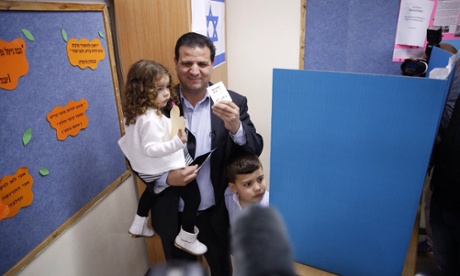
Odeh’s party has united several Arab factions ranging from socialist to Islamists, and Joint List could win between 13 and 15 seats in the Knesset, polls predict. Odeh has saidthe party’s priority is to prevent Netanyahu’s re-election, but also that it will not join a coalition government formed by Herzog.
“The ultimate goal is to get out Netanyahu. That is the most important thing. We are not in Herzog’s pocket but we are interested in hearing what he has to say.
“This has been the worst government in Israel in decades not only because it killed 2,200 Palestinians in Gaza but because of its racist policies and because it has entrenched the occupation and increased the economic gap between Jews and Arabs in Israel.
“It has undermined democracy in the country and increased incitement against Arabs. That is why we feel the most important thing is to prevent Netanyahu forming another government.”
You can read the full piece here, and an op-ed Odeh wrote for the Guardianhere.
Updated
If no one wins outright, how does Israel’s electoral system work, you might ask?
Israelis are voting for seats in the 120-seat Knesset, the country’s parliamentary organ, but unlike in the US they vote for party lists, rather than individual candidates. Ministers will be elected through proportional representation, and parties must have 3.25% of the vote (four seats) to be represented in parliament.
Although polling in Israel is far from reliable, final figures showed Herzog’s center-left Zionist Union (sometimes called Labor) set to win 25 seats, and Netanyahu’s center-right Likud to win 21.
Because neither of the two main blocks will win a 61-seat majority, it will then be up to those parties and others to create a coalition government. Each of the parties represented in the Knesset will recommend a coalition leader from their party or another to Israel’s president, Reuven Rivlin of Likud. Then the president will select a party leader, usually from the party that won the most seats, to build a coalition.
That party leader will have as much as six weeks to build a government; failing that, the president chooses someone else to take a crack at coalition-building.
For this reason, the turbulent waters of party politics in the Knesset are extremely important: the coalition leader that can navigate those waters comes away with a government. Parties that could sway the final outcome include the Arab Joint List, a newly united group of Arab parties, the Kulanu party, of former finance minister Moshe Kahlon, and Yesh Atid, the secular party of former journalist Yair Lapid.
Lapid and Joint List leader Ayman Odeh have said they will not back Netanyahu, but Kahlon has not signaled whom he might recommend to lead. Rivlin could also recommend a unity government of both Herzog and Netanyahu, although both men oppose this outcome.
Updated
“Bibi is suddenly looking beatable,” my colleague Phoebe Greenwood (@pagreenwood) reports from Israel, asking in a video dispatch whether this week’s general election in Israel could be the end for the “Teflon prime minister” at the hands of an opposition that unites former security chiefs and liberal secularists.
Welcome to our coverage of Israel’s 2015 elections, the culmination of two bitter campaigns that have billed the race as a referendum on the nation’s future.
Prime minister Binyamin Netanyahu called snap elections after a summer of war, strained relations with allies and growing economic inequality, but his bid for quick re-election with a new coalition has given way to a “wide open” election, as one Israeli minister put it. Netanyahu’s opposition united in recent months and found viable allies in the Knesset, Israel’s parliamentary body, and the prime minister has found himself trailing in the last opinion polls before the vote.
Netanyahu has waged a combative last-ditch effort to best his main rival, Isaac Herzog of the center-liberal Zionist Union party. Netanyahu’s main themes are of security and nationalism; Herzog has campaigned largely on economic grounds and disaffection with Netanyahu, who is seeking his fourth term.
The first exit polls are due to be published when polls close at 10pm local time (4pm ET; 8pm GMT), at which point parties will begin to know their powers in the new government. Several parties, including the newly united Arab Joint List and the secular Yesh Atid, could act as wild cards or kingmakers for Netanyahu or Herzog, depending on how many votes they receive and the bargains they’re willing to make.
Neither Netanyahu or Herzog are likely to win outright, and both have made final pleas to woo voters away from the narrow interests of smaller parties. Netanyahu appealed to rightwing hardliners yesterday by reversing his position on Palestine and rejecting the possibility of a Palestinian state. Herzog and his party’s co-leader, Tzipi Livni, sought to simplify their alliance for undecided voters, and said they would no longer share the prime minister position if brought into power.
Updated