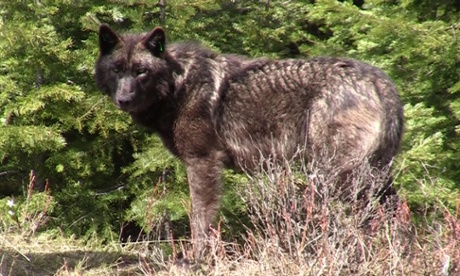
The longest continuous study of a predator-prey system in the world is about to come to an end in Michigan. Isle Royale National Park’s wolf and moose study has been running for 57 years, but its fate hangs in the balance as the National Park Service debates whether to introduce mainland wolves to the island and restart the wolf population.
The island’s wolf population crossed an ice bridge to Isle Royale in the late 1940s, surviving by hunting moose. Taken together, the wolves, moose and plant life they survive on have given scientists a rare chance to study a complete predator-prey system in isolation for decades. That research has resulted in new information about why protecting wolves is necessary to preserving the ecosystem all over the United States, and provided ammunition for those who argue that sustainable ranching must include supporting wolf conservation.
Although there is evidence that some wolves have made it off the island over the years, as the ice bridge has occasionally re-formed, no new wolves have crossed the other way. In order to bring new wolves to the island, the National Park Service (NPS) would need to do so intentionally.
Rolf Peterson, the scientist who has been leading the Isle Royale study since 1970, says that even if the NPS acts swiftly and dramatically now, it may already be too little, too late.
“I’ve been advocating for several years that we bring in wolves to mate with the native Isle Royale wolves, and several years ago it would have been pretty easy and would have been an almost guaranteed success,” he says. “Now it’s too late for the current wolves. They could bring in wolves and do a restart, but they won’t have a genetic rescue.”
That’s because the remaining three wolves on the island are a male-female pair and their pup, so the chances of either of the existing three mating with an outside wolf are slim to none. At its healthiest point, the wolf population on Isle Royale numbered between 18 and 27, but the population has been declining for years.
The NPS has considered introducing outside wolves at various points throughout the years. The agency most recently studied the idea from 2012 to 2014 and ultimately decided in April 2014 that it would continue to support a hands-off approach. At that time there were nine wolves still left on the island, and Isle Royale National Park Superintendent Phyllis Green said: “The decision is not to intervene as long as there is a breeding population.”
In just one year, that “breeding population” is all but extinct. The drop to three wolves – due largely to poor health caused by inbreeding – which Peterson and his Michigan Technical University research partner, ecologist John Vucetich, documented in their annual wolf report released earlier this month, makes genetic rescue impossible at this point.
Peterson makes a distinction between genetic rescue and a reboot of the population, because part of the focus of the research on Isle Royale has been to study how this particular population of wolves has survived, how inbreeding has affected them, and how they have operated in this system. Also, researchers have observed the same population of wolves continuously for more than five decades. Bringing in non-Isle Royale wolves at this point is akin to starting the study over.
Nonetheless, Peterson still believes it worthwhile to restart the wolf population on the remote island. “There’s still a good reason to do it now because time is of the essence to protect the ecosystem,” he says. “There haven’t been enough wolves on the island for the last four years to do what wolves do, which is kill moose.”
That has led to a doubling of the island’s moose population, which Peterson anticipates will double again in the next three to four years. With no predators and not enough vegetation, some of those moose will starve to death, but not before decimating much of the island’s plant life.
The National Park Service is about to embark on yet another study of the island, in which it will mull the environmental impact of doing something about the wolf issue or leaving it alone. That process is likely to be a fairly long one.
At the heart of it is not just the question of Isle Royale’s wolves, but a much larger philosophical quandary that could have implications throughout the country’s parks: the role of humans in nature. The NPS has traditionally taken a hands-off approach, believing its job is to let nature run its course. The NPS will need to decide which is more important: its commitment to not interfering or the protection of the island’s ecosystem and the value of the research done there.
In the meantime, Peterson will continue to spend time on Isle Royale. “I’ll keep studying what’s left of the wolves, moose and vegetation on the island,” he says. “It’s a tightly linked food chain. That’s been the scientific attraction all along.”