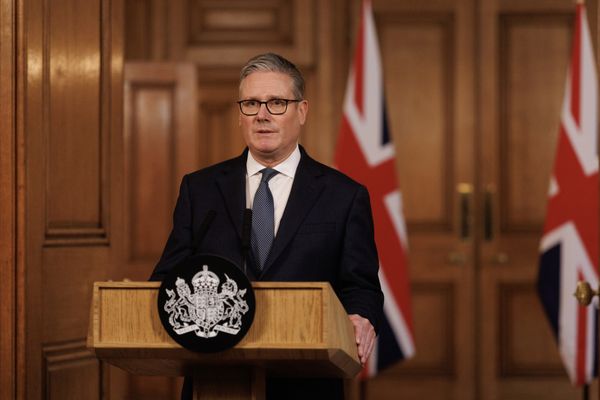
Dec. 06--President Obama on Sunday will take the unusual step of addressing the nation from the Oval Office to discuss his administration's terror policies in the wake of the massacre in San Bernardino.
The FBI is investigating the shooting spree -- which killed 14 people -- as an act of terrorism after officials discovered that one of the shooters pledged her allegance to an Islamic State terrorist group just before the opening fire.
The White House said in a statement that Obama would discuss progress in the San Bernardino investigation and "discuss the broader threat of terrorism -- including the nature of the threat, how it has evolved, and how we will defeat it."
"He will reiterate his firm conviction that ISIL will be destroyed and that the United States must draw upon our values -- our unwavering commitment to justice, equality, and freedom -- to prevail over terrorist groups that use violence to advance a destructive ideology," the statement continued.
The Oval Office address would be the first since 2010, when he declared the end of U.S. combat operations in Iraq.
Obama vowed Saturday that investigators would "get to the bottom" of the massacre as new details emerged about the woman at the center of the terrorism investigation.
Obama, in his weekly radio address Saturday, said investigators were still trying to get a "fuller picture" of the shooters' motives.
"It is entirely possible that these two attackers were radicalized to commit this act of terror," the president said. "And if so, it would underscore a threat we've been focused on for years -- the danger of people succumbing to violent extremist ideologies."
One of the two assailants, Tashfeen Malik, pledged allegiance to an Islamic State leader in a Facebook posting, officials said. And the other shooter, her husband Syed Rizwan Farook, had contact with people from at least two terrorist organizations overseas, including the Al Qaeda-affiliated Nusra Front in Syria, a federal law enforcement official said.
On Saturday, several news organizations including CNN and the Associated Press reported that the Islamic State extremist group had described the couple as "supporters" of the group in an online radio broadcast.
The broadcast declared, "We pray to God to accept them as martyrs" but did not say whether ISIS played any role in the planning of the attack.
FBI Director James Comey said the assailants showed signs of "radicalization" but that there was no evidence they were part of a larger terrorist network.
Farook and Malik died in a police shootout Wednesday, several hours after bursting into a holiday potluck for the San Bernardino County Health Department and killing 14 people.
Pakistani intelligence agents say they have questioned members of Malik's extended family in the province of Punjab, an area that is considered a stronghold of Islamist militant organizations.
Malik belonged to an educated, politically influential family from Karor Lal Esan in Layyah district. Malik Ahmad Ali Aulakh, a cousin of Malik's father, was once a provincial minister. Residents said the Aulakh family is known to have connections to militant Islam.
"The family has some extremist credentials," said Zahid Gishkori, 32, a resident of the Layyah district in the area who knows the family well.
Officials cautioned that Malik's Facebook posting did not mean that the militant group directed her and her husband to carry out the Wednesday attack, and that investigators think it instead suggests that the couple had become self-radicalized.
The Malik family moved to Saudi Arabia when she was a child, but Tashfeen traveled frequently to the Punjab region to visit family and she returned there to attend Bahauddin Zakariya University in Multan in southern Punjab to study pharmacology from 2007 to 2012.
After college she returned to Saudi Arabia, and from there moved to the U.S.
A family member in her hometown of Karor Lal Esan, who asked not to be identified, told The Times that Malik was "a modern girl" who became religious while studying at the university.
"After a couple of years in college, she started becoming religious. She started taking part in religious activities, and also started asking women in the family and the locality to become good Muslims. She started taking part in religious activities of women in the area," the family member said.
"She used to talk to somebody in Arabic at night on the Internet. None of our family members in Pakistan know Arabic, so we do not know what she used to discuss."
The same family member said that Malik, after moving to the U.S., began posting messages of religious extremism on her Facebook page, an issue that was a source of concern for her family in Pakistan.
Her paternal aunt, Hafza Batool, told a local correspondent of the BBC that the family was in a state of shock. "She was so modern. I do not know what happened to her. She brought a bad name to our family," she said.
Malik's father owns a house in the Babar Colony neighborhood of Multan, where she attended college, and she lived there during her studies.
The family was "not too social," a neighbor told Pakistan's Channel 24.
"The family would visit the house every three or four months, but they hardly have established links with the people in the area," the neighbor said.
Nisar Hussain, one of Malik's professors in the pharmacology department during her five years at the university, said she was veiled when attending classes.
"She was religious, but a very normal person as well. She was a very hardworking and submissive student. She never created any problem in the class. She was an obedient girl. I cannot even imagine she could murder people," he said in an interview.
She was a good student and at one point was first in her class, he said. "I don't think she had any kind of mental illness. She was among the best students, always hardworking, never created problems. Yes, she was religious, but not an extremist. She never tried to influence the class in the name of religion, never."
Witnesses and police have said that Farook, a county public health worker, had been at the holiday party but left, possibly after a disagreement with a co-worker, and returned with Malik to attack the gathering.
An acquaintance who prayed with Farook at a San Bernardino mosque told The Times that the shooter said he liked his wife because she wore a niqab, a veil that covered almost all of her face.
Nizaam Ali, 23, said Friday that he thought Farook believed that Malik's niqab showed that she was religious and wasn't embodying "the modern role of women today, working and all that."
Ali, a student at Cal State San Bernardino, said he occasionally talked to Farook at Dar al Uloom al Islamiyah of America mosque.
Ali remembered Farook saying something like, "That's what really made me interested in her, that's what made her stick out from the other women."
Ali said he believes that wearing a niqab is courageous, especially in the West, where people aren't familiar with such clothing. The two men agreed about that, he remembered.
"Other than that, his wife never came up in other conversations," he said.
He said Farook met his wife online, a practice that Ali said is common among his friends. "In our community, it's different," he said, noting that it's difficult for Muslim men to find women to marry. "Internet has become something that eases it."
Ali said he had met Malik on a few occasions, but the niqab obscured her face. "If you asked me how she looked, I couldn't tell you," he said.
The couple were married in Islam's holy city of Mecca in Saudi Arabia last year, according to Farook's co-workers at the health department and others who knew them. The Saudi Embassy in Washington confirmed that Farook spent nine days in the kingdom in the summer of 2014.
Authorities said that when he returned to the U.S. in July 2014, he brought Malik with him on a so-called fiancee visa. After a background check by the FBI and the Department of Homeland Security, she was granted a conditional green card last summer.
The couple's daughter was born in May, according to records.
An attorney representing Farook and Malik's family said Malik never spoke about Islamic State or terrorism.
"As far as I know, there was no discussion of any of that [among family members]," Mohammad Abuershaid said.
The couple hadn't been married that long, he said. "It wasn't like the family had much time to get to know her."
Abuershaid said the family was very conservative and that it would have been unlikely that Malik discussed her thoughts on world events, including the trouble in the Middle East, with her in-laws.
"Tashfeen was an individual who kept to herself most of the time," Abuershaid said. He added that she was a soft-spoken housewife who stayed at home with the baby.
The family has met with the FBI and plans to meet with agency officials again Monday, the attorney said.
Another lawyer for the family said authorities questioned Farook's mother and siblings for hours.
"It went into deep, scary witch-hunt mode," said David Chesley.
He said agents requested Farook and Malik's wedding guest list.
A federal law enforcement official said the couple tried unsuccessfully to destroy their electronic devices.
David Bowdich, the assistant director in charge of the Los Angeles FBI office, said investigators have recovered evidence of multiple explosive armaments and that the assailants attempted to destroy their "digital fingerprints."
He said two crushed cellphones were found in a trash can.
Farook and Malik had amassed an arsenal of 2,000 9 mm handgun rounds, 2,500 .223-caliber rifle rounds and "hundreds of tools" that could have been used to make explosive devices, authorities said.
The couple fired at least 65 shots when they stormed a party at the Inland Regional Center, where about 80 people had gathered. Twelve of the 14 dead and 18 of the 21 injured were county employees, police said.
Hours later, the couple exchanged gunfire with police on San Bernardino streets, launching bullets into homes and terrifying residents.
Farook and Malik used two semiautomatic rifles and two semiautomatic handguns, all of which were bought legally, according to the federal Bureau of Alcohol, Tobacco, Firearms and Explosives.
On Friday morning, dozens of reporters were let inside the Redlands townhouse where Farook and Malik lived. The doors and windows were boarded up, and the home was sparsely decorated. The upstairs had a crib, baby toys and children's books.
In the middle of the living room, a copy of the Koran rested on a small black table. On another table was a lengthy list of items the FBI had seized in its investigation: Christmas lights, an iPhone, boxes and bags of ammunition, letters, a passport and gun accessories.
FBI agents on Saturday raided a Riverside home belonging to a friend of San Bernardino shooter Farook as they try to determine whether the man purchased two of the semiautomatic rifles used in the massacre, according to a law enforcement source.
The source, who asked to remain anonymous because the case is ongoing, said officials have been trying to talk to man to see what he knows about the attack. It's far from clear whether the man had anything to do with the violence or even knew what Farook did with the guns, the source added. A second source said the guns were purchased three years ago.
The search warrant was served at the home on Tomlinson Avenue, FBI spokeswoman Laura Eimiller said. She did not have a specific address.
"The warrant has been sealed by the court and I am prohibited from commenting further," she said.
Victor Venegas, who lives in the neighborhood, said law enforcement showed up at a home in the 3800 block of Tomlinson Avenue early Saturday and stayed for a few hours.
He and other neighbors have said Enrique Marquez, Jr., a young man who lived at the home, and Farook appeared to be good friends. The source said Marquez is the person the FBI is seeking to interview.
Farook, his parents and siblings lived on Tomlinson for several years before moving out a few months ago. Marquez lived next door.
While Farook generally kept to himself, the one exception was his friendship with Marquez, who like him, loved to tinker with cars, neighbors said.
On Thursday, Gustavo Ramirez, who said he was Marquez's stepdad told a Times reporter that he and his wife hadn't heard from Marquez since Wednesday afternoon and were concerned. Ramirez said it was unlike Marquez not to come home.
On Friday someone had put up a sign in the family's yard that said: "Please keep off the property thank you."
The garage door appeared to have been busted and a window was shattered.
Correspondent Sahi reported from Pakistan. Staff writers Veronica Rocha, Paresh Dave, Jack Dolan, Richard Winton, Kate Mather, Rong-Gong Lin II, Joseph Serna, Phil Willon and Matt Stevens contributed to this report.
MORE ON SAN BERNARDINO SHOOTING
Victim talked about Islam with assailant 2 weeks before San Bernardino shooting
Media ripped for TV coverage from home of San Bernardino shooters
FBI seized guns, ammo, computer and notebook from home of San Bernardino shooters