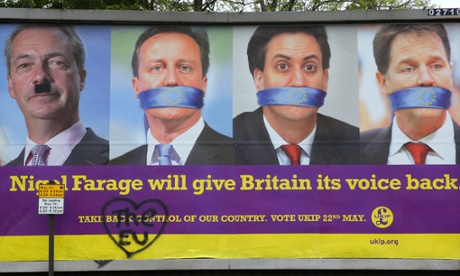
It isn’t usually associated with the digital world, but the United Kingdom Independence party is proving itself to be pretty social-media-savvy. A YouTube video of a Ukip calypso song has been shared widely online, with Nigel Farage tweeting at his supporters to buy the track and make it No 1 in the singles chart. #Ukipcalypso trended on Twitter on Monday as a result.
The party, which is currently polling at 15% according to YouGov, has disproportionately high levels of social media engagement for the size of its membership (which is about 39,000, according to the most recently released figure, compared with 190,000 for Labour and 134,000 for the Conservatives). What with Labour hiring Obama’s digital strategist David Axelrod, social media is expected to be a key political battle ground in the upcoming general election, with unprecedented levels of online interaction from the mainstream political parties.
Ukip supporters are flooding Twitter, says Carl Miller, research director of the Centre for the Analysis of Social Media at Demos. “What you’re really seeing at the moment is a spontaneous, organic outburst from a group of people who think they’re poised to make history. That will be negative as well as positive for Ukip as their supporters, members and PPCs [prospective parliamentary candidates] will be tweeting things that are unacceptable, and I know the media are looking quite hard at their output.”
Ukip was, perhaps unsurprisingly, mentioned on Twitter more than any other party in the runup to the European elections, according to analysis from Impact Social. But many of those mentions are likely to have been in a negative context and, although Ukip’s number of Twitter followers is high – 69,000, so closing in on the Liberal Democrats’ 73,300 and surpassing the post-referendum Scottish National party, which has 62,6000 – a follower is not an endorsement.
#UKIPCalypso is number 23 in the itunes chart, 22 more to go, only 79p with 20p to UKIP https://t.co/ZcnuJYTiEZ pic.twitter.com/0pOgcljlgn
— UKIP (@UKIP) October 20, 2014
But if following a party on Twitter doesn’t mean you support them; liking them on Facebook usually does. Ukip currently has 276,435 likes on Facebook, which is just 18,153 likes short of the Conservative party’s 294,588 and over 82,000 ahead of the Labour Party, which only has 193,788. The Liberal Democrats have 104,132, the Green party of England and Wales has 96,723 and the Scottish National party has 166,795.
Unlike the other parties, Ukip is not just attracting young Facebook users, but is getting older users to engage. The Conservative and Labour parties see their main Facebook interactions among the 18- to 24-year-old age bracket, but Ukip are seeing most engagement from 25-34s and 45-54s.
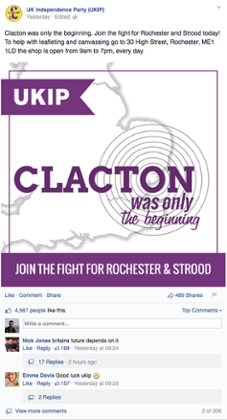
Social media is predisposed to being friendlier to anti-establishment figures, says Miller. In the runup to the Scottish referendum, Salmond’s online success came from his ability to frame the debate as pro and anti Westminster, something Ukip are also doing. “Social media generally hates politicians and the mainstream business-as-usual political class,” says Miller. “Twitter and Facebook really value independent voice, familiar intonation and personality,” he says, all things that Ukip are good at.
But the link between social media dominance and votes is far from established. Miller points to the outcome of the Scottish referendum: “The Yes campaign were leading from the beginning [on social media] and that had absolutely no correlation with the electoral polling.”
Labour want to charge YOU to see YOUR GP. Retweet and spread the word! pic.twitter.com/rhzennK7dy
— UKIP (@UKIP) October 13, 2014
Miller stresses that electoral polling and social media dominance are two very different things: “Electoral polling is really targeting undecided voters and the thousands of mildly apathetic voters who will probably turn out on the day, whereas on social media you are seeing the galvanised vocal minority – the core adherents.”
It seems Ukip will have to do a lot more than just tweet if it is to transfer its online popularity into votes.