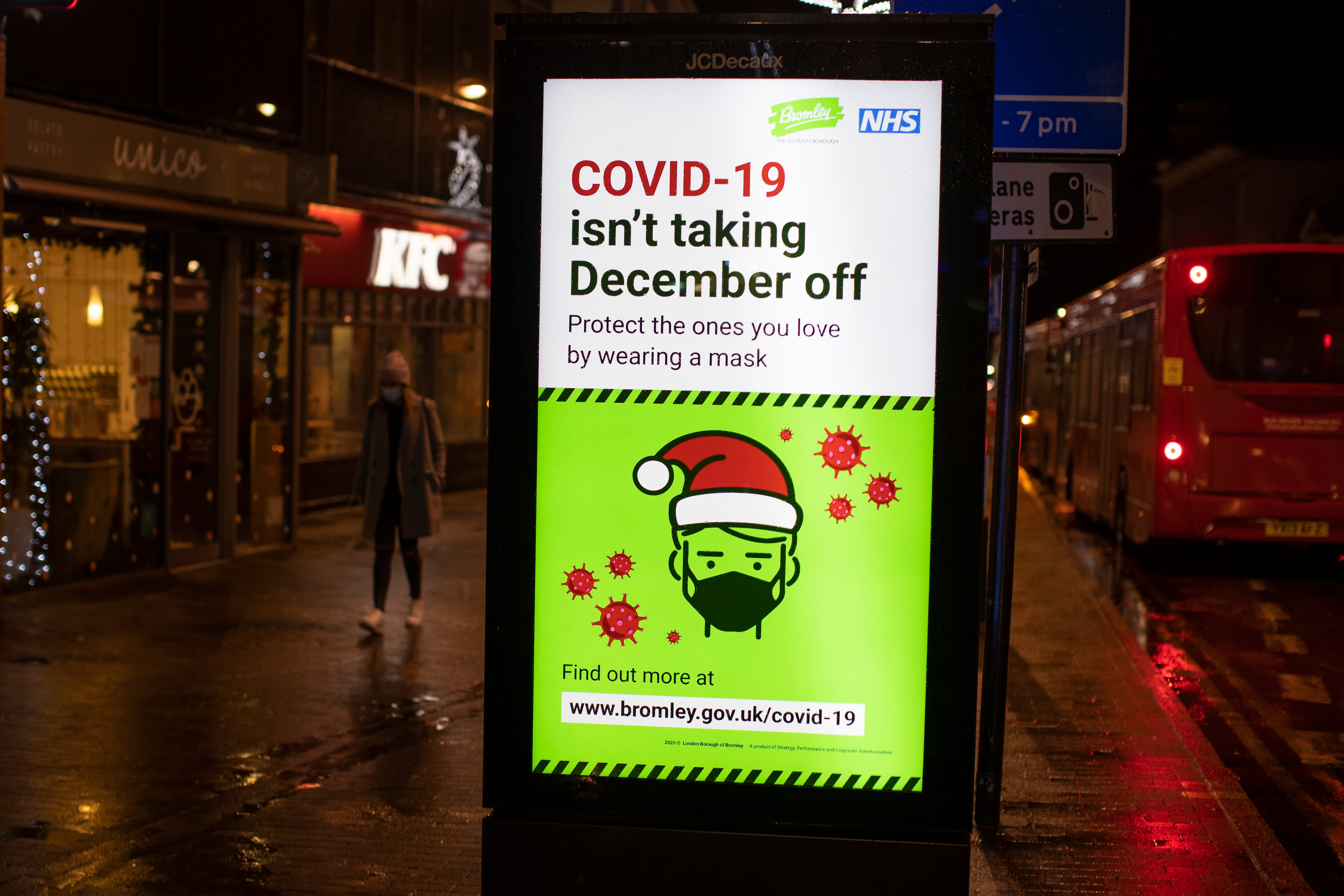
Those living under tier 4 restrictions in the southeast of England and London are likely feeling a sense of deja vu. That is, if the dejection of having Christmas cancelled because of a new, more infectious strain of coronavirus is not entirely overwhelming.
Boris Johnson predicted at the end of October that the festive season may be “very different” when he announced the second English national lockdown – but he had hoped that four-week lockdown could have meant families could gather over the holidays.
A different Christmas it will be for some 20 million people in tier 4 areas who must stay at home, but not all that different from living under a full lockdown.
Johnson acknowledged that the measures will be “broadly equivalent” to the national restrictions that were imposed in November at the press conference introducing the new tier on Saturday.
Residents in London and the southeast and east of England, including Bedford, Milton Keynes, Luton, Kent and Medway, Essex, Surrey and Peterborough, must stay at home and non-essential retail must close, just like in the nationwide lockdown.
Under the tier 4 rules, household mixing indoors or in private gardens is banned, but people can meet one other person from another household in an outdoor public space.
People should work from home where possible, but may leave home for work where it is not.
So far, so full lockdown.
Essential shops can remain open, as can schools, colleges and universities. Colleges and secondary schools, however, will have to carry out coronavirus testing from the first week of January, and there will be a staggered return to classroom teaching at the latter.
Pubs, bars, restaurants must stay closed, except for takeaway and deliveries, and non-essential shops, gyms, cinemas, casinos and hairdressers have to stay shut, as was the case in the national lockdown.
Those in tier 4 should not travel out of the region, while those living outside are advised against visiting.
So is tier 4 just a rebranded version of the prime minister’s nuclear option?
Not quite. Although most of the restrictions mirror those introduced in November, there are exceptions.
Places of worship, for example, are able to hold services and people can attend, so long as they do not mingle with anyone outside of their household or support bubble. During the second national lockdown, they were only able to open in exceptional circumstances such as for funerals.
Unlike the November lockdown, tier 4 has no end date, yet.
The rules are set to be reviewed on 30 December, and Matt Hancock, the health secretary, says parliament, which is in recess, will vote on the measures in January.
Because tier 4 was introduced via statutory instrument at 6am on Sunday, it must be approved by both the House of Commons and House of Lords within 28 days, otherwise, the change to the law is reversed as per a process known as the “made affirmative procedure”.