The first round of this year’s NCAA men’s tournament was one of the most lopsided on record.
Thirteen of 32 first-round games were decided by at least 20 points, the most on record according to CBS Sports. Just one top-five seed lost (Wisconsin, which fell to High Point), and while there were a few scares like Siena’s upset bid against No. 1 overall seed Duke, plenty of top seeds pulverized their first-round foes. Defending champion Florida’s 59-point win over Prairie View A&M was the largest margin of victory in the Big Dance since 1969. And all this comes on the heels of a 2025 tournament in which the Final Four featured all four No. 1 seeds, no No. 13 or worse seeds won games and no double-digit seeds made the Sweet 16.
Is it fair to say that the madness is becoming less mad? These are still relatively small sample sizes, and the last two years come on the heels of some of the more upset-filled tournaments ever. But the trend is certainly not an optimistic one for those who adore Cinderella runs in the tournament, and that it comes as the sport’s landscape changes drastically with regards to NIL and the transfer portal doesn’t feel like a coincidence.
Is it as simple as that? Sports Illustrated set out to diagnose the real reasons for the limited chaos of the Dance to date, and spoke with coaches who’ve lived both sides of the March pendulum to get their take on this year’s chalky tournament.
The best teams are better
There are a lot of reasons why we’ve gotten to this point, but at its core, elite teams in the sport the last two years have been far more separated from the pack than they were just a few years ago.
We’ll use KenPom’s adjusted net efficiency margin as the measuring stick for this. In 2021–22, the last season where rosters weren’t substantially shaped by NIL paydays, there was just one team with an efficiency margin north of 30: Gonzaga. This season, eight teams are currently clear of that threshold, and all are above that Gonzaga team’s final mark. Last year, six teams cleared 30. There were 16 teams in 2022 with efficiency margins of 20 or better; this year there are currently 31. Essentially, the No. 4 seeds in this year’s bracket (relative to the rest of the sport that season) are as efficient as No. 2 and No. 3 seeds were in 2022.
“There’s a bigger gap right now between the top and the middle,” Florida head coach Todd Golden says.
Some of that is driven by the portal, but it is also a function of NIL keeping players in school longer. Look through this season’s top 10 teams, and there’s a smattering of guys who may well have turned pro without often seven-figure deals keeping them in school. Alex Condon and Thomas Haugh at Florida, Yaxel Lendeborg at Michigan, Motiejus Krivas at Arizona, Milos Uzan and Joseph Tugler at Houston, maybe even Braden Smith at Purdue … the list goes on and on of guys who likely wouldn’t be in college basketball still if not for the big paydays they received. That certainly makes life more difficult on mid-major teams trying to shock the world.
SI’s @CBB_Central breaks down why there has been a lack of upsets in the men’s NCAA tournament 🏀 pic.twitter.com/qevqe96rrK
— Sports Illustrated (@SInow) March 21, 2026
Mid-majors can’t build continuity
Maybe the best teams are more talented than before, but smaller schools have always gone into the tournament at a talent disadvantage. Recruiting has never been a fair fight, even well before NIL. The potential great equalizer was the ability for mid-majors to build a level of roster continuity that the bigger brands struggled to match, then ride that experience to upset wins.
The money alone is enough to entice many top mid-major stars to bounce around. But when the NCAA briefly attempted to enforce a one-time transfer rule without sitting out, mid-majors could at least attempt to build that continuity by taking transfers themselves. Without any restrictions on the amount of times you can enter the portal, there’s essentially no recourse for mid-majors to try to maintain continuity outside of having unbelievably loyal players.
“Now that you can transfer every year, I don’t know how anyone stays long enough to where there’s continuity,” said Texas Tech head coach Grant McCasland, a former mid-major head coach at Arkansas State and North Texas. “That’s why I respect Akron so much and that team we played. I loved watching them play, and I wasn’t able to even say it enough, just they had so many guys return and stay. To me, that's the x-factor in winning at the highest level with these teams is, who can you have continuity with so you can beat people because of your togetherness. These teams that don’t have the resources, it’s just hard to keep anyone longer than one year if you’re great.”
Nate Oats built an elite team at Buffalo that won games in back-to-back NCAA tournaments before he made the move to Alabama. In his last season with the Bulls, he led a team that brought back four of its top five scorers from a group that had beaten Arizona in the Big Dance the previous season to a No. 6 seed and top-15 final ranking in the AP poll.
“I go back to the guys I had; C.J. Massinburg could have played at a high-major school,” Oats said. “I had a great relationship with C.J., I love him. I’m sure he would’ve loved to stay and play for me, but it’s going to be hard for him to turn down the amount of money he would have been offered back then.”
So while it isn’t impossible to build strong mid-major teams (many of the No. 12 and No. 13 seeds this year were excellent), the next level of roster retention to build a truly elite mid-major capable of fully blowing up the bracket is much more of a pipe dream.
“I think there’s still mid-major teams that are going to win games,” Oats said. “It’s just going to be hard for a mid-major team to end up as a six-seed and be favored in your first-round game like we were that year.”
Stylistic shifts
One underdiscussed angle in all this is fairly drastic changes in stylistic trends across the sport, particularly for top teams. A few years ago, teams around the country were leaning heavily into shooting and skill, trying to space the floor and take tons of threes. Now, the best teams in the country are also the biggest bullies: Michigan and Florida with their three-headed frontcourt monsters, Arizona and Michigan State mauling people on the glass, Duke with multiple NBA players rotating through the four and five spots. Rim protection and offensive rebounding are now the premiums elite teams chase, not stretch big men and sharpshooting.
Florida under Golden has been among those who’ve led the shift back toward rim dominance. It’s even something he embraced at San Francisco, playing two bigs on his 2022 Dons team that went dancing.
“That was kind of the wave for a couple years, teams that sold themselves as playing a ‘pro-style’ offense and spread out … but when you play that way, you allow a lot of volatility to enter the equation,” Golden says. “When you have the opportunity to recruit bigger, stronger, faster athletes and play a style that allows you to raise your floor with high two-point field goal percentage and get on the glass, that just gives you a better chance to be consistently successful.”
A prime example Golden pointed out was the No. 11 vs. No. 6 battle between Miami (Ohio) and Tennessee on Friday. Miami was built in the mold of many traditional mid-majors, opening the floor with four- and five-out offensive sets and firing up shots from beyond the arc. Tennessee is among the sport’s biggest smashmouth squads, leading the nation in offensive rebounding rate and rarely taking threes. Tennessee won the rebounding battle 42–25, made nearly double the number of two-point field goals that Miami did, and was never in serious danger as a result.
“Recruiting bigger, that to me is a way to protect yourself from some of these really good mid-major teams,” Golden says.
Is this permanent?
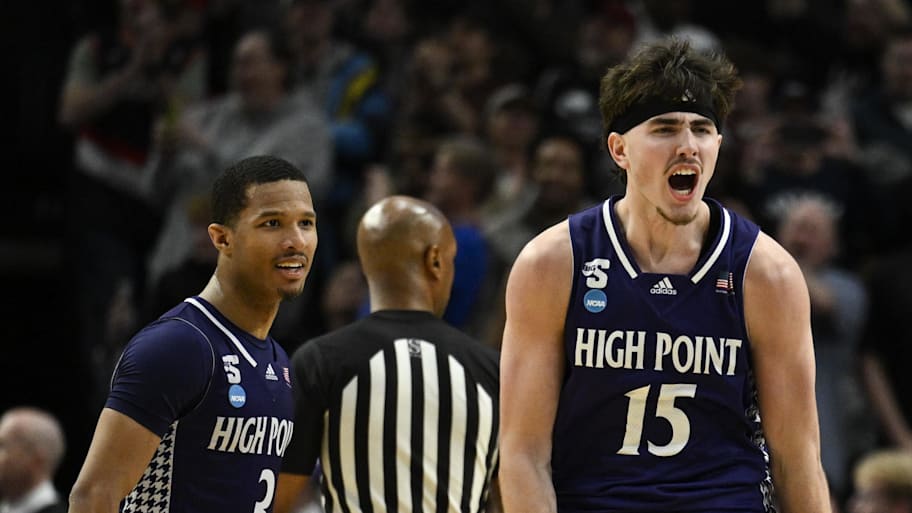
That answer feels too early to give. Among other reasons, it feels foolish to write off Cinderella forever when we’re fewer than 48 hours removed from a Siena team that finished third in the MAAC leading the No. 1 overall seed by 13 in the second half. Many of the blowout final margins were misleading: Akron and Hofstra were within five in the final eight minutes before the wheels came off and turned into 20-point margins, Furman and McNeese were within range late and ended up losing by double digits. At every point in history, long shot upset bids have always been a game of simply giving yourself a chance late. Plenty of mid-majors did this year, but none—other than High Point—was able to pull it off.
But it’s also hard to argue that a world with unlimited transfers, almost-uncapped NIL and revenue-share spending is conducive to “the little guy” emerging victorious. The richest teams can build superpowers if they use their funds well; the poorest can’t even hope to keep a promising freshman or sophomore long enough to lead them to March glory.
So while it may not be wise to totally write off mid-majors from future Cinderella runs, the current climate has made it harder than ever to pull off the top of shocking upsets that make March feel the most chaotic. And without further changes to the sport’s landscape, it might be a while before we get the type of earth-shattering first weekends of the Dance we used to be accustomed to.
More March Madness From Sports Illustrated
Listen to SI’s college sports podcast, Others Receiving Votes, below or on Apple and Spotify. Watch the show on SI’s YouTube channel.
- Road to the Final Four: March Madness Predictions, Picks for Sunday's 2nd-Round Games
- The Long-Awaited Showdown Between Rick Pitino and Bill Self Has Finally Arrived
- Duke Is Still a Work in Progress—and That’s the Scary Part
- Why Tom Izzo Believes Its Important That He Keeps Coaching in NIL Era After Many of His Peers Have Left
This article was originally published on www.si.com as Is This the End of Cinderella in Men’s March Madness?.