The recent mockery of Tony Abbott on mainstream and social media for his knighting of the Duke of Edinburgh reached its height when the Australian prime minister fired back that Facebook and Twitter were merely “electronic graffiti” and not worth anyone’s serious attention.
Abbott wasn’t entirely wrong. Electronic graffiti is quite a good description of the hit-and-run style of much social media. Of course, that doesn’t make it worthless.
In contrast to the sophistication of carefully argued, long-form journalism, 140 characters won’t deliver much analysis, but a burst of humour or anger often kicks along the political argument more effectively. And as someone on Twitter noted in the wake of the Queensland election result, Abbott’s “electronic graffiti” turned out to be the writing on the wall.
Writing on actual walls goes back at least as far as Pompeii, and doubtless there were always those who believed it was little more than vandalism. Some of it probably was. Similarly, art’s most famous example of graffiti – Marcel Duchamp’s bearded and moustachioed Mona Lisa – has often been dismissed as a puerile prank, but the fact that we remember it suggests it was something more: not only a critique of mass production, but arguably the start of post-modernism – and this in 1917, when modernism itself was barely under way.
So what about music? Is there such a thing as musical graffiti? The 18th-century composer Haydn comes first to mind. Holed up for most of his professional life in the Esterházy palace, where he was liveried composer-in-residence to a family of Hungarian aristocrats, he took endless pleasure in jolting his listeners from their cosy reveries. A lulling slow movement is disrupted by an abrupt bang; a courtly dance plunges, mid-phrase, into total silence; a symphonic finale is halted so everyone can tune; another is invaded by bagpipes. They’re not real bagpipes – the drones come from horns, bassoons and low strings – but the sound is startlingly vibrant, dragging demotic noise into the symphony, mud-caked boots trampling the courtly parquet.
Throughout history, musicians have delighted in roughing up their work. There are, for example, numerous Renaissance masses based on pop songs of the day, often with scurrilous lyrics. The great Flemish composer Orlande de Lassus took a song in praise of the breasts and vaginas of 15-year-old girls as the musical foundation for his celebrated Missa Entre vous filles (1581).
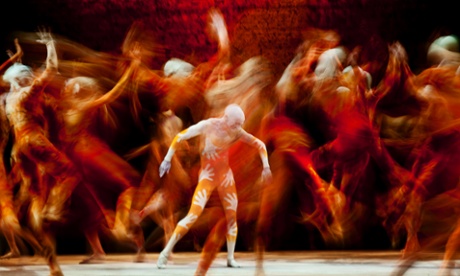
Stylistically, Lassus’s Mass is a fine example of 16th-century polyphony – no roughing up there – but plenty of other composers and performers have attempted to make their music sound more primitive. Perhaps the most obvious example is The Rite of Spring (1913) in which the composer Igor Stravinsky established rhythm as the vital element of his ballet score, while simultaneously reducing the role of harmony. His famous stamping chords are usually discussed in terms of their insistence, but much of that comes down to harmonic stasis – the point is that it is the same chord repeated more than 200 times. For more than four centuries Western music had thrived on harmonic development, and here is was – gone!
From the proto rock and roll of Bo Diddley’s Pretty Thing to the minimalist epiphany of Terry Riley’s In C, absence of harmonic variation has been one way of avoiding sophistication. Another is to do with the quality of sound – the sound of beaten drum skins or the raw tone of the human voice.
The composer Edgard Varèse, whose Ionisation (1931) was effectively the first piece for an orchestra of percussion alone, spoke of the emancipation of noise; the American vocalist Diamanda Galás merges song with primal screaming; on Scott Walker’s album The Drift, we encounter not only the singer’s distressed vocals, but also a member of his band relentlessly punching a side of meat.
Primitive technique also comes into this. The brilliant jazz pianist Thelonious Monk often adopted the flat-fingered technique of a child; the Portsmouth Sinfonia (who really couldn’t play their instruments) set about giving perfectly serious minded accounts of classic orchestral scores such as the Rossini’s overture to William Tell. The resulting shambles was often oddly touching.
The Oxford English Dictionary gives “simple, rude or rough” as a definition of “primitive”, and in searching for these qualities musicians have returned to sounds that engage our bodies as much as our minds. As the graffiti goes: “Fuck art, let’s dance”. The curious thing is that in looking back, they have so often created something brand new: The Rite of Spring, rock’n’roll, minimalism.
Music that suddenly speaks with the simplicity and directness – and, often enough, the rudeness – of graffiti, can strip away artifice. Perhaps that’s what Twitter does to politicians.
• Andrew Ford’s Earth Dances: Music in search of the primitive is published by Black Inc