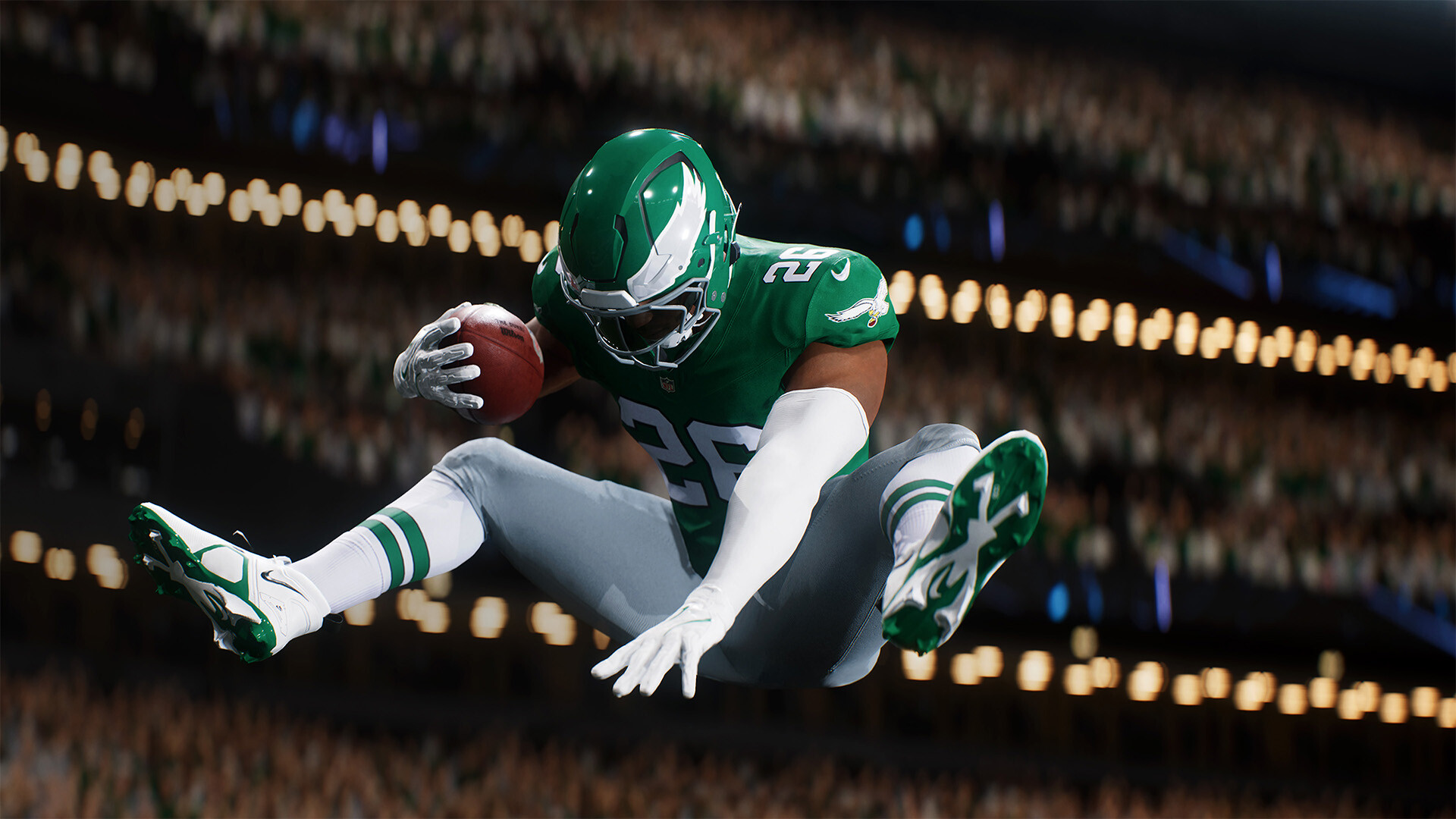

With Madden 26, the Madden franchise has been at the forefront of football video games for over 35 years. Very few challengers have ever gained a foothold for very long on the football video game scene, especially at the pro level. There is, of course, a great college football option currently with EA’s other football title, College Football 26, the second installment of the new CFB series, which is a spiritual successor to the NCAA franchise that ended in 2014. Outside of EA, the football video game landscape is a barren desert, with oases becoming increasingly scarce with each passing year.
As we move into 2026, officially entering the second quarter of the 21st century, I want to take stock of this corner of the video game world. I want to find out why we are seeing so few football video games, how we got ourselves into this monopoly, and what’s next for football gaming in the future. So without further ado, let’s get into it!
History of Alternate Football Games
Pre-Madden
Before Madden, and even before the widespread popularity of home consoles, there were football video games like the aptly named arcade game “Football” made by Atari in the late seventies. Early in the eighties, there was real sports football for the Atari 2600 and 5200, featuring small blue sprites playing against small yellow sprites that vaguely resembled football players (if you squinted). The following year, Nintendo released a vastly more visually stimulating product with 10-Yard Fight. However, it was clear the Japanese creators had never actually watched football, as the gameplay had no basis in actual football rules or scoring.
Throughout the eighties, more football games came out, including John Elway’s Quarterback, Mac Pro Football for Mac OS, and Arena Football for the Commodore 64, but the big one was obviously Tecmo Bowl, which came out for the NES, Game Boy, as well as being an arcade staple. The game was iconic and had real NFL rosters, which made hit a smash hit in the NFL. Tecmo Bowl differentiated itself with a more cartoonish style, which was a stark contrast to John Madden Football, which came out a year later.
The Nineties
While John Madden Football 88 (the first edition of the game wasn’t necessarily a smash hit due to being only on the PC), it did lay the groundwork for what NFL games would come to look like. With realistic teams (fully equipped with 11 players per side), with a top-down view from behind the quarterback, which was different from the traditional side view that games took before then. Games like ABC Monday Night Football, Joe Montana Football, and NES Playaction Football followed suit, but couldn’t get a foothold before John Madden Football ’92 came out and expanded on the previous iteration.
Despite the growing popularity of the Madden franchise in the early nineties, Tecmo Super Bowl’s 1991 release was the big sports game of the era. TSB was the first game to gain the NFL and NFLPA licenses to include team and player names, making it the preeminent NFL game in the early nineties and still seen as one of the best sports video games of all time. Unfortunately for Tecmo Bowl, the Madden Franchise gained the NFL/NFLPA licenses in 1994 and helped the franchise soar above other similar football games franchise that tried to start up during the decade including Troy Aikman NFL Football, Emmitt Smith Football, Bill Walsh College Football 95, and Quarterback attack with Mike Ditka, they truly tried to give every 90’s football star their own game, and they each fell to Madden one by one.
In 1998, EA added NCAA football to its yearly scheduled releases and kept that dual football game strategy up until 2014.
The Golden Age Of Football Games

This era was kicked off by NFL Blitz, the legendary arcade game that was created in the late nineties and styled itself as a wacky and over-the-top alternative version of an NFL video game. It is still considered one of the better sports video games ever created and epitomized the fast-and-violent era of the late 1990s and early 2000s in sports. Following the wacky cartoonish style of NFL Blitz but bringing a more family-friendly approach and animation was the 1999 classic Backyard Football, which also became an instant classic. Also in 1999 was the beginning of the 2K football series, which was initially launched by Sega for the Dreamcast but eventually became its own thing and was the closest thing Madden ever had to a direct competitor in the realistic NFL game realm.
With consistent annual releases, 2K Football, NFL Blitz, and Backyard Football were joined by short-lived series like NFL Game Day, NFL Fever, and Street Football in the early 2000s. From 2000 to 2005, there were typically five or more annual football game releases, each worth playing. This era culminated in the Madden 05 vs. ESPN NFL 2K5 season, which is viewed as the greatest year for NFL video games, with both games topping the list of greatest football games ever made.
The Post-Golden Age
Following the end of the 2K run of NFL games and now firmly in the Xbox vs. PlayStation console wars, Madden retook its stranglehold on the sports video game scene. As a staple game on both consoles, Madden grew in popularity even as its quality regressed. Blitz ended its run around 2007, and Backyard Football ended in 2010, and most of the non-EA football games came from small publishers, usually trying to promote arena football. In 2016, we saw Axis Football make an attempt to garner grassroots support, and had a small fan base for a few years, as well as Maximum Football, but neither has found a foothold in the football video game landscape like the games in the golden age did.
The Challenges Of Making Alternative Football Games

The question then becomes, why? Why can’t we get true rivals to Madden as we did in the early 2000s? Well, for that answer, we have to go back to the tail end of the golden age of football games, 2004-2005, when it seemed like we had endless quality games, highlighted, obviously, by Madden and ESPN NFL 2K. See, both EA and 2K were raking in money hand over fist, while fighting over the same audience, this made them compete more fiercely, leading to a better product for consumers, but led to smaller profit margins. While EA and 2K might have been happy with high revenues and small profit margins, the NFL was not. That’s simply not how the NFL operates. If there’s money to be squeezed out of consumers, the NFL will do it.
So, because of good old American capitalism, the NFL signed an exclusive deal with EA, allowing only Madden to make NFL games featuring NFL teams and players. This was hugely beneficial to the NFL (who got a ton of money from EA) and to EA (who now had a monopoly on all NFL games), but killed off all of their competitors, namely NFL 2K, NFL Fever, and NFL Gameday (Blitz and Backyard Football could still make NFL related games as long as they weren’t “simulations”) and led to regression in Madden whose quality fell consistently for more than a decade after the deal, and killed the rest of the football game industry as there simply wasn’t an audience for non-NFL football games.
Even if there was an audience for non-licensed games, the cost of making quality games has soared since the early 2000s.
The Future Of The Football Game Market
The NFL’s exclusive rights deal with EA ends in 2030, limiting any other company to either non-NFL licensed games or non-simulation games. Neither of which has enough demand to warrant a big studio investing heavily in making something like that. However, it’s not completely out of the realm of possibility that we see another attempt at an arcade-style game like NFL Blitz, Backyard Football, or my personal favorite, Street Football. Whether or not a company would take the risk of doing something like that remains to be seen.
As for post-2030, we may see the NFL open up the bidding war again for the exclusive rights, although I’m not holding my breath that they will return to the non-exclusive era that created the Golden Age, as it simply doesn’t make business sense for them. I could see 2K Studios try to pull the rug out from under EA now that EA is under new management. I could see the new private equity owners of EA not wanting to invest the money to retain the NFL license, opening a window for 2K or another publisher to take a stab at creating a non-Madden NFL game.