
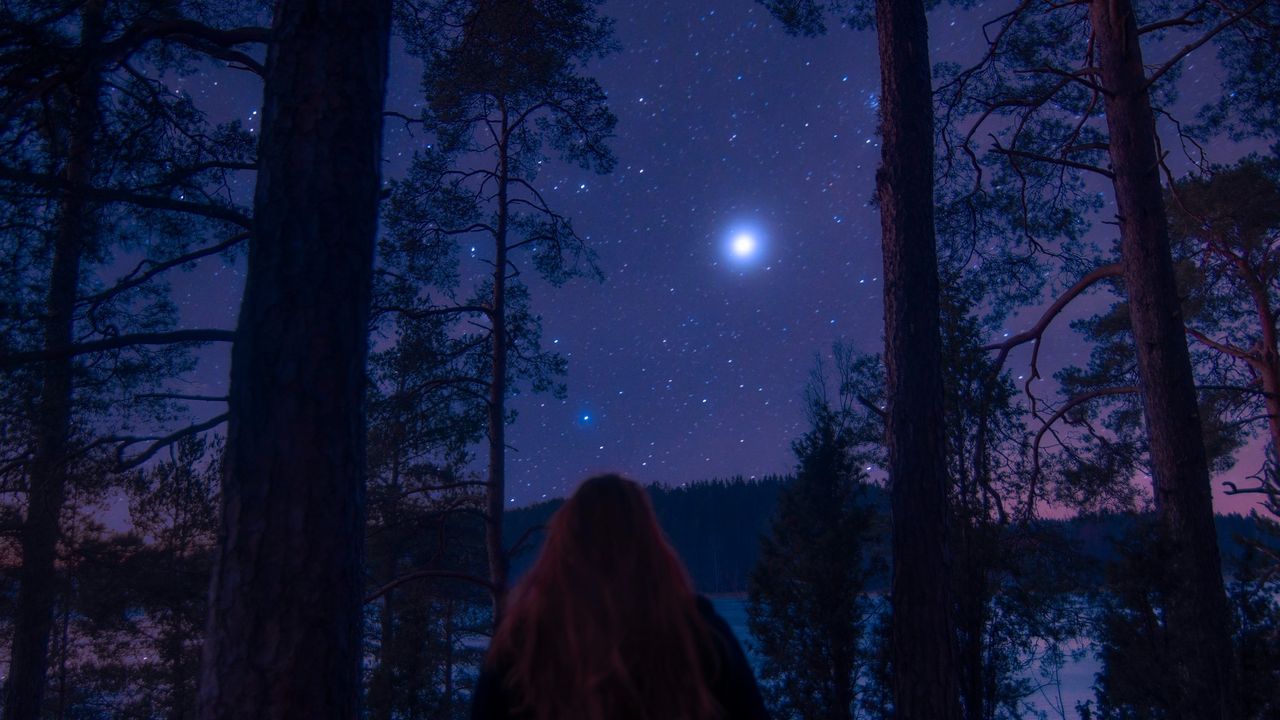
Christians are well aware of the Nativity story, in which three wise men follow the "Star of Bethlehem" to the newborn Jesus. But does this biblical story have astronomical origins? What was the "Christmas Star"?
Modern skywatchers have posited many theories, such as the star being a very close conjunction of Venus and Jupiter in 2 B.C or a less visually striking triple conjunction of Jupiter and Saturn seen throughout 7 B.C. (Historians continue to debate the actual date of Jesus' birth.) Another theory suggests it may have been a bright stellar explosion.
There are no major close conjunctions this December, nor any naked-eye comets, exploding stars or anything else particularly unusual. However, there is a bright point of light visible for much of the night, and it's rising in the east soon after dark.
Jupiter will come to opposition on Jan. 10, 2026. On that date, Earth will be between Jupiter and the sun, putting the giant planet at its closest and brightest to Earth. When an outer planet like Jupiter is at opposition, it rises in the east at sunset, reaches its highest point in the sky around midnight, and sinks in the west at sunrise.
Whether Jupiter alone was the "Star of Bethlehem" is doubtful, because its opposition occurs every 13 months. That's because Jupiter takes 11.86 Earth years to orbit the sun once, and Earth gets between it and the sun once each year. According to Sky & Telescope, Jupiter completes about one-twelfth of its orbit each Earth year, so it takes Earth about a year to catch up to the point where it can align with Jupiter again, resulting in a 13-month opposition cycle.
In December, a month before opposition, Jupiter is rising about two hours after sunset. However, because sunset occurs early during December in the Northern Hemisphere, Jupiter dominates the sky for much of the night. Easily visible in the eastern sky after 8 p.m. local time, Jupiter dominates the night sky as a neatly timed "Christmas Star."
Shining at a very bright magnitude of -2.4 at the beginning of December, Jupiter will get even brighter as it approaches opposition, reaching -2.5 by the end of 2025. (In astronomy, a lower magnitude corresponds to a brighter object; negative magnitudes are the brightest.)
Was Jupiter the Star of Bethlehem? We may never know — but in December 2025, its brilliance will make it a worthy stand-in.