“There has been a shift of opinion against playwriting, in favour of collective methods of theatre. The very activity of playwriting has been attacked as individualistic, undemocratic and even immoral,” declared playwright David Edgar when it was announced that he would be this year’s visiting professor in drama studies at Oxford and giving lectures and hosting discussions in February.
Blimey! Edgar talks of an “anti-writer trend”. That sounds serious and worrying. I’d like to think that he was being a little tongue in cheek because, after all, he also pointed out that “for the first time in at least 100 years, new work has overtaken the old work in the repertoire”, which can surely only be a good thing for writers of all kinds. Then there’s the roll call of people he’s invited to take part in discussions over the week, who include, among others, Bryony Lavery, David Greig and Chris Goode, who definitely all write plays but who often also create work in many different ways via collaboration, and for whom text plays distinct roles in different contexts.
When I was talking to Scott Graham of Frantic Assembly recently, he talked eloquently about working with Bryony Lavery on Stockholm and how she expressed the wish to write silence, condensing a scene to the point where “words were redundant”. That’s still very much writing in my book, and I bet most other people’s, too.
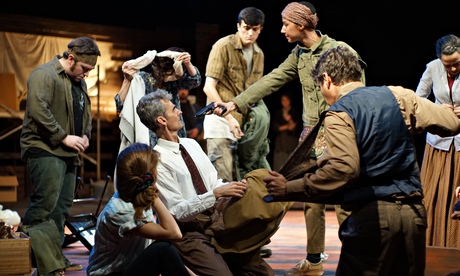
But even if what Edgar is saying is just a provocation, I’m really not sure that talking about an “anti-writer trend” is either true or helpful. After all, the adaptations of The Curious Incident of the Dog in the Night-Time or Let the Right One In are still distinctly scripted plays however many other tools have been utilised to make them. And why wouldn’t all theatre-makers – and that includes playwrights – use all the tools available to them that they find helpful for a particular piece of work? The danger is that Edgar’s statement sets up the idea that different kinds of theatre are in opposition to each other, and that the individual playwright must be at odds and in competition with those making work collectively or collaboratively or using other kinds of theatrical languages.
It’s not a case that one kind of theatre-making invalidates another or steals money and resources away from others. There is room for all comers and different ways of working because different is good and invigorating – and variety adds to the richness of our theatre culture. What suits some as a way of working will not necessarily suit others or perhaps only at particular points in their career for particular projects. Bryony Lavery can work fruitfully with Frantic Assembly and write plays entirely on her own, too. Doing one doesn’t mean you can’t do the other.
Does the fact that we have a variety of methods of working mean that the individual playwright with a singular vision is an endangered species? Of course not. You only have to look at the programmes of our new writing theatres to see that’s not the case. The fact that the Bush, the Royal Court and other theatres across the country may also programme other kinds of work, some of it made collaboratively, simply reflects the fact that most of those now directly involved in new writing understand that what is needed is a far wider and looser definition around what we mean by new writing. That doesn’t threaten the playwright; it potentially liberates and provides more opportunities.