
What was the first thing I did when I seized upon the idea of teaching body image classes in schools, back in 2007? Did I consult a leading psychologist? Did a produce a PowerPoint presentation visually documenting my own journey through bulimia, via anorexia and back again? Did I trawl the internet for celebrity quotes about their own myriad and often crippling insecurities?
The correct answer is (d) None of the above, because these techniques had been tried before and the results weren’t nearly as innovative or radical as I would have liked.
Instead, what I did was interview hundreds of teenagers to ask them how they’d like to discuss the issue. What they told me was that, in actual fact, they were weary of discussing it. What they wanted instead was some clarity, someone who could cut through all the crap and contradictory advice, give them some practical solutions they could really apply to their everyday lives without patronising, or assuming that the issues are a) universal or b) the same as when they were at school. It was from these suggestions that my body image class was born (THEN I went and consulted leading psychologists. Still no PowerPoint, though).
Today, having joined forces with Grace Barrett and Nadia Mendoza to form The Self-Esteem Team to deliver a wide range of lessons on mental health and wellbeing, it’s still the students we interact with who drive our agenda. We’re constantly tweaking, re-drafting and evolving our content in line with what young people are telling us. It’s an exhausting process, but instantly rendered worth it when we receive emails telling us our classes are “just SO relevant to my life”.
It’s hardly surprising, then, that when the time came for us to write our handbook for teens The Self-Esteem Team’s Guide to Sex, Drugs & WTFs?!! we once again let young people take the lead. The chapters each begin with one of the 20 commonest questions we’ve been asked in schools and colleges over the past decade, which we then go on to answer.
Here are seven of the questions occupying the minds of today’s teens - and our answers.
If I have high self-esteem will I become arrogant?
This is one of the only universal questions to span the generations, since we often get asked this by the parents we work with, too. It partially arises because the term “self-esteem” is currently being battered by a barrage of bad press, associated either with a narcissistic generation obsessed with selfie-taking, or hippies making a caring circle in a meadow while playing acoustic guitar and wearing crowns of daisies.
Contrary to popular belief, the most confident person in the room isn’t necessarily the loudest. In reality, self-esteem is relevant to squeezing the potential out of life, whether that’s in educational, vocational or social environments.
I don’t feel ‘right’.
This phrase is used particularly frequently among boys, who tend not to have developed the “emotional vocabulary” to identify whatever emotion they’re experiencing. The problem then becomes convincing them that they are entitled to feel however they do, even if there aren’t any dramatic circumstances that have given rise to their general sense of unease.
It isn’t normal or healthy to be cheerful 100% of the time and a big part of growing up is learning to detect and deal with negative emotions before the fester and become toxic.
How do I know if I’m healthy?
There’s a veritable sea of (often contradictory) health and lifestyle advice out there on the web, usually masking the suspect agenda of attempting to sell bogus diet and fitness products. This has left young people confused. The Self-Esteem Team are often asked about “ideal” sizes and “normal” weights. Of course neither truly exists – health is a lifestyle, not a look and making smart choices which benefit our physical health is a lot simpler than advertisers, bloggers and instagrammers might have us believe.
Sexting – good idea?
This is one of those areas where schools tend to take a scaremongering approach (“YOU WILL GO TO PRISON FOR DISTRIBUTING CHILD PORNOGRAPHY!”). The problem with this is that, of course, not everyone who sexts goes to prison/loses their dream job/is the victim of revenge porn. These are potential consequences, but they are far from inevitable.
The real issue here is about respect – The respect the recipient has for the sender and the respect the sender is showing for themselves. If either of these are absent then sexting is conclusively a terrible idea.
What’s it like to take drugs?
Another example of a potential truth gap hazard because, of course, not everyone who takes drugs becomes an impoverished, addicted vagrant or suddenly and inexplicably believes they can fly and flings themselves out of a seventh storey window.
Of course, experimenting with illegal substances is invariably a daft idea, if only because they aren’t regulated, but the risk of actually dying is small so it’s far better to describe the realities of what it’s like to take drugs and the reasons why you might be tempted to get out of your box.
What’s the difference between porn and real sex?
Obvious to anyone who’s been doing it within the context of a loving relationship for a few years. Not so obvious if you’re a virgin whose lack of experience curiosity/hormones has led you to a site filled almost exclusively with entirely hairless, plastic-looking people ramming 15 inch monstrosities into bottoms with surprising ease for hours on end.
What will happen if I tell someone?
There’s still huge stigma surrounding mental health, fuelled in no small way by the prevailing media stereotype that all mentally ill people are either dangerous or entirely deranged and need to be dragged away in a straight jacket. For many young people the fear isn’t about saying the words, it’s what might happen afterwards. There are concerns about privacy – many don’t want their parents to know, either because of fear of “disappointing” them or because there is abuse within the home. Fear of being “taken away” from family or even a special announcement being made about their condition within the school are also commonplace.
Of course, until attitudes change, there is always the possibility that whoever a teen chooses to tell about their mental health struggles might freak out. The task now at hand is to challenge social mores, so that seeking help for issues of the mind is no more shameful than having a broken leg.
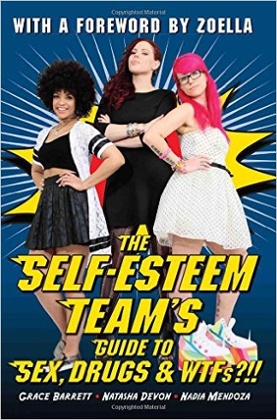
The Self-Esteem Team - Natasha Devon, Grace Barrett and Nadia Mendoza - travel the UK visiting around three schools, colleges and universities a week to deliver their award-winning classes on body image and mental wellbeing. To date, they have worked with more than 50,000 teenagers, as well as teachers and parents. Buy their new guide for teenagers - Sex, Drugs & WTFs?!! - at the Guardian bookshop