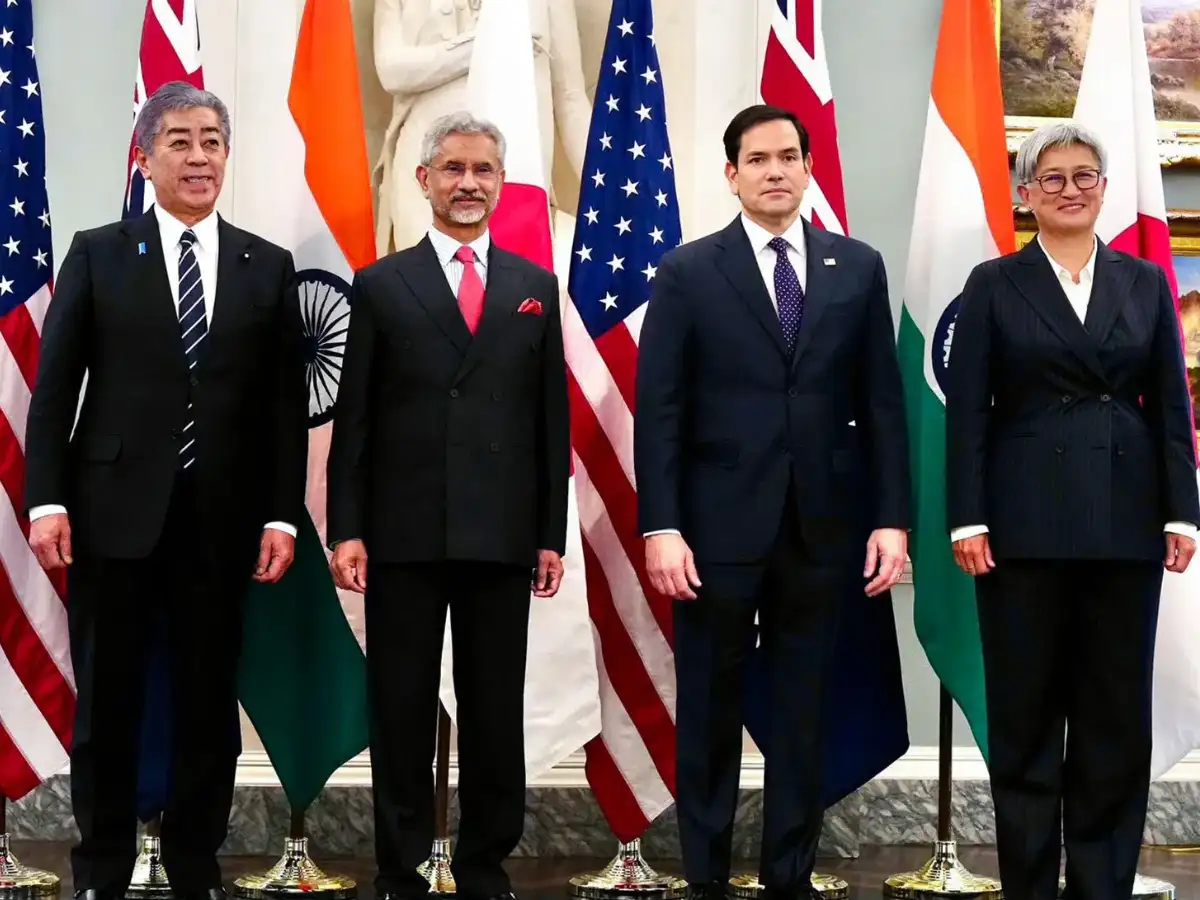
As Quad foreign ministers from Australia, India, Japan and the US met in Delhi on Tuesday, the grouping remains caught between two competing descriptions that have long shaped perceptions of its future. Chinese officials once dismissed the Quad as mere “ocean foam”, a transient and incoherent arrangement that would quickly dissipate, but later warned against it evolving into an “Asian NATO,” a US-led security bloc aimed at containing China.
These contrasting phrases reflect the central ambiguity surrounding the Quad -- whether it is a loose consultative platform or an emerging strategic coalition in the Indo-Pacific. Trump's transactional diplomacy has made it all the more complex.
Also Read: Quad’s 5-step push for Indo-Pacific cooperation unveiled at Delhi meeting
The Quad met in New Delhi at a moment when the grouping is facing its deepest strategic uncertainty since it was revived nearly a decade ago. The foreign ministers announced new initiatives on critical minerals, maritime surveillance, energy security, undersea cables and port infrastructure in Fiji, all aimed at demonstrating that the Quad still has operational relevance. Yet the bigger question hanging over the meeting was political rather than institutional. Can a grouping originally revived to balance China retain coherence when the US itself appears to be softening its strategic posture toward China?
The Delhi attempt to show momentum
The Quad foreign ministers’ meeting in Delhi was carefully designed to project continuity and relevance. The announcements were deliberately practical rather than ideological. There was no dramatic anti-China declaration and no attempt to revive the earlier language of democratic solidarity against authoritarianism. Instead, the emphasis was on functional cooperation.
The most visible announcement was the Quad’s first joint infrastructure project: a port initiative in Fiji. The choice of Fiji is strategic. The Pacific Islands have become a major arena of competition between China and Western powers, especially after China expanded infrastructure financing and security engagement in the region over the past decade.
The Quad also unveiled a Critical Minerals Initiative Framework that aims to mobilise up to $20 billion in government and private investment for mining, processing and recycling critical minerals. The framework reflected growing anxiety over China’s overwhelming dominance in rare earths and mineral supply chains. The initiative proposes coordinated financing tools, regulatory cooperation, geological mapping, recycling ecosystems and potential common approaches to unfair trade practices.
Also Read: India, US seal critical minerals and rare earths pact amid global supply chain race
Another announcement involved energy security. The Quad launched an Indo-Pacific Energy Security initiative with a focus on stable energy markets, resilient supply chains and protection of maritime routes such as the Strait of Hormuz. The proposed Quad Fuel Security Forum is intended to institutionalise coordination during energy shocks.
On maritime security, the Quad expanded the Indo-Pacific Partnership for Maritime Domain Awareness and launched the Indo-Pacific Maritime Surveillance Collaboration initiative. These mechanisms are designed to create a more integrated maritime picture across the Indian Ocean and Pacific through surveillance sharing, information fusion and common operational awareness. This is strategically important because the Quad increasingly sees maritime data integration as one of the most effective ways to counter grey-zone Chinese activities without formally militarising the grouping.
The meeting also highlighted undersea cable resilience, 6G standards, Open RAN telecommunications, digital identity interoperability and AI-enabled agricultural technologies. In many ways, the Quad may now resemble a techno-economic coalition more than a traditional security bloc.
Still, one absence stood out. There was no announcement of a leaders’ summit. The joint statement merely said the ministers look forward to a future summit. That omission reinforced perceptions that the Quad’s political momentum remains weak.
How the Quad emerged
The Quad’s origins lie in the aftermath of the 2004 Indian Ocean tsunami. India, the US, Japan and Australia coordinated disaster relief operations with remarkable efficiency. That experience created the first template for strategic cooperation among the four maritime democracies. Japan’s Shinzo Abe was the first leader to give the grouping a geopolitical shape. Abe viewed the Indo-Pacific as a single strategic theatre linking the Pacific and Indian Oceans. He feared China’s growing naval reach and wanted a coalition of democracies capable of preserving balance in Asia. The first Quad dialogue emerged in 2007 alongside the Malabar naval exercises. But the grouping quickly faded. Australia withdrew after Chinese pressure and because many members feared appearing openly anti-China at a time when economic engagement with Beijing was booming.
The Quad’s revival came in 2017 under Trump’s first administration. Ironically, Trump’s first term gave the grouping its strongest political momentum. His administration framed China as a strategic competitor and elevated the “Free and Open Indo-Pacific” concept into a central pillar of US policy. The Quad gradually expanded beyond diplomacy. It began discussing supply chains, critical technologies, maritime awareness, vaccines and infrastructure financing. Under Joe Biden, the Quad became even more institutionalised. Leaders’ summits became regular. Working groups proliferated. The Quad Vaccine Partnership during the pandemic gave the grouping a developmental dimension.
By 2024, the Quad appeared to have evolved into the most important minilateral framework in the Indo-Pacific outside formal alliances.
Why Trump’s second term changed the equation
The shift began after Trump returned to office in 2025. The problem was not that the US abandoned competition with China altogether. Rather, the nature of competition changed.
Trump increasingly framed foreign policy through transactional bilateral bargaining rather than coalition-building. His tariff wars affected allies as much as rivals. Australia faced tariffs despite a free trade agreement. India faced renewed friction over trade and Russian oil purchases. Japan became uneasy over pressure tactics linked to investment and trade deals.
At the same time, Trump’s diplomacy with China softened. His summit with Xi Jinping in China and his repeated references to a US-China “G2” generated alarm across Indo-Pacific capitals. Analysts began asking whether the US still viewed coalition-based balancing against China as central to its strategy. The US National Security Strategy issued in late 2025 reportedly gave the Quad only passing mention. That mattered symbolically because the Quad had earlier been portrayed as a cornerstone of Indo-Pacific strategy.
India began cautiously stabilising ties with China after years of confrontation following the Galwan crisis. Modi’s engagement with Xi at the SCO summit in Tianjin signalled that India did not want permanent hostility with China, especially when trust in the US appeared less certain. Australia recalibrated economically. China remains Australia’s largest trading partner and Australia became increasingly uncomfortable with Trump’s tariff-driven economic nationalism. Anthony Albanese’s outreach to China reflected not a strategic realignment but hedging behaviour. Japan also started diversifying. It remains deeply tied to the US alliance system but has grown wary of excessive dependence on unpredictable US leadership. Japan’s outreach to China in trade and travel reflected strategic caution rather than strategic surrender.
The result is that all three US partners now hedge simultaneously between strategic balancing and economic accommodation with China.
Is the Quad losing its original rationale?
The Quad’s original rationale was never formally stated but always implicitly understood: balancing China without creating a NATO-style alliance. That logic now faces a contradiction. If the US itself pursues accommodation with China in certain domains, then the strategic clarity underpinning the Quad weakens.
But that does not necessarily make the Quad irrelevant. The Quad is increasingly evolving into something different from what it originally appeared to be. Instead of an embryonic military coalition, it is becoming a flexible platform for economic security, technological coordination and maritime resilience. This transition is visible in today’s announcements. There was little emphasis on military deterrence. Instead, the Quad focused on critical minerals, ports, energy systems, digital standards and undersea cables. This reflects broader geopolitical reality. None of the Quad members wants direct military confrontation with China. Even at the height of strategic tensions, the Quad carefully avoided collective defence commitments.
What holds the grouping together today is not ideological alignment but converging anxieties about supply chain dependence, maritime coercion, technological vulnerability and Chinese economic leverage. In that sense, the Quad may survive precisely because it is informal. Its lack of treaty obligations allows members to cooperate selectively without forcing strategic uniformity.
Can the US revive the Quad meaningfully?
If revival means returning the Quad to the sharp anti-China geopolitical posture of Trump’s first term or Biden’s Indo-Pacific strategy, that appears unlikely under current conditions. Trump’s own approach toward China has become too transactional and inconsistent to sustain that framework credibly. Moreover, the other Quad members no longer fully trust long-term US strategic consistency. That trust erosion is perhaps the single biggest challenge facing the Quad.
However, if revival means transforming the Quad into a practical coalition focused on economic resilience and regional public goods, then the Delhi meeting suggests the process is already underway.
The Quad still possesses significant structural advantages. Together, the four countries account for enormous technological capacity, financial resources and maritime reach. Their cooperation on semiconductors, telecommunications, maritime surveillance and critical minerals can create long-term strategic effects even without overt military coordination. The Fiji port initiative illustrates this emerging model. Rather than directly confronting China militarily, the Quad intends to compete through infrastructure standards and connectivity. Similarly, maritime domain awareness initiatives create strategic leverage without formal alliance commitments. By improving surveillance and information-sharing, the Quad can constrain coercive behaviour indirectly.
The challenge is political signalling. The absence of regular leaders’ summits weakens perceptions of cohesion. The Quad’s strength during 2021-24 partly came from visible leader-level chemistry and summit diplomacy. Still, some argue that quieter institutional coordination may ultimately prove more sustainable. Functional cooperation among bureaucracies, militaries and technology agencies can continue even when political leadership fluctuates. That may be the Quad’s future of less grand strategy and more practical coordination.
Where the Quad stands today
The Quad today is neither collapsing nor fully coherent. It occupies an ambiguous middle ground. China still sees it as strategically relevant enough to criticise. The joint statement’s references to the South China Sea, maritime coercion and freedom of navigation clearly indicate that China remains central to Quad thinking even when not explicitly named.
At the same time, the Quad lacks the political unity and strategic clarity it possessed between 2021 and 2024.
The grouping is entering a more pragmatic phase where cooperation survives but ambition narrows. Instead of becoming an Asian NATO, the Quad may evolve into a flexible strategic network focused on resilience rather than deterrence. Whether that counts as success or decline depends on perspective. The original vision of a tightly aligned anti-China democratic coalition has undoubtedly weakened. But the Quad’s ability to adapt into a looser but still functional framework may ultimately ensure its survival.
For the US, reviving the Quad meaningfully will require more than announcing initiatives. It will require restoring confidence that American strategy in Asia is stable, coalition-oriented and not subordinated to short-term transactional diplomacy with China. Until that happens, the Quad is likely to remain operational but strategically tentative. It will be active enough to matter but still adrift.