I spent yesterday afternoon at the grandson's fifth birthday party. Lovely stuff, of course, even if you don't particularly enjoy the spectacle of 18 tiny knights and fairies careering round a park whacking each other with plastic swords.
What's this got to do with politics? Quite a lot if the advance publicity for Gordon Brown's latest government relaunch – whoops, we don't say relaunch any more – is accurate.
We live only two miles from the grandchildren, which helps towards a viable family support network. Working-class families that have been scattered by well-meaning social housing policies that don't acknowledge kinship networks don't enjoy this luxury.
Nor do lots of people; I realise that. But families divided by mobile careers and other distance factors are not in quite the same boat as entrenched communities divided by policy.
One of Brown's aims, a bit late you may feel, is to restore to local authorities the right to set their own council housing priorities, giving greater attention than they have done to local links, family ties and jobs as well as to those who have been on the waiting list for longest.
A whole raft of new individual "rights" are expected to replace the target-driven approach to policymaking, the theory being that the "right" to private cancer treatment if the NHS doesn't act within a certain amount of time – or the "right" to private tuition if little Jimmy fails to thrive – will be more effective levers on the performance of those paid to provide public services.
It's all part of the Blairite choice-and-consumerist model of society, which has become fashionable in recent years despite the frequent efforts of then-chancellor Brown to obstruct it.
It has survived the car crash in the private sector, banks, credit cards, the whole consumer edifice – rightly so in my view, though the mechanisms work worst for the poorest. Who's going to pay for it has also become an urgent question in both public and private sectors, one which ministers and their political rivals seem in no hurry to answer.
According to today's advance publicity (a borderline case for Speaker Bercow to complain about using the media, not parliament?) one ulterior motive for the housing policy shift is to win back white working-class voters who have been alienated by the priority often given to homeless immigrant families and asylum seekers.
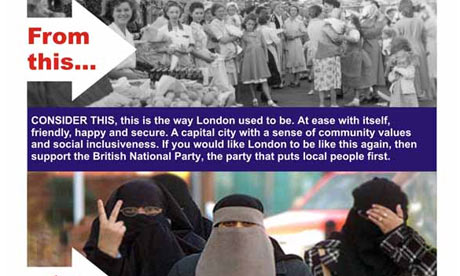
They are supposedly the kind of people who drifted off to the BNP in the 4 June elections, winning them two elections. Anti-racists are complaining in today's Guardian that the Crown Prosecution Service isn't robust enough in prosecuting scurrilous racially inflammatory leaflets. It's what happens when you win elections: you get more attention.
Incidentally, I can't help thinking that the black-robed Muslim "woman" giving two fingers in the BNP flyer used to illustrate the Guardian article looks a bit masculine. Nick Griffin posing in a burka perhaps? I think we should be told.
But the point about housing policy has long struck me as an important one. Back in the 70s and 80s, so friends who live or work in social housing recall, the pressure from grassroots radical groups – on the left – was to force councils and housing associations to give priority to the neediest, that is to say the homeless and dispossessed, often immigrant families.
That was a reaction to the fact that existing points-based policy reinforced the claims of existing community networks. You could see why it happened, but it was hugely disruptive: young mothers separated from mum (quite possibly from gran too) via bad bus services (no designated space for baby buggies in those days) just when mum was most needed.
No wonder perhaps that we have developed a disruptive underclass, that small minority of feral, alienated kids. Every little helps – or hinders, and affluence is no guarantee. You could spot potential trouble among the tiny knights and fairies in the park yesterday.
We will learn more about "Building Britain's Future" – Labour's latest fightback – by nightfall, though Peter Mandelson was on the breakfast airwaves providing a silky gloss, quite like old times. He sometimes sounds now like the last man standing.
But there are difficult balances to be struck across the schools, hospitals, crime and other policy agendas. Do we approve, for example, of Ed Balls replacing school league tables with "report cards"? They sound a softer option. Brown has a weakness for tactical measures that fail to impress.
But it's always good to see competitive politics in action. If Labour can raise its game at this stage in the cycle, others must raise theirs too, even if today's non-relaunch proves to be a dead cat bounce.