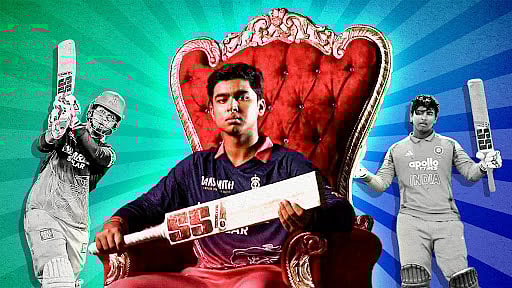
In 2011, the year India conducted its last full census, Vaibhav Suryavanshi was born in Samastipur district of Bihar, a state long seen as peripheral to the power centres of Indian cricket – often convincingly, and at times condescendingly, described as its backwaters. Fifteen years on, with the next census now underway, that landscape has shifted, if only incrementally, even as the media universe around the sport has transformed far more sharply. Faster, more restless. Suryavanshi’s emergence as a teenage sensation in the Indian Premier League sits squarely within that shift, even as he remains yet to arrive on the international stage and in the longer, more exacting formats of the sport.
This moment frames the central dilemma: is he being heralded too early, or does caution risk missing the revelation of a generational talent? That tension acquires an added layer in light of his admiration for Brian Lara, a batter whose legacy of elegance was matched by the tenacity to build enduring innings in Test cricket – the ultimate examination that still awaits Suryavanshi.
In early readings of his approach, the signs point to a kind of box-office appeal. It draws attention instantly, holds it, and often bends the game around moments of impact. That very quality, so central to his rise, also frames a quieter dilemma. The methods that make him compelling are, at present, well suited to conditions that reward early assertion – true surfaces, limited time, and formats that privilege intent over endurance. His strengths are evident: quick hands, sharp bat speed, and an ability to read line and length early enough to commit with conviction. The repertoire of shots, on both the off and leg sides, is evident, and steady head positioning enables him to attack bowlers like Hazlewood, Boult and Bumrah without losing body balance. That’s far from slogging; there are far more hints of a discerning sense of timing.
But the question that follows is unavoidable: does he possess another register when IPL conditions and surfaces are taken out of the equation? The immediacy that defines him today, if not complemented by an ability to adapt – to wait, to recalibrate, to construct – could allow the very appeal that elevates him to begin to confine him. The distance from his chosen ideal, Brian Lara, becomes instructive here – not in terms of flair, but in the capacity to carry that flair across time, formats, and increasingly difficult conditions.
The reading becomes more complicated in the environment in which it now takes place. He is not emerging into a vacuum of observation, but into a hyperactive media space where performance is instantly converted into narrative, and narrative into expectation. This environment also sharpens attention around players from non-traditional regions, where his teenage appeal becomes an additional layer to that fascination. Each innings is clipped, circulated, debated, and at times concluded upon within minutes. The cycle of assessment has shortened dramatically, and what once unfolded over seasons is now compressed into moments. In such a space, the distinction between noticing a talent and declaring it becomes increasingly fragile.
The contrast, in the Indian context, is not merely nostalgic; it is structurally grounded in how reputations were formed. When Sachin Tendulkar emerged as a teenager, he was first spoken of for his performances in the longer format in the domestic circuit, particularly the Ranji Trophy, before being fast-tracked into international cricket at 16 – a baptism by fire against the pace battery of Pakistan in the winter of 1989. In those early days, the attention around him also carried the markers of youth – a boyish face, curly hair, the fascination of a teenage presence. But his batting reputation did not arrive in advance of performance; it was built innings by innings. It took shape in demanding conditions, most notably in his hundred at Old Trafford in seaming English conditions, and was then announced with authority on the fast, bouncy surface of Perth in 1992. The arc was gradual, forged against difficulty rather than projected ahead of it.
Virat Kohli, in contrast, was not a teenage sensation in the same sense; his rise to superstardom was gradual, built on sustained excellence, most notably through his commanding performances in Australian conditions and his eventual redemption in England in 2018 after the setbacks of 2014. That trajectory, too, was earned over time, across conditions. Where Suryavanshi stands in relation to such benchmarks remains uncertain. The game has seen early projections before – players like Prithvi Shaw, whose initial promise led to expectations that, in time, appeared to have been announced too early, at times flattering to deceive.
Suryavanshi, by contrast, is yet to encounter that phase. Recognition, in his case, must remain distinct from conclusion.
If the present moment is defined by acceleration – of attention, of expectation, of narrative – then what lies ahead for Vaibhav Suryavanshi will be defined by resistance. Not resistance in the sense of opposition alone, but in the demands the game will place on him when conditions are less accommodating. As his exposure widens, so will the scrutiny: opposition bowlers and support staff will study his method closely, identify possible chinks in his armour, and devise strategies to test them across conditions. What appears fluent in one setting can be unsettled in another; technical certainties may be challenged, and patterns of scoring disrupted.
Cricket offers enough precedent here. Players like Daryll Cullinan, a South African batter whose arrival carried high expectations, saw their methods repeatedly exposed by sustained tactical probing from Australian attacks and, to an extent, in English conditions as well, with similar patterns emerging across different environments. In these phases, a batter is often found out – not conclusively, but enough to demand adjustment.
The question then extends beyond repertoire. It begins to involve temperament: the ability to absorb failure without distortion, to recalibrate method without losing identity, and to sustain clarity when early success gives way to more uneven returns. The early surge of recognition can be heady, but the game rarely moves in a straight line. Form shifts, conditions vary, and the capacity to adapt – mentally as much as technically – becomes as decisive as any stroke in the repertoire.
For now, a safe way to read Vaibhav Suryavanshi is to hold both possibilities in view. The appeal is evident, the early promise difficult to ignore, and the attention, in many ways, justified. The game he is yet to play, the conditions he is yet to encounter, the adjustments he will be required to make, will ultimately shape the meaning of his rise far more than the immediacy that has defined it so far. Cricket, particularly in its longest form, has a way of restoring proportion. It stretches time, tests method, and places a premium on technical solidity and tenacity over impulse.
Between early recognition and lasting achievement lies a distance that cannot be shortened by narrative alone. Suryavanshi has already shown how to command attention; whether he can convert that attention into authority, across formats and over time, remains the question. That question, for now, is best left open.
In almost every early ambition, there is a trace of a schoolboy’s imagination – of rehearsed moments, of strokes played in the mind long before they are executed in the middle, an almost surreal unfolding. In that sense, some part of what Vaibhav Suryavanshi is doing now may resemble what he has already seen himself doing, in quieter hours, away from the noise.
The game, in its fuller demands, will ask for more than the fulfilment of those early visions. It will take him to surfaces, conditions, and contests that require a different order of response – over time, through adjustments, through the slow acquisition of technical craft and mental resilience. His admiration for Brian Lara gestures in that direction: a batter who was not only a poet with the bat, but also, when the game demanded, a patient craftsman.
It is perhaps in that balance that Suryavanshi’s journey will find its truer measure. The dilemma persists for those watching closely: whether to read what is already visible as arrival, or to wait for what is yet to be tested.
Complaining about the media is easy. Why not do something to make it better? Support independent media and subscribe to Newslaundry today.
Elections are not just about who wins, but about the questions that often go unasked – and this time, they matter more than ever. Support our new NL Sena on the five upcoming assembly polls to help us follow the missing voters, the shifting politics, and the stories that could shape India’s future.
Newslaundry is a reader-supported, ad-free, independent news outlet based out of New Delhi. Support their journalism, here.