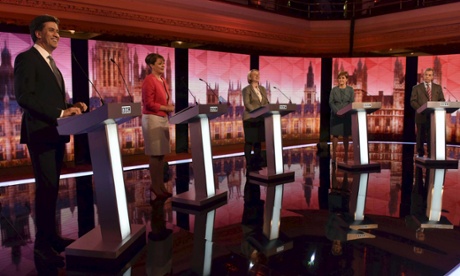
It was one of the most Googled questions during the challengers’ debate screened by the BBC on Thursday night: where was David Cameron?
What does Cameron say?
The prime minister claims he was not invited. Speaking before the debate, he said: “I’m a polite individual and if I’m not invited, I’m not going to try and gatecrash it.” This line was repeated by William Hague, the former foreign secretary, in the post-debate spin room.
Nick Clegg, the deputy prime minister, had made a similar argument, saying he was not asked to come along.
What does Ed Miliband say?
Miliband says Cameron chose not to come along and did not have the guts to debate him head to head. He received cheers from the audience as he questioned why the prime minister was not on the platform.
What does the BBC say?
The BBC has yet to respond to Cameron’s claim. However, it issued a statement after Clegg said he was not invited.
Over many months the broadcasters, jointly, have worked hard to ensure that their audiences were offered the best possible combination of programmes to help them engage with the election, to inform them about the issues and to scrutinise the politicians.
The programmes which have been agreed – including the BBC debate on the 16th – involved all sides, broadcasters and parties, making a number of compromises, allowing the different elements to go ahead.
For each of the broadcasters, ensuring due impartiality is not only a priority but an obligation, and the BBC is satisfied that the election programmes it is offering on each of its services fulfils that obligation and that all the relevant parties will have the opportunity to put their case and to be appropriately scrutinised.
What is the truth?
Cameron is clearly being somewhat economical with it. The main piece of evidence for this is that the prime minister had already made clear he would take part in only one debate, and certainly nothing that took place during the short campaign period. This had been his position since at least 2012 when he complained that the 2010 format sucked the life out of the campaign.
In other words, there was no point issuing a formal invitation to a debate that he had already made clear he would not attend.
Downing Street clearly rejected an original proposal from the broadcasters inviting the prime minister to three debates – one with five parties, one with Miliband and Clegg, and one head-to-head with Miliband. This was dismissed by the Conservative negotiators for a variety of reasons, including the argument that it was unfair to exclude the Green party (who were later invited).
After weeks of wrangling, the prime minister’s director of communications made a “final offer” that Cameron would take part in “one 90-minute debate between seven party leaders before the short campaign”.
There were threats to “empty-chair” Cameron, with all the other parties carrying on without him. But the broadcasters did not appear to be brave enough to show an empty podium and a compromise solution was found: a seven-way debate, a challengers’ debate and two interview-style events.
All the parties signed up to this agreement, meaning the Conservatives and Lib Dems at the very least acquiesced to the idea of not being invited to the challengers’ debate.