
/Bristol-Myers%20Squibb%20Co_%20logo%20on%20building-by%20tatu%20Campelo%20via%20iStock.jpg)
New Jersey-based Bristol-Myers Squibb Company (BMY) is a global biopharmaceutical giant focused on discovering, developing and delivering innovative medicines for serious diseases, with core areas including oncology, immunology, cardiovascular conditions and blood disorders. Bristol-Myers Squibb commands a powerful presence in oncology, led by blockbuster immuno-oncology therapies including Opdivo, Opdivo Qvantig, and Yervoy, among others.
With a market capitalization of around $100.3 billion, Bristol-Myers comfortably sits in the “large-cap” tier, a class that generally includes companies valued at $10 billion or more. Through a strong pipeline supported by global clinical research across severe and immune-mediated conditions, Bristol-Myers aims to continue delivering breakthrough medicines for patients with unmet needs.
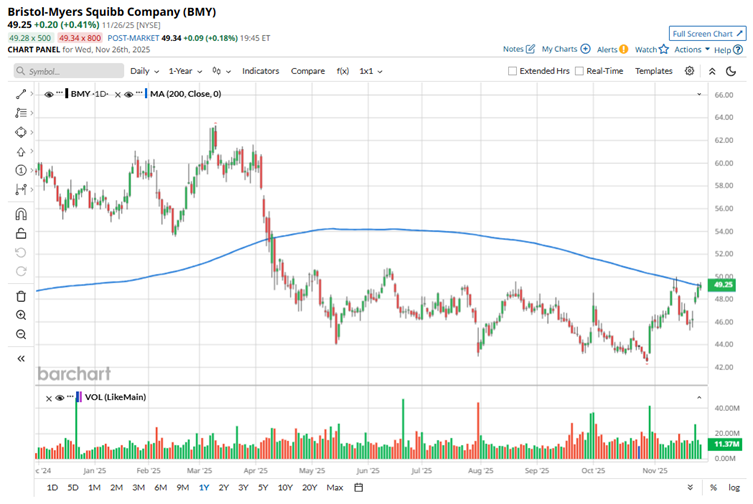
Even with its strengths, Bristol-Myers hasn’t quite won Wall Street over lately. Over the past three months, BMY has gained only about 4.3%, trailing the broader S&P 500 Index’s ($SPX) 5.1% return during the same stretch. After peaking at a 52-week high of $63.33 in March, the pharma stock has since dropped roughly 22.2%.

The long-term picture doesn’t offer much comfort either. Over the past 12 months, BMY is down about 16.2%, and so far in 2025, shares have tumbled roughly 13%. Meanwhile, the S&P 500 has surged, up 13.4% over the past year and is up another 15.8% in 2025.
After spending months stuck below its 200-day moving average since April, BMY has finally climbed back toward that key technical level. The stock has been hovering right near the 200-day moving average mark since the start of this month, a potential sign that momentum may be shifting in a more positive direction.
Bristol-Myers continues to feel the sting of generic competition eating into its older blockbuster franchises, including Revlimid, Pomalyst, Sprycel and Abraxane. In the company’s Q3 earnings update on Oct. 30, management reported that the revenue from its legacy portfolio fell 12% year over year to $5.4 billion, driven largely by sharp generic erosion in Revlimid. Even solid demand for Eliquis couldn’t counter the broader decline.
Fortunately, the picture looks much brighter in the company’s growth portfolio. Next-generation therapies such as Reblozyl, Camzyos, Breyanzi and Opdivo fueled an impressive 18% year-over-year revenue increase to $6.9 billion, reinforcing that Bristol-Myers’ future success hinges on the rising strength of its innovative pipeline.
Bristol Myers’ underperformance stands out even more next to rival Amgen Inc. (AMGN). While BMY has struggled to gain traction, Amgen has surged, climbing 23.1% over the past year and an impressive 32.2% year-to-date, leaving BMY stock trailing far behind.
With the stock struggling to gain traction, analysts aren’t rushing to turn bullish. Bristol-Myers currently has a consensus “Hold” rating from 29 analysts, and its average price target of $52.52 implies only about 6.6% upside, signaling tempered expectations for a near-term rebound.