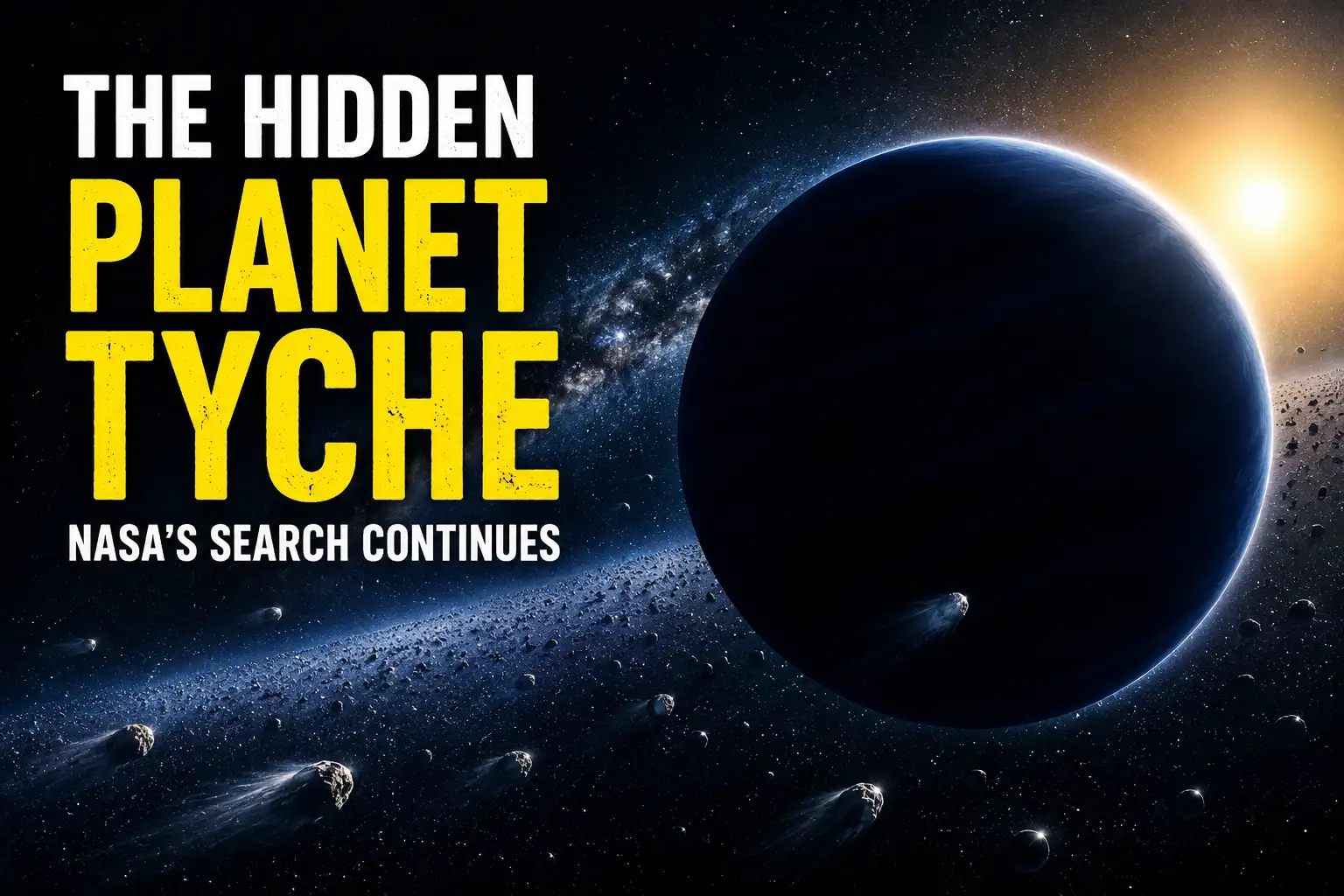
For over two decades, the mystery of the Tyche planet held the imagination of astronomers worldwide. Proposed in 1999, the Tyche planet theory suggested that a gas giant four times the mass of Jupiter was hiding deep inside the Oort Cloud. Scientists wondered if an undiscovered world was silently pulling distant comets off course. Although NASA eventually disproved the original claims, the Tyche planet debate changed how we look at the cosmic edge.
Understanding this debate requires stepping back into the history of planetary discovery. Science moves forward by chasing shadows until better data clears them away. The story of this phantom world is a masterclass in how human curiosity tests the boundaries of physical reality.
The Origins of the Tyche Planet Hypothesis
The story of the Tyche planet began with an intriguing gravitational puzzle. In 1999, astrophysicists John Matese, Patrick Whitman, and Daniel Whitmire published a compelling observation.They noticed that long-period comets were not entering the inner Solar System from random directions.Instead, a disproportionate number of these icy wanderers appeared to originate from a specific, inclined band in the night sky.
The researchers argued that a massive body, dubbed the Tyche planet , was responsible. They theorized that its immense gravitational pull was constantly nudging icy debris out of the cold outer reservoir. Named after the Greek goddess of fortune, this hypothetical giant was imagined to orbit at a staggering distance of roughly 15,000 astronomical units from the Sun.That is nearly 500 times farther than Neptune.
At such extreme distances, the orbital period would span nearly 1.8 million years.It was a bold idea, but it rested on sound celestial mechanics.
Why Astronomers Suspected the Tyche Planet Existed
Astronomy has a long, proud history of discovering unseen worlds through mathematics before ever laying eyes on them. Neptune was famously discovered in 1846 because its gravity tugged on the orbit of Uranus. Mathematician Urbain Le Verrier pointed his pen at the sky, calculated where an invisible planet had to be, and observational astronomers found it the very same night.
In a similar way, researchers hoped the Tyche planet would explain lingering anomalies at the solar edge. Proponents argued that the Tyche planet could be a cold, Jupiter-like world composed mostly of hydrogen and helium.Because it was located so far from solar warmth, it would reflect almost no visible sunlight, making traditional optical telescopes completely blind to it.
Yet, skepticism remained high across the scientific community. Many astronomers warned that the sample size of known comets was simply too small to prove the Tyche planet existed. They suggested that the apparent clustering of comet orbits was an illusion caused by observational bias. The debate highlighted a fundamental tension in science between recognizing subtle real patterns and misinterpreting random noise.
How NASA Tested the Tyche Planet Science
To settle the debate, astronomers needed an instrument capable of peering into the freezing darkness of the deep Solar System. While the world would reflect almost no sunlight, its massive interior would still retain faint residual warmth from its formation billions of years ago. To find it, scientists had to look in infrared light.
In December 2009, NASA launched the Wide-field Infrared Survey Explorer, known as the WISE space telescope. WISE scanned the entire sky in four infrared wavelengths, mapping millions of faint thermal sources. If the planet was out there, WISE was designed to detect its heat signature.
By 2014, NASA published the comprehensive results of the WISE sky survey.The outcome was clear and unambiguous.The infrared survey ruled out any giant world, officially disproving the Tyche planet as originally theorized. The cosmic ghost was finally laid to rest by hard empirical data.
The Legacy of the Tyche Planet Search
Science rarely ends with a simple negative result. Falsifying a hypothesis is not a failure of scientific curiosity. Instead, it is a triumph of the scientific method in action.
While the Tyche planet was disproved, the core idea that massive undiscovered worlds exist in the outer Solar System lives on. In 2016, astronomers proposed the Planet Nine hypothesis to explain the strange orbits of extreme trans-Neptunian objects in the Kuiper Belt. Unlike the older proposal, Planet Nine is thought to be a smaller ice giant, roughly five to ten times the mass of Earth, orbiting much closer than the distant Oort Cloud.
The long search for the Tyche planet reminds us that knowledge is built by ruling out wrong answers. As philosopher Karl Popper observed, science progresses through conjectures and refutations. By testing bold ideas against precise observations, we strip away illusions and come closer to reality.
The hunt for unseen worlds beyond Pluto continues today with advanced observatories like the Vera C. Rubin Observatory. Though the search for this lost world yielded no physical discovery, the journey to disprove it brought the outer edge of our Solar System into much sharper focus.