The iron ore giant founded by billionaire climate crusader Andrew "Twiggy" Forrest isn't backing away from its plans to mine a mineral vital for green steelmaking, despite losing millions on the operation.
Fortescue metals and operations chief executive Dino Otranto on Thursday dismissed a suggestion the miner curtail its Iron Bridge magnetite mine in the Pilbara to stem three years of cash losses and free up capacity at Port Hedland for other iron ore shipments.
"We're going to keep ramping this up, mate," Mr Otranto told an earnings briefing on Thursday.
"We believe in the asset. We believe it's a differentiator in terms of our products. For the next year or so now, it's full steam ahead."
Fortescue, which is chaired by Mr Forrest, had put a lot of capital into Iron Bridge.
"It's a personal ambition of a lot of people here to get this thing now cranking up to full capacity, and that's what we're going to do. And we'll make cash on it on the way through," Mr Otranto said.
Magnetite feedstock creates fewer carbon emissions during steelmaking than hematite, the iron ore predominantly mined in the Pilbara, because it has a higher iron content and fewer impurities.
But Iron Bridge was beset by billion-dollar cost overruns during construction and has never operated profitably or achieved its nameplate capacity of 22 million tonnes since opening in 2022.
Fortescue on Thursday predicted the mine would produce just 11 to 14 million tonnes of magnetite in 2026/27 and lowered its estimated value of the money-losing asset, taking a $US525 million ($737 million) non-cash impairment on it.
That writedown, combined with $150.1 million in compensation that Fortescue was ordered to pay the traditional landowners in May, led to Fortescue's statutory net profit coming in 15 per cent lower than a year ago.
It made $US2.86 billion ($4 billion) in the 12 months to June 30.
Excluding the court case and the Iron Bridge impairment, Fortescue's underlying profit rose three per cent to $US3.5 billion ($4.9 billion).
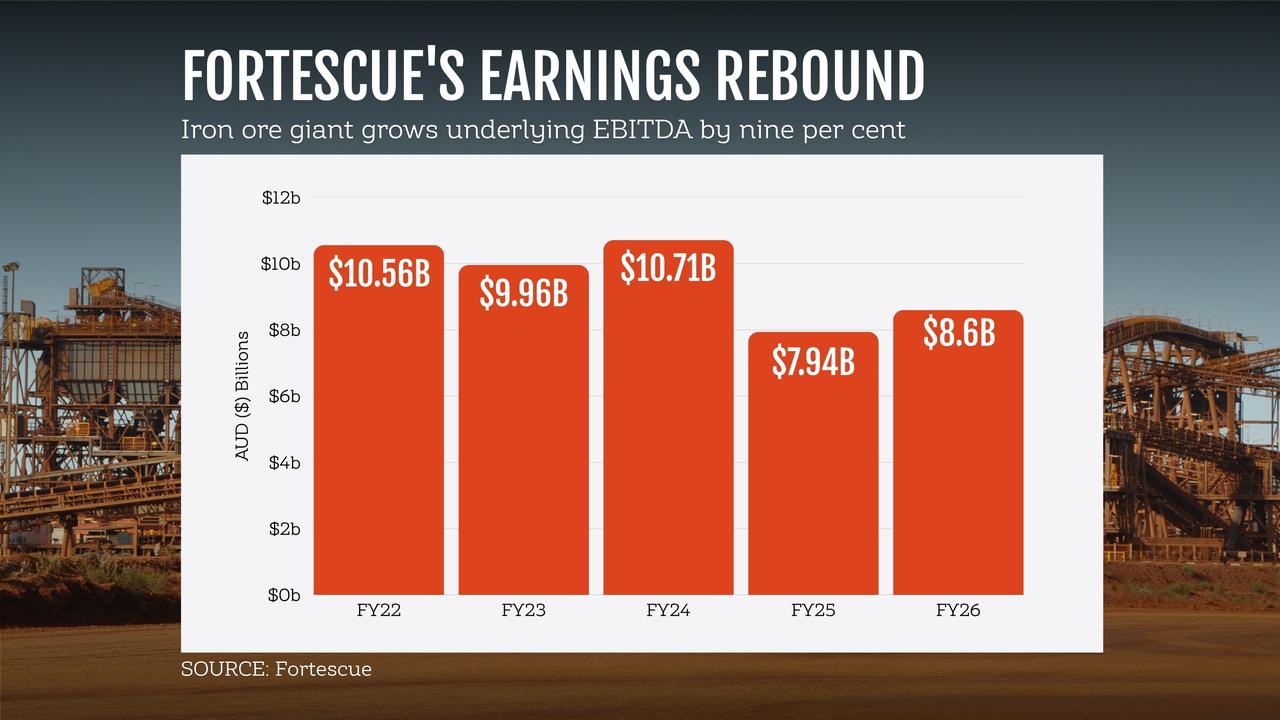
Its underlying earnings before interest, tax, depreciation and amortisation climbed nine per cent to $US8.6 billion ($12.1 billion).
Fortescue said the compensation claim represented a $US73 million ($102 million) hit to its bottom line.
The Federal Court ordered the $150.1 million payout to the Yindjibarndi Ngurra Aboriginal Corporation on May 12 after the company dug up millions of tonnes of iron ore from their lands without their permission.
Fortescue, which had the permission of both the government and a different Aboriginal group it had backed, didn't address the court case on Thursday.
But it did note that it had awarded $1 billion in contracts to Aboriginal businesses in 2025/26.
Fortescue also faces a different legal matter, a class-action lawsuit brought by female employees who allege widespread sexual harassment while on remote worksites.
Mr Otranto said that in 2025/26, Fortescue dismissed 11 employees for sexual harassment or discrimination after investigating 29 alleged complaints.
"Our top priority is our people and sexual harassment and unlawful discrimination and any behaviour that makes people feel unsafe have no place here," Agustin Pichot, Fortescue's chief executive for growth and energy, said.
Fortescue's full-year earnings were in line with expectations, RBC Capital Markets analyst James Redfern said.
The company ended the year with US$5.1 billion ($7.1 billion) in cash and a net debt of just $0.9 billion, Mr Otranto said.
"That puts us in a strong position to continue investing in growth while delivering returns to shareholders," he said.
Fortescue will pay a fully franked final dividend of 46 cents per share, taking its full-year dividends to $1.08, down from $1.10 last year.
Fortescue shares on Thursday afternoon were changing hands for $18.08, up 0.1 per cent from Wednesday's close.