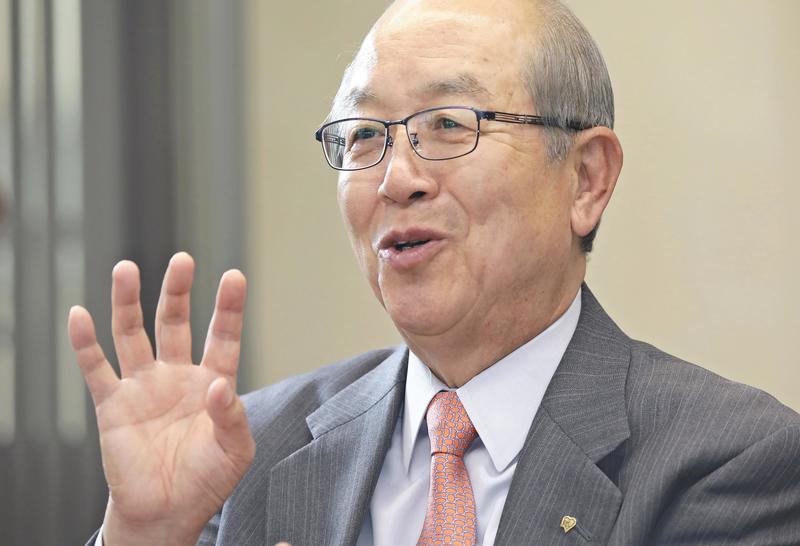
Starting out as a small local factory dealing with plastic materials, Iris Ohyama Inc. now aims at becoming a 1 trillion yen company also developing home appliances. In this installment of Leaders, a column featuring corporate management and senior executives, The Yomiuri Shimbun spoke to Iris Ohyama President Kentaro Ohyama about the driving force behind the company's growth.
The corporate image of Iris Ohyama is probably quite different depending on the generation to which one belongs.
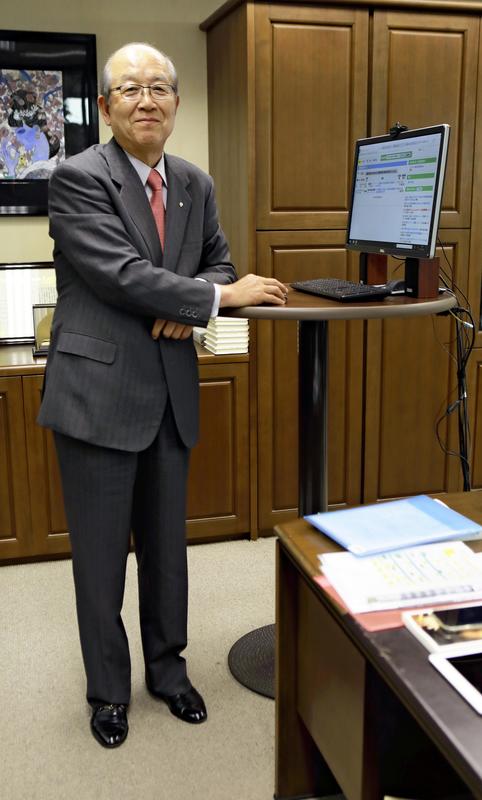
Iris Ohyama deals in a range of goods, from garden and pet products to home-use products such as storage boxes that allow one to see what is being stored inside. We have also been successful with LED lighting, and home appliances have become a mainstay in recent times.
The form that the company has taken has continued to change. We have continued to grow by opening up new markets. I call this a "demand-creation type of company."
[It all started in 1958 when his father, Morisuke Ohyama, set up a small factory called Ohyama Blow Industry in Higashiosaka, Osaka Prefecture. After turning into a manufacturer of buoys for the fishing industry, the business evolved into a format they call the "Maker/Vendor" system, a combination of both manufacturing and wholesaling.]
One of the secrets to the company's expansion is ideas -- in particular, the uniqueness of our viewpoint. The principle of "user in management," which involves thoroughly considering products from the perspective of the consumer, is fundamental to us.
Allow me to express it more simply. We go all out to develop the kinds of products that respond to the needs and questions of daily life, as expressed in comments like: "How convenient it would be to have this kind of function!" or "It would make the job so much easier if I could do this!"
A recent example is our futon dryer. It takes a lot of work to open up the bag that blows out the warm air and place it between the futon's comforter and quilted mattress. Elderly people find it tougher than you would expect. So we changed the large hot-air bag to a nozzle, which you just push in between the comforter and the mattress. People liked it for being easy and convenient, and it got more and more popular through word of mouth.
It is the same thing with our rice cookers. You just pop in the rice, and the cooker will automatically measure the amount of water needed. The top and bottom sections can be separated so that the top section functions as a container for cooked rice and the lower one is an induction-heat cooker. This is also an idea that we got by thinking from the consumer's perspective.
Don't you think that it is surprisingly easy? We work together to extract ideas that solve life's inconveniences by always asking: Why? How come? The next step is to acquire the technology to bring this into reality. That's the important part.
We changed glass fishing buoys, which crack easily, to light plastic ones that don't break easily. In the past, household storage boxes had been only about storage, but we made them transparent, which made it easy to look for things and to get them out. Both of these products were big hits. The company has always adapted to changes happening in the world.
I would like to make another important point, which is the sense of good value. This does not simply mean cheap. It's important that consumers feel surprised about finding good products at great prices. We gauge that level by using our experience and intuition.
Even so, there are many people in management who don't understand this sense of value. They plunge into unnecessary price wars or try to create products that are expensive and good quality. But there are a lot of consumers who are not after things like that.
Once the price -- which represents good value -- is fixed, the stage is set for "subtraction management." How do we keep production costs down in order to be able to sell at the price we have decided on? This is all about management skill. Most companies practice "additive management." They calculate their costs, add on their profit, and decide the price. You can't win by doing that.
Losing commercial rights
[Ohyama's father discovered he had cancer when Ohyama was in his final year of senior high school. He was the oldest son, with seven brothers and sisters. Ohyama abandoned his dream of going to school and becoming a film director and decided to carry on the family business.]
It seemed that my father wanted me to keep studying because, when he was lying in the hospital bed, he would often ask me what I wanted to do about university.
I lied to him, saying that I hadn't passed the exams and so I was going to cram school. But I was actually going to the factory behind our house every day.
I was a greenhorn with neither technology nor capital nor sales capacity. I had to take every kind of contract I could get -- with a smile on my face -- even if it was a tough and brought little profit.
Then there were all the sorrows of being a subcontractor. Business practice in those days was for the company who puts in the order to bargain over the supply price every six months. Objecting to it meant an end to trading together. You just had to accept it. Even though you would expect both sides to be equal in the business world, the relationship between major companies and subcontractors was one of subordination. Bit by bit, I found myself no longer able to stand it. This is what pushed me to become a manufacturer, developing products like the plastic fishing buoys myself.
[On top of that, they were hit by a big wave. Two oil shocks. After skyrocketing, prices collapsed in a major way for plastic products. In the space of two years, they lost the assets they had spent 10 years accumulating.]
This was a massive blow to us because we were dealing 100 percent in plastic products. With tears in my eyes, I let employees go. It was especially hard to dismiss five people who had supported the company from the day it was founded. They understood the situation, so they didn't complain. I was moved.
Another thing that I felt keenly was the fragility of running a business as a manufacturer who leaves the distribution up to wholesalers.
A wholesaler with whom I thought we shared a good relationship suddenly changed its attitude, started beating the price down, and stopped doing business with us. The commercial rights that we had been spending time building were lost in an instant at the whim of the distributor. Of course, I bear no grudge. Everyone was desperate to stay alive.
While the situation couldn't have been helped, I did learn that I couldn't protect our commercial rights and brand unless I controlled the wholesaling function myself --where, what, and in what quantities to sell wholesale. This is what spurred me to aim at a form of business where we also wholesaled, to become a Maker/Vendor type of manufacturer.
We took 20 years to build the system. We are able to trade directly with chain stores nationwide. By reducing the intermediate distribution costs, we are able to reduce the final price. We are able to position our products in a very detailed way in accordance with different regional needs. This is a system that allows us to take advantage of the merits of multi-product production, which is one of our characteristic features, and it functions as a great support for the business.
Information gets thin, distorted
Iris Ohyama doesn't have medium-term planning. Circumstances surrounding consumption change instantly; trends change all the time. A plan decided on a year ago is useless to us. Contemporary management is all about speed.
[From morning until evening on Mondays each week, they spend more or less a full day on new product development meetings. In principle, all managerial staff from President Ohyama down and section manager level up are obliged to attend.]
I think it's really important to share information about things like company policy and the basic thinking style at the top. Whether it goes top-down or bottom-up, information becomes thin as it gets passed along, and sometimes it even gets distorted.
At the meetings, I have new products presented in front of me and I point out their pros and cons, together with areas for improvement. If my staff hear this, it means that even in situations where there is trouble making a decision when visiting our trading partners, they never end up saying something as awkward as "I'll take it back to the company and consult with my boss." This is why these meetings are so important to us.
Looking back, I can see that my time was a lucky time. The baby-boomer generation was the generation just below me. If we came up with the kinds of products that we felt that we wanted, a new market would follow along. In a new era, it is vital to have new methods.
Moving forward, we can expect online shopping to become mainstream. The long tail is a characteristic feature of the internet, which means how many products we have is our lifeline. In this respect, we are in an advantageous position as manufacturers, with the more than 20,000 products that we have. As we are also vendors [or wholesalers], we have distribution bases all around Japan. An increasingly product-oriented age is coming. We have the foundation in place that will allow us to survive it.
-- Kentaro Ohyama / President of Iris Ohyama Inc.
Born in Osaka Prefecture in 1945. Took over the family business at the age of 19, becoming the representative of Ohyama Blow Industry (now Iris Ohyama). Expanded development and product lines, entering the home appliances market in recent years. Grew a small subcontractor factory into a global company. On July 1, he will transfer the presidency to oldest son, Akihiro Ohyama, and will become chairman with the right to represent the company.
-- Key Numbers: 50% 1,000 products
In order to be constantly developing new fields, Iris Ohyama aims at maintaining a situation in which new products account for more than 50 percent of sales. New products are those released within the past three years. The 1,000 products figure refers to the number of new products that are released each year. The company's total number of products comes to 20,000. In 1972, the company expanded to Miyagi Prefecture as its production base for eastern Japan, with the head office moving to Sendai in 1989. It is not listed. Total sales for the Iris Group, which comprises 25 companies including overseas companies, are approximately 420 billion yen. Approximately 12,000 employees work for the group.
Read more from The Japan News at https://japannews.yomiuri.co.jp/