In 2011, Kim Haughton noticed a man standing outside St Mary’s Pro-Cathedral in Dublin dressed in a clerical collar and fake devil’s horns. His name was John Deegan, and he was a survivor of sexual abuse. Every Sunday, Deegan protested outside the church at the failure of the Roman Catholic hierarchy in Ireland to deal with evidence of widespread child abuse by priests.
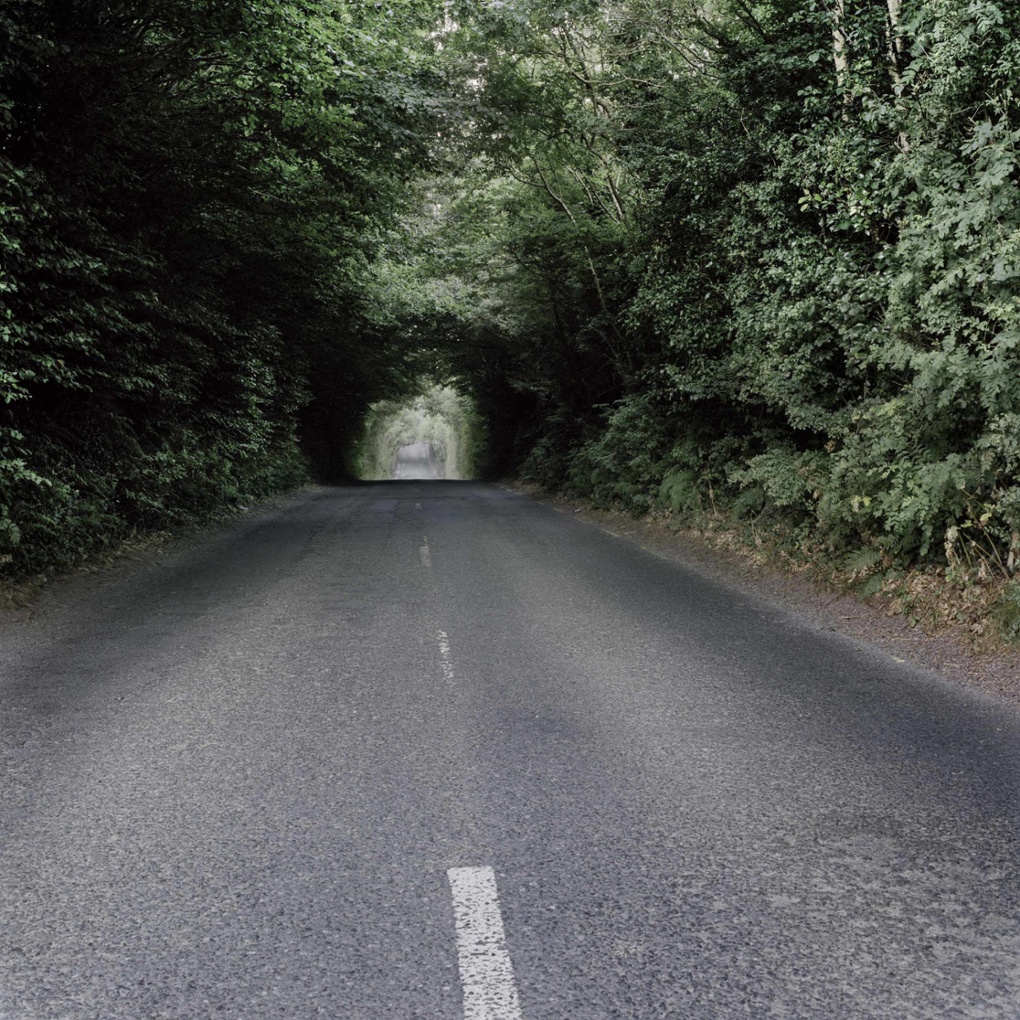
“I ended up chatting to him,” remembers Haughton, a photographer whose work appears regularly in the Guardian. “That’s when the seed of the idea for In Plain Sight was planted.” It began to grow soon after, she says, when she visited her parents in Donegal, where she met a retired garda detective who had been investigating paedophilia around Gweedore. “We drove around country lanes and byroads, past deserted beaches and empty car parks, all the places where child abuse had taken place,” says Haughton, “and that’s when the project really took shape in my head.”
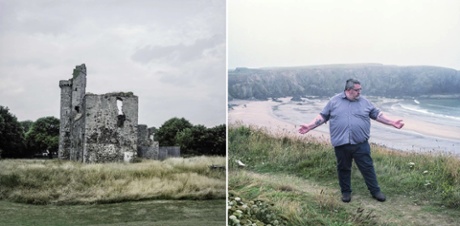
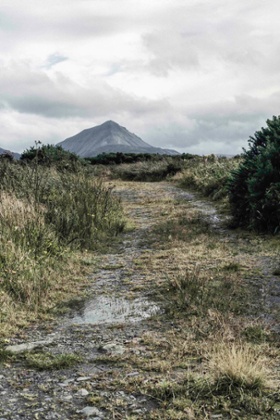
In Plain Sight merges portraiture and landscape to powerful effect, evoking an Ireland that is a kind of shadowland, a place where the ordinary and the picturesque are both familiar, yet loaded with dark meaning. A grass-lined lane leading to a mountain in rural Donegal is quintessentially Irish in its still, empty beauty. It was here that Martin Gallagher was abused by Father Eugene Greene, who spent nine years in prison for similar crimes against 26 young boys over a 20-year period. A ruined castle close to the main street of Fethard-on-Sea, County Wexford, speaks of Ireland’s contested history, but it is also the site where Father Seán Fortune took young Patrick Bennett up into the belfry and sexually assaulted him. Fortune killed himself in prison in 1999, while awaiting trial on 66 charges of sexual abuse against 29 boys.
Perhaps most shocking of all is Haughton’s interior shot of the altar of St Patrick’s church in Monageer, Wexford, its immaculately polished wooden floor divided by a long strip of red carpet. It was here, beneath the tabernacle containing the Eucharist, that Father Jim Grennan sexually assaulted several young girls as they were preparing for their confirmations. He abused them on the altar while listening to their confessions.
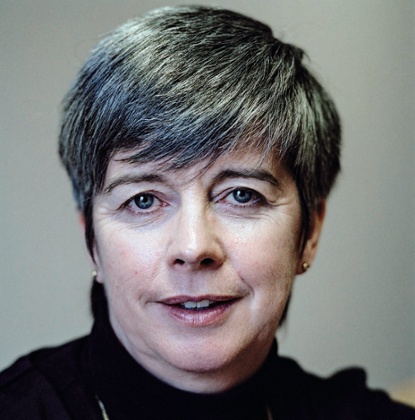
These are landscapes and interiors where the commonplace and the monstrous co-exist, even if the latter is invisible to most locals. “Kim’s photographs show how each of these places are essentially innocent,” says Louise O’Keefe, a woman from Kinsale, Co Cork, who was abused aged nine by her primary-school principal in 1973. “One can go for a walk and pass an old building or a beach or a lay-by and these places are, in themselves, ordinary. Equally, you might have children who play there or explore there, so you have the innocent child and the innocent place. One person can have the power to destroy that innocence, to defile the place and turn it into a crime scene, and to potentially destroy the life of the victim. So, we pass these places every day, unaware of their secrets – and that is how it should be. And yet …”
O’Keefe successfully sued the minister for education and the Irish state for negligence, having taken her case to the European Court of Human Rights after it was dismissed by Ireland’s supreme court. Like Haughton, she thinks even more needs to be done to break the silence around child sexual abuse in Ireland. “There is still a sense that the state authorities, the church and the school system would like it all to go away, and for everyone to move on. It is important to have exhibitions as powerful as In Plain Sight, because they bring another level of understanding to the immensity and complexity of an issue that, for the victims, never goes away.”
For Dave Dineen, the childhood experience of being abused physically by his mother and sexually by his brother in a council house in Ballyphehane, Cork, informs the work he now does as founder of the Lámh Healing foundation. The group helps others come to terms with the often devastating effects of child abuse. To measure the extent of Dineen’s extraordinary journey, one has only to listen to his testimony – Haughton has recorded the recollections of several of her subjects. “It is not for the faint-hearted,” she warns me. Dineen’s words do indeed echo in my head for days.
In one brooding landscape, titled The Graveyard, Haughton frames an ancient yew tree looming over Deansgrange cemetery, Dublin. This is where Fiona Doyle was raped as a child by her father. Her testimony reads: “He wouldn’t say anything. He didn’t lie me down, it was up against a tree, and all I remember is the fear – the fear of somebody coming along and catching us.” Doyle had her portrait taken at the cemetery by Haughton. “It was the first time she had been there in 33 years,” says Haughton. “It is moments like that when you feel such a weight of responsibility, and you hope your work can somehow carry that weight.” It does.