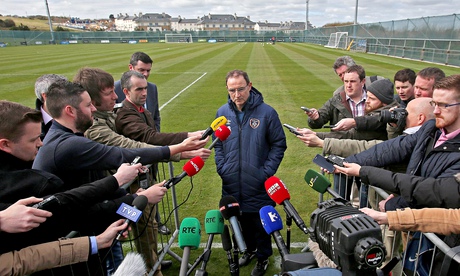
Home advantage has been a rather alien concept to the Republic of Ireland in recent years. The team’s best performances came on the road under Giovanni Trapattoni, and Martin O’Neill goes into tomorrow’s match against Poland in Dublin knowing that his side need to prove they can be inhospitable hosts.
Since the opening of the Aviva Stadium on the site of the old Lansdowne Road in 2010, Ireland have yet to enjoy a landmark victory against highly rated opponents at home. “I hear this talk about the players not getting results at the Aviva in the past couple of years but you can change that with one game, one fantastic performance,” said O’Neill.
The former Leicester and Aston Villa manager has taken charge of just one competitive home match since his appointment in November 2013 and although that yielded a 7-0 victory over Gibraltar, the feebleness of the opposition meant the result did not establish the Aviva as a fortress. By contrast, a win against the Group D leaders Poland would certainly do the trick, as well as re-ignite Ireland’s attempt to qualify for next summer’s European Championship following the 1-0 defeat to Scotland four months ago. That loss took the gloss off the previous two good results, victory in Georgia and a draw away to the world champions, Germany.
“The importance of the occasion shouldn’t be missed,” said O’Neill of the meeting with Poland. “I’ve said all along that games at home will shape our destiny. This is a very important one against a team that have started off brilliantly in the competition. It might not decide everything but it is very important. It would be a big dent in proceedings if we were beaten so we have to try to win.”
Poland are not quite at full-strength - they will be without their usual full-backs, Artur Jedrzejczyk and Lukasz Piszczek – but they still represent a formidable obstacle to the Irish. In an effort to stimulate more creativity from his team, O’Neill has been experimenting with different formations in training this week, raising the possibility that he will start with a 3-5-2 system. That would have the twin merits of giving Ireland greater protection against Poland’s main threats – the strikers Robert Lewandowski and Arkadiusz Milik – while also freeing up Seamus Coleman and Robbie Brady to raid forward as wing-backs.
“Genuinely everything is possible,” says O’Neill. “We have to be aware that if we change the system the players will know. Some players have played that system at club level, other players take a wee bit more adapting. Like everything else there are advantages with it and of course there are pretty obvious flaws. Adapting to it is the most important thing.”
O’Neill also has difficult personnel decisions to make. After dropping Robbie Keane for the clash with Scotland, the manager may turn back to the 34-year-old, who insists he remains as determined as ever and is convinced he can add to his 65 international goals. “I wouldn’t be here if I didn’t think that,” says Keane. “I think I’ve helped myself because of the way I keep myself and because of the hunger and desire that I have. If you don’t have that and don’t still want to be the best and score goals, you’re not going to do too much. I had it when I made my debut 17 years ago and I still have it. I’ll do it until I can hardly walk, that’s how much I love the game.”