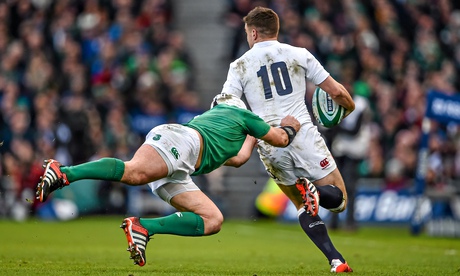
Not for the first time in a World Cup year, England went to Dublin with high hopes – favourites in some minds – and came away without much other than the knowledge it will be at least another year before they get a chance of a first grand slam since 2003.
It wasn’t as demoralising as the 30-point beating of 2007, but Stuart Lancaster is an honest man and he got it just about right when, seconds after the final whistle, England’s head coach admitted: “We didn’t fire a shot in that first half.”
What Lancaster didn’t have to say was that while Johnny Sexton was on the field England were second best, the fly-half doing for 52 minutes what he does better than anyone else playing Test rugby. It wasn’t until he limped off holding his hamstring, to be replaced by Ian Madigan, that England sensed they might be in with a shout.
Unfortunately by then they were 19-3 behind and the Leinster man’s comparative lack of precision when rated on the Sexton scale hardly mattered. In those 52 minutes the template had been set. In fact it took only eight and even though England got through to half-time only 9-3 down, a bigger beating than 19-9 looked on the cards with all of England’s back three looking increasingly vulnerable to the array of kicks which Sexton has at his command.
You only have to compare and contrast something seemingly as simple as the kick-off or restart to see how Ireland scored. In those eight minutes England had kicked off three times and got it wrong, each time.
There was nothing wrong in targetting Simon Zebo, because the Munster wing can’t or doesn’t kick. Unfortunately for England, the Irish, their coach Joe Schmidt and their playmaker, Sexton, had read the script. Only once was the ball kicked out and on the other occasions the pressure was put right back on England.
From Zebo, the Irish took the ball through two phases into centre field and when the clearance came it wasn’t to any of England’s back three – Alex Goode, Jack Nowell and Anthony Watson – who presumably had spent most of the week rehearsing what to do under the bomb. Instead the kick was on George Ford and the pressure was put on the England fly-half, who wasn’t having such a good day with the boot himself.
Instead of Cardiff, where he and the scrum-half Ben Youngs forced Wales either to turn under the kick or take man and ball, making it difficult to run the ball back, in Dublin they tended to invite Ireland’s players on to the ball and, with so many of them grounded in Gaelic football, that was asking for trouble.
Add a couple of lineouts conceded – in fact two on the bounce and both when they should have formed attacking platforms – and England hardly got any ball. Worse still the scrum, seen as the great attacking tool, were being neutered with Mike Ross, considered a potential weak link, more than standing his ground against Joe Marler, the man favoured to do the damage.
Not until Ross departed after close on an hour’s hard graft did England get a nudge on. The Irish scrum won a couple of penalties – one when that was clearly the way they saw of getting themselves out of a bit of rare territorial trouble. Rare indeed, because when Ireland were in a spot of difficulty their exit strategy – getting away from their own line – was as polished as the kicking game which has become a real attacking tool, much as it is for the All Blacks.
If Sexton doesn’t hoof it away with his right foot, Rob Kearney does the business with his left or Conor Murray takes bite-sized pieces of territory with his box kicking in his burgeoning role as Sexton’s half-back partner.
They are not yet equals but Murray has a good nose for a try. On Saturday we spoke of the try he set up for Tommy Bowe against South Africa in the autumn. Yesterday he picked out Robbie Henshaw, signalling that, with a penalty already on its way, the ball was going behind Goode and into the corner where the 6ft 3in Connacht centre (another with a Gaelic background) would have an advantage over the 5ft 11in Saracen, especially as Goode had to run backwards.
If that was where the game was won and lost, it’s also worth pointing out the return of Courtney Lawes will be good news for England while an end to Joe Launchbury’s neck problems will be even better.