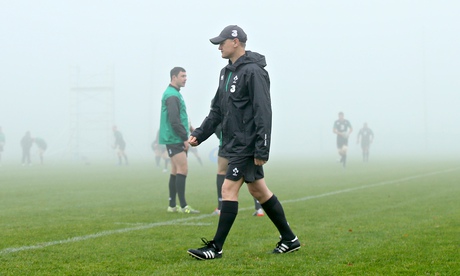
The only surprise in the buildup to Saturday’s afternoon’s match between Ireland and Australia at the Aviva Stadium has been on the political front. Why, some people are asking, has the Irish government never called on Joe Schmidt to work his magic on the massed ranks of the disgruntled?
The New Zealander has enjoyed a longer and happier honeymoon than any other overseas coach in either rugby or football in Ireland. If he gets one over on Saturday on his opposite number, Michael Cheika – the man he succeeded in Leinster in 2010 – it will be Ireland’s first clean sweep of a three-Test November series since 2006 and Schmidt’s 10th win from 13 Tests since he took over this time last year.
As with his Leinster career, it started slowly: three defeats from his first four league games at club level, and then two from three with Ireland. Since then his team have gone on to a Six Nations Championship and are narrow favourites to avenge the defeat by Australia 12 months ago, in Schmidt’s second game in charge.
When he stepped up to the international game it was wondered how such a highly energetic, hands-on coach would cope with there being so few games each season. Evidently he has used the extra time well, for his detailed analysis of opponents is paying off in spades.
“Now that he has that time on his hands you can imagine the detail that’s going into it,” says the Leinster manager, Guy Easterby, who has worked with Schmidt. “The one that stands out in my mind was Leinster’s game against Biarritz in the Amlin semi-final two seasons ago. I think we had the ball three times in the first half and we scored off three set plays. Joe had assessed the situation and the way they defended and came up with the right play. And we nailed it every time. He’s doing the same now with Ireland and you can see it in the results.”
It’s not as if the players are handed their instructions in a playbook, the standard routine in professional rugby. Rather the details are posted in the team room and there is a limited window in which to view and learn. Stories are emerging from Camp Ireland of players sweating like exam students, which is apposite for a school teacher turned coach. “It’s very challenging for the players and it absolutely tests them but the proof of the pudding is in the eating,” Easterby says.
Currently Ireland are filling their faces. They prepared for this series against a mounting injury backdrop but by the kick-off in their victory over South Africa were short of only three certain starters. One of them – the hooker Rory Best – returns on Saturday afternoon, while the flanker Chris Henry’s return to action is unknown. He was withdrawn on the morning of the Springbok Test with what last week was diagnosed as a TIA, or mini-stroke, and is recovering well.
The challenge of Australia will be an interesting one for Schmidt, given that the Wallabies have played only three games under their new coach. Not that much has changed in their pattern, however, since the departure of Ewen McKenzie, so Schmidt will be expected to produce yet another unlocking device that works first time.
What is certain is that Cheika will have the wagons circled, with a gap left for Johnny Sexton. The fly-half got special attention from Cheika’s Waratahs against the Lions two summers ago, and with the coach looking to increase the mongrel factor Ireland’s playmaker can expect to be chased.
“There’s not a lot of grunt up front but Cheik’s got to put that into them,” says Alan Gaffney, now coaching at the Waratahs, who has served both Ireland and the Wallabies. “They’ve got to stand up and be counted. Nathan Grey hasn’t had much time to work with them on defence but with the Waratahs this year he had them getting off the line with great speed and that was one of the big differences with the way they played.”
The weather forecast for Saturday is cold but dry, which will be a relief to the away side, especially their explosive back line replacements of Will Genia, Kurtley Beale and Quade Cooper. Schmidt will be scheming to have Ireland’s noses in front by the time they appear.