LOS ANGELES _ An Iranian man who was barred from entering the United States under President Donald Trump's travel ban returned to Los Angeles on Thursday, the first person allowed into the country after a legal challenge to the White House's executive order.
Ali Vayeghan was aboard a flight from Qatar that landed at Los Angeles International Airport at 12:40 p.m. PST, said family members and attorneys who took up his case. A roar of approval went up from immigration attorneys and relatives who had gathered at LAX's Terminal 2 when it was announced that Vayeghan's plane had landed.
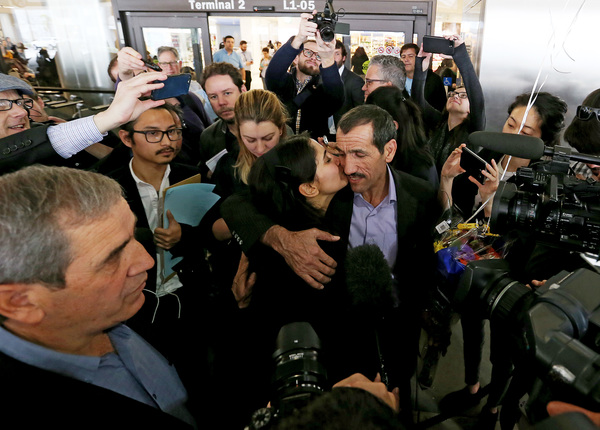
Vayeghan reunited with supporters around 1:30 p.m. after officials allowed him into the U.S.
Flanked by his brother and Los Angeles Mayor Eric Garcetti, Vayeghan was surrounded by a throng of journalists when he emerged. Asked how he felt, he responded in Farsi, which was translated by his niece: "This is what humanity looks like. This is what human rights looks like. I am shocked, honored and awed."

His arrival came shortly after attorney Talia Inlander, part of the legal team that fought for Vayeghan's return, spoke to reporters of his tortuous journey to the U.S. As supporters nearby held balloons and flowers, she blasted federal immigration authorities for turning Vayeghan away.
Garcetti, who has spoken out against the severe travel restrictions, was on hand to celebrate the news of Vayeghan's arrival, but warned the effects of the president's order continue to be felt.
"The moment we are about to witness should not be extraordinary," he said of Vayeghan's impending arrival.
A spokesman for U.S. Customs and Border Protection declined to answer questions about the case, and requests for comment sent to the Department of Justice were not returned.

Trump's order, which went into effect last Friday, bars people from seven predominantly Muslim countries, including Iran, from entering the U.S. for three months. It also imposed a four-month ban on refugees from any country coming into the U.S.
Vayeghan's return marked a dramatic reversal from last Friday evening, when the 61-year-old touched down at LAX just hours after Trump signed the executive order, setting off chaotic scenes in airports as confused federal officials scrambled to decipher the new rules.
Waiting for Vayeghan at the airport on that day was his brother, who lives in Los Angeles. The men had planned to spend a short visit catching up before Vayeghan continued on to Indiana, where he would reunite after 12 years with his son, a U.S. citizen.
The brother and other family members said they waited at LAX until after 3 a.m. Saturday, with scant information about his whereabouts.

The American Civil Liberties Union and L.A.-based immigration attorney Stacy Tolchin stepped in, filing a habeas corpus petition Saturday. Attorneys argued that Trump's executive order violated Vayeghan's due process and was hostile to a specific religion, Islam, putting it at odds with the First Amendment's establishment clause.
U.S. District Judge Dolly M. Gee granted an emergency temporary restraining order instructing that Vayeghan be allowed to enter the country, but it arrived too late. Vayeghan was put on a plane to Dubai in the United Arab Emirates on Saturday afternoon.
According to his brother and attorneys who had sporadic phone contact with him, Vayeghan was pressured by officials to sign documents that revoked his immigrant visa. Regretting the decision afterward, he resisted demands that he board a plane for Dubai and was carried to his seat, an attorney for the ACLU said.
Gee amended her order and instructed that U.S. officials were to return Vayeghan from Dubai and admit him to the country. Citing the "irreparable harm" Vayeghan would face if he was forced to go back to Iran, Gee ruled that his attorneys had showed a strong likelihood of successfully arguing that his denial to the U.S. violated federal law.
Instead, however, officials in Dubai placed Vayeghan on a plane bound for Tehran.