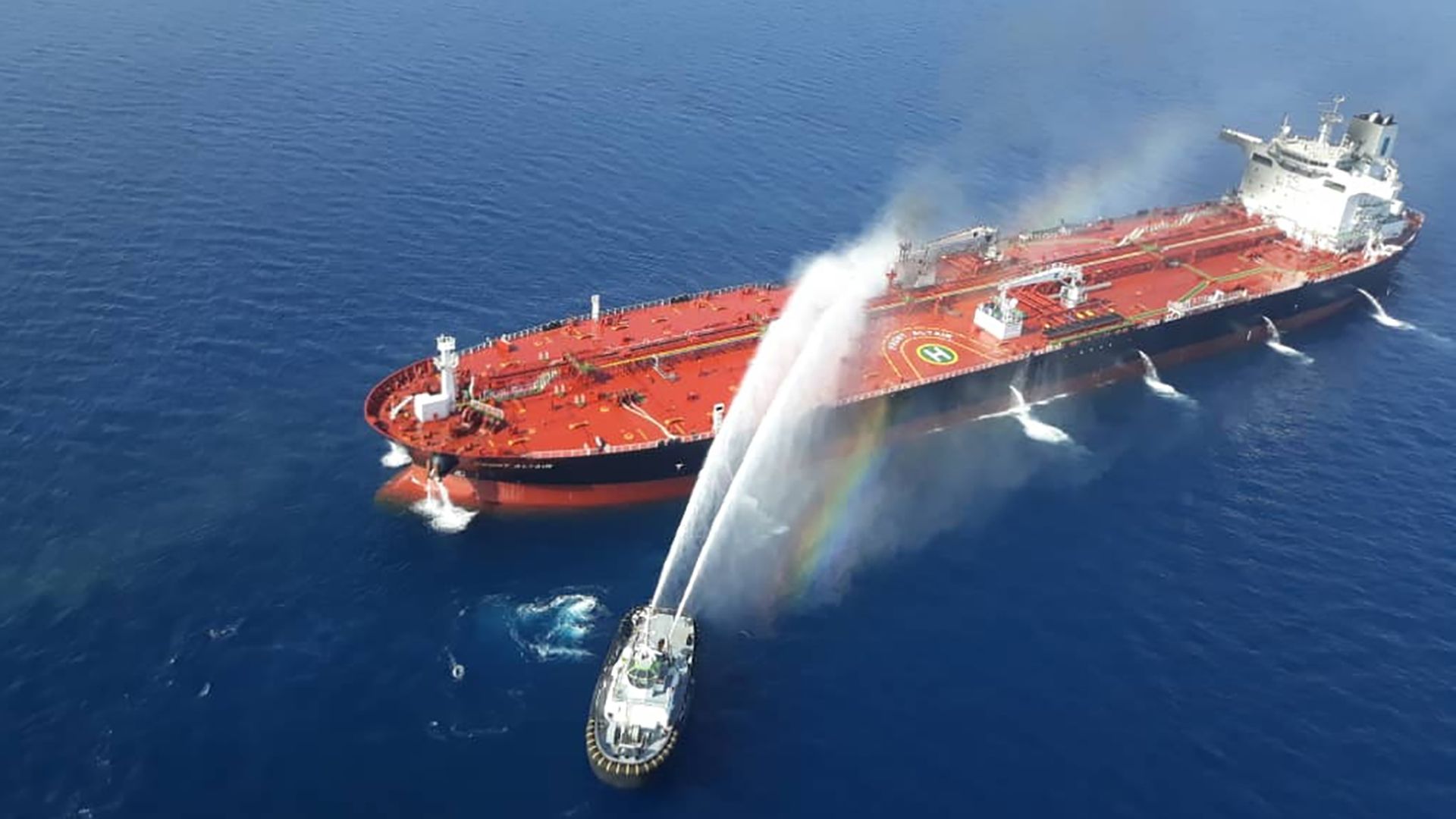
Two big forces are tugging on the global oil market: the weakening global economy and rising geopolitical tensions over tanker attacks in the Gulf of Oman.
Where it stands: The weakening economy is carrying a lot of weight despite the spike in tensions from the U.S. blaming Iran for yesterday's violence near the Strait of Hormuz, which is the world's biggest oil choke point.
- Prices, which rose after the attacks, dipped Friday as the International Energy Agency cut its estimate for 2019 oil demand growth to 1.2 million barrels per day.
- They've since recovered some ground but are still down overall this week.
Why it matters: The muted price response despite the tanker attacks is likely a sign of the faltering global economy.
- "World trade growth has fallen back to its slowest pace since the financial crisis ten years ago," IEA noted in its closely watched monthly report.
What to watch: Whether the economic headwinds or the threat of more and wider conflict will hold more sway. RBC Capital Markets' Helima Croft summed up the competing forces in a CNBC interview yesterday.
- The question this summer, she said, will be this: "What war is going to dominate the market? A trade war or a shooting war?”
What's next: Looking at 2020 for the first time, IEA sees demand growth recovering to 1.4 million barrels per day, "supported by solid non-OECD demand and petrochemicals expansion."
- But there's more than enough barrels to meet it thanks to growth from the U.S., Brazil and elsewhere.
- The report sees non-OPEC supply rising 2.3 million barrels per day in 2020.
But, but, but: Demand growth would be lower if U.S.-China trade battles worsen.
What they're saying: "A clear message from our first look at 2020 is that there is plenty of non-OPEC supply growth available to meet any likely level of demand, assuming no major geopolitical shock," IEA said.
- They call this "welcome news" for consumers and the vulnerable global economy, "as it will limit significant upward pressure on oil prices."
Winners and losers: As Bloomberg notes, the report underscores OPEC's struggles. IEA sees demand for OPEC's crude falling to 29.3 million barrels daily next year, which is 650,000 barrels below May's output.
Go deeper: U.S. releases video claimed to depict Iran removing mine from targeted oil tanker