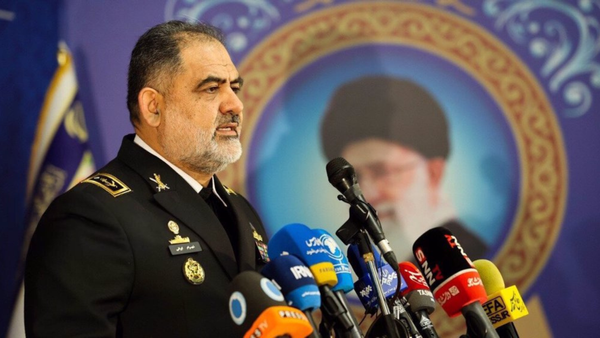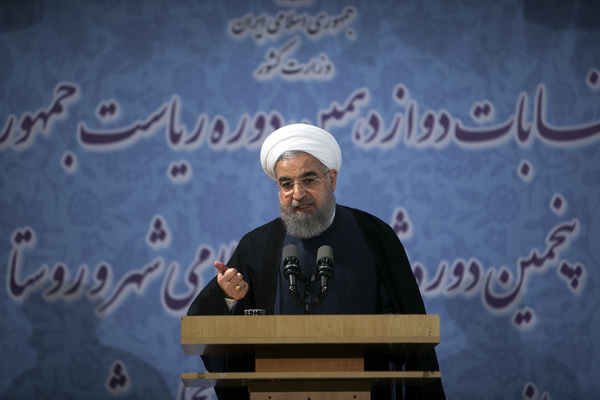
TEHRAN, Iran _ With Iran's presidential election weeks away and its beleaguered economy showing signs of improvement, the nation's ruling clerics seem uninterested in a new round of hostilities with the United States.
The Trump administration's escalating threats against the Islamic Republic have elicited muted responses from the theocracy and President Hassan Rouhani's government, signaling that the Tehran establishment may ride out the current wave of criticism from Washington.
Secretary of State Rex Tillerson this week accused Iran of destabilizing the world, compared it to the largely isolated but aggressive North Korea, which has a nuclear arsenal, and said the Trump administration was reviewing the U.S. decision to lift economic sanctions as required under Iran's 2015 agreement to curb its nuclear program.
At the same time, the Trump administration certified that Iran was complying with the nuclear pact, allowing what he once called "the worst deal ever" to be extended.
The agreement has helped Iran resume oil sales and solicit foreign investment to jump-start its economy, which had been all but disconnected from the world under one of the toughest sanctions programs ever imposed.
At the same time, analysts say, Iranian hard-liners believe that the U.S. is unlikely to withdraw from the deal and risk a diplomatic crisis with the five other signatories _ Britain, China, France, Germany and Russia.
Abdullah Gangi, editor of the Javan daily newspaper, a mouthpiece of Iran's hard-line Revolutionary Guard, dismissed Tillerson's remarks as contradictory.
"On one hand he and others in the U.S. administration confirm that Iran has abided by the terms of the nuclear agreement, and on the other hand they threaten Iran and draw parallels to North Korea," Gangi said.
"This is an absolute fallacy," he said. "The new U.S. administration tries to mask its own domestic problems and illegitimacy by accusing Iran of sponsoring terrorism or nuclear noncompliance from time to time. These are sheer lies and irrelevant."
Iran has long denied allegations that it supports an array of Shiite Muslim militant groups across the Middle East, including Hezbollah in Lebanon, Hamas in the Palestinian territories and Houthi rebels in Yemen _ all of which the U.S. opposes.
Tehran is also one of the staunchest allies of Syrian President Bashar Assad, whose forces the Trump administration targeted this month with missile strikes on an airfield in response to a suspected Syrian government chemical gas attack that killed dozens of people in a rebel-held town in Syria's Idlib province.
Foreign Minister Mohammad Javad Zarif, Iran's lead negotiator on the nuclear deal, tweeted that the United States' "worn-out accusations cannot mask its admission of Iran's compliance" with the nuclear agreement.
Analysts said Iran's ruling establishment, including Supreme Leader Ayatollah Ali Khamenei, doesn't want to raise tensions with the U.S. just as the economy is picking up.
This week, at the annual military parade to mark National Army Day, amid the usual menacing fanfare of hardware and missiles _ including one that carried the sign, "Death to Israel" _ the semi-official Fars news agency quoted Khamenei as telling a group of commanders: "Today, strengthening the economic foundation is the top priority of the country."
Tehran also showed restraint in its response to Trump's executive order in January banning citizens of Iran and several other Muslim-majority countries from visiting the United States. After a federal judge blocked the order, Iran granted visas to wrestlers from the U.S. to participate in a major international tournament in a move widely seen as a bid to lower tensions.
"While they want to keep their anti-American slogan as an undertone, they want more American tourists here in Iran and more Iranian students studying in America," said Nader Karimi Juni, a political analyst close to Iran's reformists.
Juni said Iran "is not following suit with North Korea," which test-fired a missile this week in a move that the Trump administration called a "provocation."
But Iran's response could change depending on the outcome of the May 19 presidential election. Rouhani, a relative moderate, remains popular despite concerns that ordinary Iranians are not reaping economic gains from the nuclear deal that he championed.
Although there are no reliable opinion polls in Iran, analysts say there is little sign that voters are tilting toward more conservative candidates in response to U.S. threats.
"This is rhetoric for American domestic consumption," said Ali Nori, a 50-year-old bread vendor distributing lavash in western Tehran.
But the National Iranian American Council, a Washington-based advocacy group that supports the nuclear deal, said Tillerson's comments "lend credence to hard-liners in Iran who warned of any negotiation with the United States and politically isolates Iran's voices of moderation."
Iran's interior ministry said Thursday that the Guardian Council, which oversees elections, had finalized the slate of presidential candidates. They include Rouhani, hard-line former judge Ebrahim Raesi and four other candidates.
Former President Mahmoud Ahmadinejad, who surprised many by filing papers to run last week, was disqualified. Though the council does not give reasons for disqualifying candidates, Khamenei had advised Ahmadinejad not to run again.
If a hard-liner wins, he might respond more forcefully to U.S. threats. That could also embolden members of Congress who support imposing tougher unilateral sanctions against Iran, which would torpedo Iran's nascent economic recovery and could provoke Tehran into resuming its nuclear program.
While most U.S. sanctions were lifted last year, the Treasury Department maintains financial restrictions against Iran for supporting terrorism and maintaining its ballistic missile program.
Iranian hard-liners say that new sanctions would amount to the U.S. breaking the nuclear deal. But they refuse to express concern.
"If the U.S. wants to turn the tables and drop the agreement, it is not a big deal," Gangi said. "Let America do it. Iran will not lose."