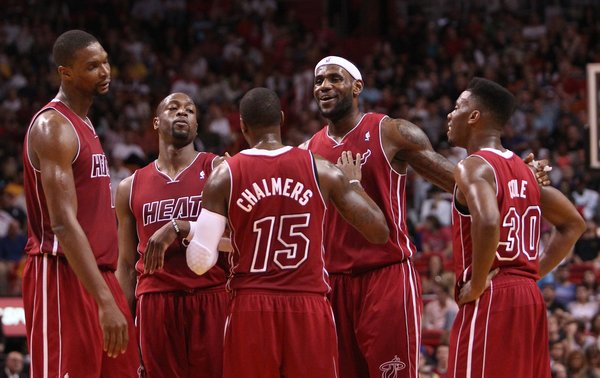
MIAMI _ The lasting image of Willie Reed will be as the lone player in tears when the media was granted access into the locker room after the season-ending realization that there would be no playoffs for the Miami Heat.
"I really wanted it for these guys," the 6-foot-11 center said as his eyes welled. "It's bigger than just basketball with us. We all truly care about each other. We have fun with each other. We hang out. It's different than anything I've really been a part of. I love all these guys. I hate to see it end. I don't want it to end."
And now it's over.
To a degree, shockingly over, after Reed was reduced recently to accepting a one-year, veteran-minimum $1.6 million deal with the Los Angeles Clippers.
Through all of the "Heat Family" mantra, Pat Riley has never lost sight that this also can be _ and often has to be _ a cold business.
When the season ended, Reed was not alone in believing he could, at worst, reach the levels of one of the NBA's mid-level exceptions from which to build a multi-year contract, be it the $8.4 million standard/non-taxpayer figure, the $5.2 million for taxpaying teams, or the $4.3 million granted to teams otherwise utilizing salary-cap space, such as the Heat.
So the Heat acted proactively, amid the belief that Reed _ who by then had opted out of $1.6 million for 2017-18 _ deserved his and would get his from a team without as much urgency with their salary-cap space. First the Heat pursued Gordon Hayward, then cycled back to the deals for James Johnson, Dion Waiters, Kelly Olynyk. And when the option was picked up on Wayne Ellington, the space was gone.
Along the way, the Heat selected Bam Adebayo with what they hope will be their last lottery pick for years. From the outset of summer league, which coincided with the start of the free-agency signing period, the big man out of Kentucky showed he would be worthy of immediate minutes as a rookie.
And then the market for big men dried up, leaving the likes of Nerlens Noel, Mason Plumlee even Marreese Speights looking for deals. This was nothing like a year ago, when Timofey Mozgov, Bismack Biyombo and Ian Mahinmi couldn't be scooped up fast enough.
Even before free agency started, one door already had slammed closed for Reed, with the Los Angeles Lakers' acquisition of Brook Lopez. Then early in free agency, the Atlanta Hawks, another anticipated potential landing spot, opted for Dewayne Dedmon.
That leaves three questions about this parting with Reed and whether enough was done to keep a player who bled Heat red, white and black last season seemingly as much as anyone this side of Udonis Haslem:
1. Was Olynyk over Reed the right move?
The league is changing. The perimeter game matters. You won't find a general manager who would opt for Reed over Olynyk.
And it's not as if the Heat could have skimmed much, if anything, off the combined Olynyk-Johnson-Waiters deals to carve out what they thought would be necessary to sate Reed, after his breakout season.
Plus, with the Heat envisioning Olynyk as an option in the middle, that would have reduced, if not eliminated, available minutes in the middle for Reed.
2. But $2.3 million for Haslem and Reed taking $1.6 million elsewhere?
Apples and oranges.
Haslem played three games over the second half of the season and never complained. For Reed, if there was only to be a one-year deal, it had to be a deal accompanied by assurances of playing time. Reed received that from the Clippers and Doc Rivers. It was among the reasons why an equal minimum-scale deal from the Heat would not have been as viable.
As for the salary difference between Haslem and Reed, it is a factor of tenure in the league, with both salaries counting the same against the 2017-18 salary cap.
3. And yet the Heat's $4.3 million mid-level remains untouched?
Again, no matter the price, Reed faced limited _ and potentially no _ playing time with the Heat behind Hassan Whiteside, Adebayo, Olynyk and possibly James Johnson, when factoring in undersized lineups.
Ultimately what the Heat make out of that exception will determine the prudence of going forward without Reed.
Last year, by saving their mid-level, the Heat were able to add Waiters later in free agency. It is an exception that can be spent at anytime during the season, including on the buyout market after the February trading deadline.