It may strike those who recall Richard Desmond pulling out of the previous form of press regulation as ironic that one of his outlets is the first national media group to be censured by the new regulator.
The Daily Express website was declared guilty by the Independent Press Standards Organisation (Ipso) of publishing a “significantly distorted” story by claiming Ukip had overhauled Labour in an opinion poll.
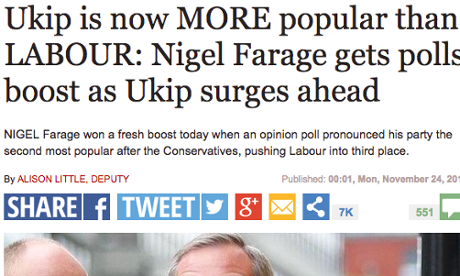
The article, Ukip is now more popular than Labour: Nigel Farage gets polls boost as Ukip surges ahead, was inaccurate in one rather important respect.
It stated that a YouGov poll showed that 38% “of those surveyed” intended to vote Conservative, 28% UKip and 25% Labour. But those figures related only to the voting intentions of Sun readers.
The Express’s deputy political editor, Alison Little, had extracted them from the overall national poll, which found that the Tories were on 33%, with Labour on 34% and Ukip on just 15%.
As noted on the YouGov website at the time, in November last year, the Express’s article - pretending that the Sun’s readers’ response reflected the national mindset - won “the coveted UKPR crap media reporting of polls award”.
So the Ipso decision was unsurprising and the Express, as ordered, has duly published its adjudication. The paper has also placed an explanatory footnote at the end of its contentious, inaccurate, distorted article.
But, as my screen-grab shows, the offending headline remains and it is unlikely that browsers will make it to the end of the piece to read the footnote.
Surely the remedy is therefore insufficient because the inaccuracy remains in place. Ipso should look again at the matter because the problem remains. A footnote, in such circumstances, is just not good enough.
Secondly, with the old Press Complaints Commission’s pledge of swift decision-making in mind, I wonder why it took so long to reach this adjudication on what appears to be an open-and-shut case.