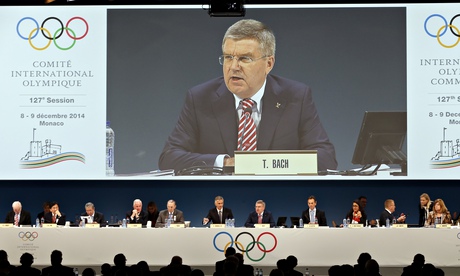
With no discernible irony the International Olympic Committee chose Monaco, home of the tax shy and super rich, to vote through a series of proposals partly designed to make bidding for and hosting its showpiece events cheaper and easier.
The end result of a sometimes stultifying day of presentations, punctuated by cloying paeans to the German IOC president Thomas Bach, was a patchwork of 40 unanimously passed resolutions it has been claimed will set a “roadmap” for the next 15 years of the movement.
“I hope this will prove to be an important day for the Olympic movement. I’m positive that today we took the right decisions, with a vision for the future of the Olympic movement getting closer to the youth and to the people,” said Bach.
The proposals are good news for baseball and softball, which could return to the Games in Tokyo in 2020 under new rules allowing hosts more autonomy. And they are potentially bad news for athletics and swimming, which could see some of their disciplines come under threat.
The veteran IOC member Dick Pound immediately wondered whether the triple jump or synchronised swimming might be among those that could become expendable. The Princess Royal was not alone in her confusion over what exactly the move from a “sport-based” to an “event-based” programme might look like. But as elsewhere, it essentially amounted to a canny attempt by Bach – determined to move quickly during the first year of his presidency – to gain a mandate for the battles to come. It is only when specific proposals are brought over which disciplines might be excluded to make space in a crowded summer Games programme that the true dogfight will begin.
There was also good news for those campaign groups such as All Out who have diligently campaigned for a specific clause outlawing discrimination on the grounds of sexuality to be added to the IOC charter, an issue that rose to the top of the agenda in the run up to the 2014 Sochi Winter Olympics thanks to Russia’s laws forbidding “gay propaganda”.
“Today is a great step forward for the Olympics, and particularly for the athletes, spectators, and residents of host countries who identify as gay, lesbian, or bisexual,” said Human Rights First’s Shawn Gaylord. “Our hope is that potential host countries, like Kazakhstan and China, will understand that protecting the rights of sexual minorities is no longer something they can dodge.”
Sepp Blatter, the 78-year-old Fifa president who remains a member of the IOC, would have been less happy.
A proposal to set the age limit for IOC members at the existing 70, with leeway for five one-off extensions of four years each, will leave Blatter having to resign his membership in two years time. He was notably absent from the hall when the unanimous vote was taken to pass that particular resolution. The IOC’s own Twitter feed, also apparently lacking an irony filter, kept a count of the resolutions as they ticked by: “Recommendation 28 – Support autonomy – is unanimously approved. Recommendation 29 – increase transparency – is unanimously approved.” And so on. Bach’s supporters would claim that winning unanimous support for all 40 recommendations amounted to good chairmanship. Others may wonder whether it was not more a reflection of the vagueness of the plans.
Some of the more eye-catching proposals voted through by the 96 of the IOC’s 104 strong membership present included resolutions to reduce the cost of bidding for and hosting the Games. In many ways, the bloated bidding process was an unintended side effect of the successful reforms instituted in the wake of the Salt Lake City bribes for votes scandal. With bidding cities banned from travelling the world to meet members, they began instead spending millions on consultants, bid books and expensive propaganda to fill the void.
Some welcome new rules will seek to temper that influence, shaping bids through collaboration with the IOC rather than as a beauty parade, though they will remain difficult to implement.
The Winter Olympics poses a particular puzzle, as evidenced by the recent withdrawal of Oslo from the race for the 2022 Games, leaving just Beijing and Almaty. The price tag of $51bn for the Sochi Olympics, while disputed by an IOC keen to separate spending on infrastructure from the operational budget, has become a millstone. The proposal to allow more than one city or even more than one country to host a Games was notable, but whether it will have much effect in practice is open to question. As with so many other resolutions passed as part of the Olympic Agenda 2020 process, the proof of the pudding will be in the eating.
The one concrete plan to come out of the day was the launch of a new Olympics television channel to try and better engage the public between Games, give a platform to smaller sports and, in particular, to try and attract younger viewers. With more than 100 new staff and a budget of $490m over the first seven years it has the means to succeed. The pitch of an “always on, aggregated platform featuring content from IOC and its key stakeholders” did not exactly sound compelling but there is enough expertise within the IOC and its broadcast partners to make the concept work if it can avoid becoming more than a propaganda outlet for “Olympism”.
The day finished much as it began, with Bach basking in the applause of his members. Pound said it amounted to “a comprehensive review of where we are and where we are going”. But as Bach would no doubt concede, the hard work starts now.