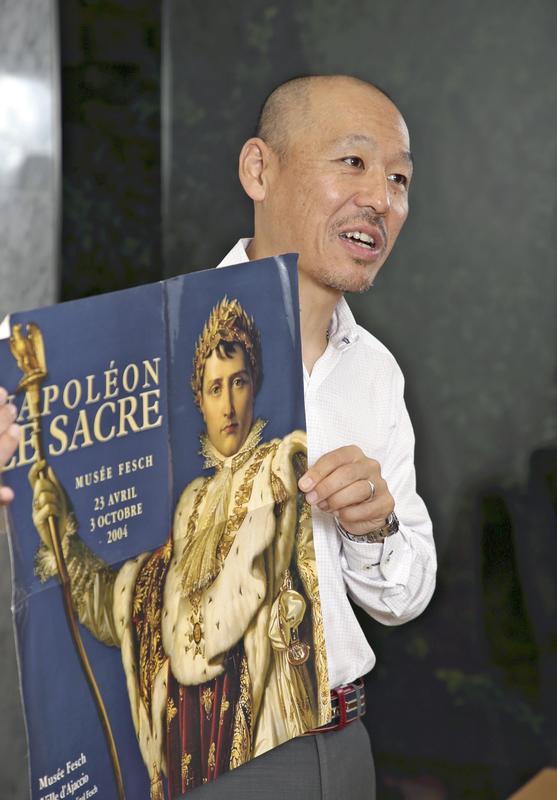
Noted writer Kenichi Sato, 52, winner of the prestigious Naoki Prize in 1999 and other accolades, is well versed in French history and last year completed a historical fiction novel on Napoleon Bonaparte. He sees a number of similarities between outgoing Prime Minister Shinzo Abe and the French emperor, as he revealed in an interview with Yomiuri Shimbun staff writer Shinya Machida when asked to assess Abe's long reign. The following are excerpts.
I have written novels using the history of France and other countries as subject matter. In looking at the administration of Prime Minister Shinzo Abe, I think a comparison with Napoleon (1769-1821) provides interesting insight.
Granted, Abe was born into a prestigious family of politicians, while Napoleon was born on the Mediterranean island of Corsica and rose to emperor through his own efforts. At a glance, they appear to be worlds apart.
But the two have intriguing points in common. The first is the eras in which each came to power. Napoleon emerged following the French Revolution at the end of the 18th century. The Bourbon dynasty, which once built an absolute monarchy, was toppled in the revolution, making it possible for the populace to express their opinions on political matters and taste the pleasure of having a say in the forming of society. At the same time, it led to serious social instability. Against this background, Napoleon emerged as a strong leader shown in the military.
Abe, for his part, regained the position of prime minister in December 2012. The major event that preceded this was the change of government control to the Democratic Party of Japan in 2009. The people came to know the joy of being able to effect political change with their own hands, while politicians broke with the politics of decision-making behind closed doors, using instead manifestos publicized before elections. But at the same time, this led to an indecisive style of governing, resulting in the chaotic response to the Great East Japan Earthquake in March 2011. Abe's second rise to power came amid the populace's pleas for ensuring a stable society.
Napoleon and Abe are both the type that is obsessed with their work. Results were all that mattered in meeting people's expectations. Napoleon led a series of victories during the military campaign to Italy, and commanded a big army to Egypt. He assumed the throne as the first emperor of France in 1804 at the age of 34.
Abe sought results with his economic policies dubbed Abenomics. The Nikkei Stock Average, which stood at about 10,000 when he returned to power, continued to rise while his administration successfully won the bid for hosting the Tokyo Olympics and Paralympics. On the diplomatic front, Abe energetically took the initiative to build pipelines with Russian President Vladimir Putin and U.S. President Donald Trump.
While the positions of emperor and prime minister are different, both emerged immediately after witnessing a revolution or change of government in which there was an explosion of energy among the populace. Keenly aware of the people's voices and their expectations for results, the two took on a leadership role behaving as a sort of president.
Eventually, the successes they experienced early on during their reigns may have transformed into heavy pressure to produce more triumphs, at the risk of losing public support. Napoleon repeatedly waged futile wars before suffering a devastating defeat in Russia, which took the wind out of his sails. In the later years of the Abe administration, he was shaken by a series of high-profile scandals involving Moritomo Gakuen and Kake Gakuen school operators, and an inadequate response to the novel coronavirus pandemic.
The Abe administration lasted for seven years and eight months. The tenure of a U.S. president is set at no more than two terms totaling eight years. That may be the limit that one person can bear such a heavy responsibility.
Napoleon's fall from power in the 19th century was followed by the gaining of power by a reactionary regime in France. After Napoleon abdicated the throne, the Bourbon dynasty, which had ruled pre-revolution France, restored the monarchy. Napoleon regained power briefly after escaping from exile on the island of Elba, but was exiled again to the island of Saint Helena, where he died at 51. After that, Charles X ascended to the throne as king.
The Liberal Democratic Party's recent selection of its president, steered by party factions, harks back to the backroom politics, which looks as if the politics swings back to how it used to be.
But there is no need to feel that we are moving backwards. After the restored monarchy continued for some time in France, the spirit of Napoleon returned with the emergence of Napoleon III. The experience of going through a revolution or a government change and the subsequent welcoming of a president-like politician remains as a form of legacy in society. What the Abe administration has left behind will be assessed by future generations. But at the very least, we know we won't see a return to the closed-door politics of the past.
Read more from The Japan News at https://japannews.yomiuri.co.jp/