The UNESCO World Heritage sites of Angkor in Cambodia and Bagan in Myanmar are among the huge ancient remains symbolizing the history of Southeast Asia that have experienced crises such as deterioration causing structures to collapse or natural disasters. Japan and other nations have cooperated to help these sites overcome the difficult situations.
Recent symposiums held in Tokyo discussed future conservation methods for cultural heritages while reflecting on past efforts that have become successful examples.
A heritage site safeguarding project started in 1994 as part of international cooperation activities following the end of the civil war in Cambodia in 1991. The progress and the latest results of the project were reported at a symposium held last December to commemorate the 25th anniversary of the formation of the Japanese Government Team for Safeguarding Angkor (JSA).
What was emphasized as a big achievement of the JSA, which consists of experts in architecture, archaeology and conservation science, was the restoration of the Bayon Temple built in Angkor Thom, the capital of the Khmer Empire, around the latter half of the 12th century.
The Bayon Temple's stylobate was built on a foundation made by tamping down the soil and covered with stones. The soil became fragile due to the infiltration of rainwater and other reasons, causing part of the stylobate to come out of alignment. In the case of the Northern Library, where sutras and other sacred documents are believed to have been stored, some parts of the columns and walls were found to be crumbling.
In restoration projects undertaken by teams from other countries, the use of reinforced concrete was the usual restoration method. JSA head Takeshi Nakagawa, a professor emeritus at Waseda University, respected the traditional method using soil and stones. Restoration was limited to areas where damage was especially serious. The JSA team adopted a method designed to enhance the strength of the soil through a minimum of improvements, including mixing lime hydrates with soil. Restoration of stones that fell off was performed by using stones whose material quality was close to that of the original stones.
This was a trailblazing attempt to put into practice the concept of "authenticity," an element also valued in determining the registration of World Heritage sites today. JSA's foresight is highly evaluated in view of the fact that aging was reported in parts of Bayon Temple where restoration had been undertaken by other countries.
Technical innovations made over 25 years of safeguarding Angkor were reported in the symposium, including digital recording of restoration processes and monitoring for the purpose of preventing deterioration caused by rainwater.
In recent years, a project has been undertaken to produce a well-crafted replica of the Bayon Temple's principal Buddha image with the aim of fully restoring it. Japan has thus made great intangible contributions to pass along the spirituality of Cambodian culture as well.
Challenges pointed out
A symposium was held in January this year to report on the status quo of cultural heritages in Mekong Basin countries attended by researchers active in the field.
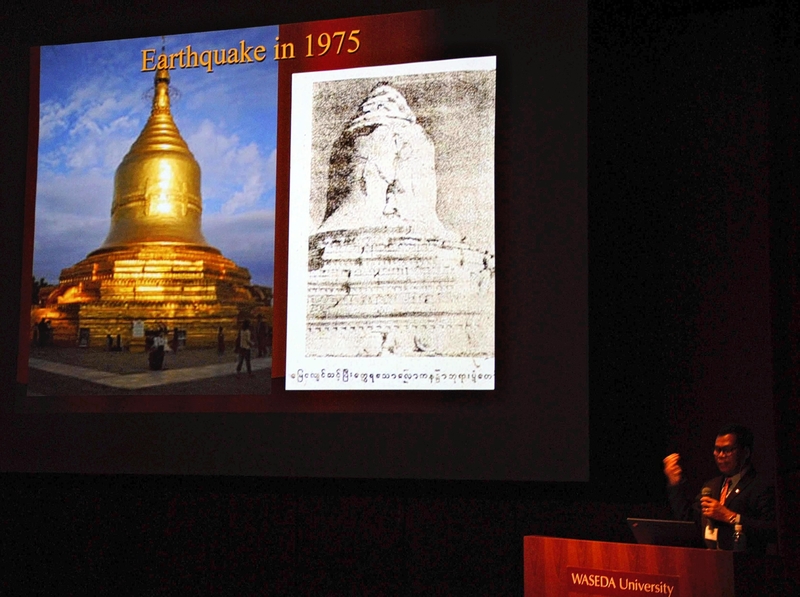
The Bagan group of Buddhist ruins in Myanmar dating back to 11th to 13th centuries contains more than 3,500 various kinds of small and big monuments, including temples and stupas. The ruins had been hit by a number of disasters, including flooding and earthquakes, but valuable architecture and murals were restored through the cooperation of local researchers and overseas teams. These efforts bore fruits last year when Bagan was inscribed as a World Heritage site, the second of its kind in Myanmar.
Thein Lwin, deputy director general of the Department of Archaeology and National Museum of the Myanmar Ministry of Religious Affairs and Culture, said Bagan is still an important place for pilgrims and festivals. It is not a historical site, but a living place, Thein Lwin stressed.
Concerning how to inherit this "living heritage," Masahiko Tomoda, director of the Japan Center for International Cooperation in Conservation at the Tokyo National Research Institute for Cultural Properties, also stressed, "It is essential to conserve both tangible and intangible values [of Bagan] while tapping not only up-to-the-minute technology, but also traditional technology that fits local areas."
Kong Puthikar, director general of the Cambodian National Authority for Preah Vihear, argued that there are still many tasks to be tackled to resolve a shortage of young researchers and to encourage participation by regional communities. Behind the difficulty in securing human resources is the situation in Cambodia where job opportunities are not offered sufficiently for the cultural heritage field compared with such fields as tourism and construction.
The employment issue was raised also in the Bayon Temple symposium. Concerns were pointed out about the possibility of jobs being lost following the end of projects by overseas teams. Fostering human resources and providing jobs for trained personnel from a long-term viewpoint will continue to be necessary for expanding the range of cultural heritage conservation.
Read more from The Japan News at https://japannews.yomiuri.co.jp/