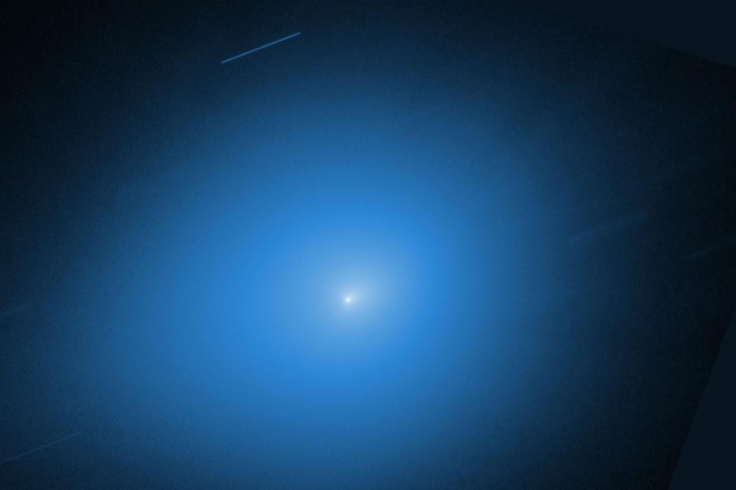
It's the most extraordinary cosmic present any astronomer could wish for. Just six days before Christmas, an ancient traveller that has been careening through the interstellar medium of the Milky Way galaxy for billions of years is set to make a once-in-a-universe approach to our planet. This is not a returning comet we have tracked for decades; this is 3I/ATLAS, and its fleeting visit is giving scientists an unprecedented peek into the birth of an alien world.
This interstellar vagabond is only the third large interstellar visitor that we have ever discovered — an asteroid or comet that originated outside of our solar system and was discovered passing through. For planet hunters, this is the gold standard. Since it presumably formed in a protoplanetary disk of gas and dust swirling around another star, it offers pure, untainted data on how planetary systems beyond our own take shape.
Most likely, 3I/ATLAS was violently ejected by a close gravitational slingshot off a giant exoplanet in its home system. Now, its journey is culminating in a spectacular, unrepeatable moment for us: on Dec. 19, just before the holiday period begins, this erratic wanderer will be the closest to Earth that it will ever be over the lifetime of the entire universe.
Astronomers can glean information about these celestial bodies by observing the light reflected off them with powerful telescopes. When 3I/ATLAS is closest to the Earth, all the features that we are looking for — especially the chemical makeup of its ices — will be easier to detect. This close approach offers our best opportunity to look up close and learn about how planet formation in exoplanetary systems is similar or different to how it unfolded in our solar system.

The Billion-Year Exile: What Comet 3I/ATLAS Tells Us About Cosmic Wanderlust
In the past seven years, we have discovered three members of an entirely new population of celestial bodies: interstellar objects. Their existence is proof that star systems are constantly shedding material into the galaxy. The reason we know they are alien is because of their hyperbolic orbits, as opposed to the bound circular or elliptical orbits of everything native to the solar system.
That's how we know that they come from elsewhere: they come and leave and never return. All we get is a fleeting look into the lifetime of these objects, and the measurements we take during their brief passage through our solar system could provide critical clues into our understanding of planet formation throughout the galaxy.
We know that the solar system ejected a huge amount of material into the Milky Way galaxy in the form of interstellar comets. Our best computer simulations have shown that, in order to reproduce the structure of the solar system that we see today, there was most likely a violent period during which the giant planets Jupiter, Uranus, Saturn and Neptune migrated, flinging material into the Kuiper Belt and the Oort Cloud.
During that process, we probably liberated about 30 Earth masses of 3I/ATLAS-sized comets into the interstellar medium. It is therefore not surprising that other planetary systems should also have ejected comets into the Milky Way.
The first known interstellar object, 1I/'Oumuamua, was discovered in 2017. Two years later, we discovered 2I/Borisov, which displayed a prominent cometary tail, and its composition was much different than those of solar system comets. Our telescopic observations revealed that it contains more carbon monoxide than water. Crucially, most solar system comets are comprised of a lot more water than any other type of ice.
The Chemical Revelation of 3I/ATLAS
The ices we see in a comet can tell us something profound about the conditions in which they formed. For example, water freezes at cold temperatures. The farther away from the sun a comet forms, the colder it is. Therefore, the fact that comets in our solar system have water as their main ice tells us that they mostly formed around where Jupiter is now, about five times more distant than the Earth.
Carbon monoxide and carbon dioxide, however, freeze at much colder temperatures than water. Therefore, 2I/Borisov's carbon monoxide enrichment tells us that it probably formed at a much farther distance from its star than the typical comets left in our solar system. Astronomers had been looking for interstellar objects unsuccessfully for six years until we spotted 3I/ATLAS this July. And it has been well worth the wait.
We have been monitoring it since we discovered it, and our early observations with facilities like the James Webb Space Telescope have revealed that it is enriched in carbon dioxide. This is probably telling us that, like 2I/Borisov, 3I/ATLAS formed much farther out in its progenitor star system than our solar system comets did.
These observations might be telling us that comet formation occurs in much farther regions than we previously thought possible based on our inferences from the solar system. In that way, the solar system would be somewhat unique. Alternatively, it's possible that we also produced such distant comets, but all of them were subsequently ejected. Either way, 3I/ATLAS is giving us a new window to put our solar system into its cosmic context this Christmas.
This is exciting for everyone, because anyone can go see 3I/ATLAS with a powerful amateur telescope or very powerful binoculars. Meanwhile, for the professionals, all these critical ice features are easier to detect the closer this incredible relic from another star system is to Earth.
An object that has travelled billions of years across the Milky Way is briefly passing through our backyard. As scientists use the most powerful instruments, from the James Webb Space Telescope down to amateur-grade equipment, to unlock its alien secrets, the rest of us get a spectacular window into the history of another star system. Dust off those binoculars or power up your telescope and look up on Dec. 19 — this truly is a once-in-a-universe sighting you will never have the chance to witness again. Don't miss this fleeting glimpse of a cosmic vagabond.