It’s happening. After years of predictions about the “connected home”, the conditions are finally in place to allow the internet of things (IoT) to flourish. Wi-Fi means devices all over the house can easily access the internet, smartphones ensure that we can easily control them, and connected appliances themselves are becoming more affordable.
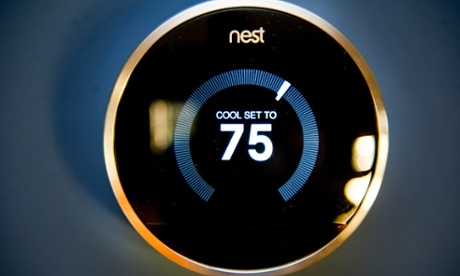
Energy appears to be leading the way. Google made a splash last year when it paid $3.2bn (£2.08bn) for Nest Labs, the creator of an intelligent thermostat which can be accessed and tracked remotely. British Gas has launched a similar product in the UK called Hive Active Heating. Meanwhile, Amazon is making a play with the Dash Button; it ensures that when you notice your kitchen roll or laundry liquid running low, you need only press the Dash Button secreted in your cupboard to have Amazon deliver a new batch.
One expert in this field is Maurizio Pilu, who is executive lead for the IoT programme at Digital Catapult. His organisation works with entrepreneurs to develop their digital ideas, and he sees three drivers of progress: energy-savings, security and convenience.
“Energy efficiency can save real money”, says Pilu. “Security can also save money in terms of insurance and gives people peace of mind. Convenience is a big bank of things which basically increase your productivity in your home.”
Aside from the big-ticket Google and Amazon offerings, there are other less flashy applications, he adds. “Some of the large players, Samsung and others, are starting to develop staple appliances such as fridges and washing machines, and the main reason is maintenance – the technology allows you talk to your washing machine and ask whether the motor is consuming too much energy, for example. That kind of stuff is not that exciting, but it does solve problems for consumers and manufacturers.”
For organisations looking to get on the bandwagon, Richard Foggie, digital knowledge transfer manager at the Knowledge Transfer Network, has some advice. “My counsel to business is ‘what data assets do I generate by means of my user enterprise activity?’ ‘How can I reuse that data in some way that is useful enough to customers that they’d be willing to pay a bit for it, or that would make my relationship with them stickier?’
“And if organisations want to take that relationship further, they could also think: ‘I have my own data, what are other data sources available that I could fuse with that to come up with an improved service offer? Or who are the third parties, the collaborators, who might be interested in having access to and consequently paying for my data?’”
A subtle threat to privacy
If you’re excited by these possibilities, then you’re not alone. However, as with many of the technologies that have emerged in the internet age, there are concerns about privacy. “When you post something on Facebook,” says Pilu of Digital Catapult, “you’re consciously sharing a bit of your life with people. IoT is subtle. A thermostat will know whether you are home or not. Your car interacting with a car park might reveal that you’re parking somewhere.”
As the internet of things takes off and data sets from different devices begin to be stored together in the same places, this is only going to become more of an issue. Apparently innocuous pieces of information gathered from homes, cars and wearables could combine to provide a quite detailed picture. Consumers will want protections, but the problem for all of the players in the IoT value chain is the potential sheer complexity of the landscape, according to Purvi Parekh, head of the international telecoms practice at legal firm Olswang.
“Because the objects communicate automatically but do so in silos, that results in a lot of different data flows,” she explains. “There will be so many people in the ecosystem; the telecoms operators at one end, the users in their homes at the other, with manufacturers, systems integrators, and retailers in the middle. Because of that you have a complex web of interdependencies and responsibilities, and businesses will need to make very clear in their contracts where the liabilities for these start and stop.”
The issue of consent poses another major challenge to business. Gaining consent to process someone’s personal information is one of the key principles of data protection law, but with IoT, the frequent lack of a user interface means it’s not as simple as asking someone to tick a box.
“What’s likely with some of these products,” explains Parekh, “is that the companies in the value chain will adopt a “privacy by security” and “privacy by design” approach, giving users the ability to be in control of their information at all times and have choices about how it gets used. The quality of the consent will be very important, particularly as the more traditional methods obtaining this do not work as easily in an IoT world. So I think that manufacturers will move to making sure they get express consent rather than leaving it to chance or trying to argue that it was given implicitly.”
Privacy by design
Back at Digital Catapult, Pilu says the tech industry needs to work with policymakers to overcome these issues, and that consumers need to be given the tools to choose the most safe and privacy-friendly products. However, his organisation also recommends that entrepreneurs take the “privacy by design” approach.
“It’s a difficult trade-off for small companies,” he says. “They need to go to market but they cannot wait for the whole world to change [in terms of setting privacy standards], So the SMEs are trying to go ultra-safe on these things, to go big on the things that will differentiate them from the large American corporates which are all ‘big data, big data’, This is one of the strongest currents they have right now to convince you to buy their products.”
Gareth Jones is the editorial manager at Slack Communications
This advertisement feature is provided by Olswang, sponsors of the Guardian Media Network’s Changing business hub