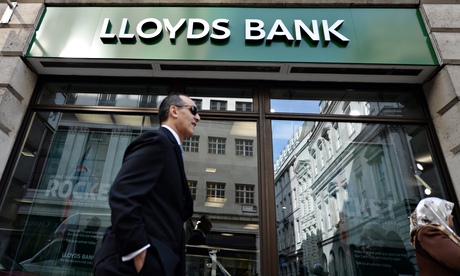
I’m not saying you could definitely play a game of rounders in the Lloyds bank branch in New Street, Birmingham, but you could give it a good try. Move a few chairs and a couple of leaflet stands, don’t swing at the ball too wildly, and I reckon the branch’s staff could conjure up a novel after-hours pastime.
The place is huge. Occupying a grand Victorian building in what is still a grand boulevard despite the noisily bustling lunchtime crowds, its doors sweep open to usher customers into a large open carpeted room, dotted almost sparsely with stuff relating to your money. On one side is a row of automated machines, some screened-off booths and a scattering of tables, on the other a large comfy seating area, and behind it, a helpdesk staffed by smiling tellers.
One corner of the bank is dedicated to a small screen rolling through a succession of inspirational buzzwords – Sweet, Sorted, Breathe – presumably because they had run out of other things to put there. And way, way at the back – remember these guys? – are five cashiers at desks (no glass screens here). Above them is a screen reading “Bliss! I can do all I need without queueing at the counter.” The welcoming message: are you really sure you need to be here at all?
Banking is changing: statements are paperless, payments are mobile, branches are sparser, more automated, populated by beaming cashiers prowling around with iPads. But how long can we count even on that? Lloyds’ announcement this week that it will close 200 branches in the next three years with the loss of 9,000 jobs was just the latest in a succession of banking retreats from the high street. Barclays has shut one in 10 of its branches in the past five years, 50 of them in the last 18 months; HSBC has closed that number this year alone.
In the most severe chop of the lot, on Friday RBS announced it will close 154 branches in the coming year. Since their peak in the late 1980s, the number of banks on British high streets has almost halved. Lloyds says it hasn’t decided which branches will shut (and that it will open 50 new ones), but while nobody is predicting an end to all in-branch transactions, the bank thinks in three years’ time we’ll visit branches half as much as we do now. The implications are obvious.
Birmingham is where Lloyds bank began, when Sampson Lloyd II, an ironmonger, and John Taylor, a cabinetmaker, set up a bank in Dale End in 1765. The building, like much of historic central Birmingham, is long gone, remembered only by a blue plaque on the wall between Cash Generators and Pound Palace.
There’s a TSB two doors down, though, and Anthony Bolger, having popped into the branch to “pay some stuff in”, is not pleased at the prospect of branches closing. The customer services worker has a laptop but has never used it to move his money because “I’m not too clever with the internet, and anyway, I like the personal touch. I think there are an awful lot of people out there who want to go to the bank and talk to someone”.
He’s not alone. Derek Stokes is visiting from Solihull and weary after “walking for miles to find a Halifax” to pay in a cheque to cover his credit card bill, as he and his wife do every month. (“I’ve got an iPad but I don’t use it for anything financial. I’m old, aren’t I?”). Hazel Jennings and her 20-something daughter Kate don’t trust digital security – “It’s just too easy with the internet to scam you these days.” If their Lloyds branch closed – and with five in the city centre you’d have to bet on at least one of them – they’d just switch to another bank, says Hazel.
Revolution is coming, all the same. Lloyds chairman, Lord Blackwell, has predicted greater change to the way we bank in the next 10 years than has happened in the last 200. We’re told to expect more and more facilities to do it all ourselves, both in branches and on our phones. I still don’t know how I’ll pay in my occasional cheques, but there’s always a way – Barclays is piloting a scheme where you just send them a scanned image of your cheque.
And there is no denying that while there are queues in some of Birmingham’s city centre branches, others tell a different story. The lunchtime rush at a huge TSB on Colmore Circus consists of a solitary customer talking to a solitary teller; three separate seating areas, two reception desks and four semi-private meeting rooms are deserted.
“The thing about internet banking is it’s just more convenient,” says Barry, a trainee teacher who uses his phone and computer interchangeably for banking services. He hasn’t seen a cheque in years and looks puzzled when asked if he has any security concerns about mobile banking.
And yet he’s coming out of the branch? “Yeah, well I came in to change my address.” He couldn’t do that by phone? “Nah, what about the phone charges?”