In Istanbul 23-year-old media studies student Kaja* is disillusioned and no wonder. Journalists made the headlines in 2014, whether the targeted attacks by Islamic State (Isis) or the lengthy prison sentences dealt out to al-Jazeera journalists in Cairo.
Trainee journalists worldwide face low wages, unreasonably stretched job descriptions and self-censorship pressures, while tutors at local journalism schools are forced to double as campaigners for press rights. Early-career journalists and journalism professors in Macedonia, Burma and Turkey talk about what it’s like to break into the industry in their country.
Macedonia
Yugoslavia’s break-up in 1990 left Macedonia saturated with multilingual media outlets – a disordered collection of TV, radio and print media working in a mixture of Macedonian, Albanian, Turkish and Serbian languages.
A reporting qualification is not essential to get into the industry, but Professor Zaneta Trajkoska, director of the School of Journalism and Public Relations in Skopje, says that the course attracts only those most “serious” about journalism.
Macedonia is 123rd in the Reporters Sans Frontieres (RSF) 2014 Press Freedom Index, in a four-year consecutive spiral down the rankings. The controversial house detention of journalist Tomislav Kezarovski is one factor, while the volume of government-sponsored advertising has sparked concerns that the media is too reliant on the state for its survival. Penalties for journalists and publishers who fall foul of Macedonia’s punitive defamation laws can be heavy.
For third-year journalism student Marija*, the “ugly truth” about breaking into the Macedonian media is that it is impossible without taking a political side: “Print, online media, TV and radio – they all present only one view of the story. Macedonian journalism needs real reporting that does not hide the economic and political side of the country.”
Trajkoska says local media activists have coined the closed access to official sources of information “the ice effect”. “We are still fighting with the public authorities for the free flow of information,” she says.
She is keen to introduce ideas about entrepreneurship into the curriculum, believing that fostering this kind of freelance resilience is in the national interest.
“It will create more media pluralism and diverse news information coming from independent sources of information,” she says, “which is so needed in Macedonia.”
Burma
Myint Kyaw, journalism trainer and general secretary of the Myanmar Journalist Network (MJN) used to disseminate daily news on Facebook under Burma’s former military regime but since April 2013, private daily newspapers have been permitted to publish.
Three journalist unions, including MJN, link and support Burma’s estimated 5,000 professional journalists. Newsroom expansions have created many new job opportunities, but training is also needed.
Kyaw, 51, was lucky to have trained overseas. “A lot of journalists here do not have a degree. Some publications give on-the-job training for two weeks, one month, or at most three months – but the smaller ones cannot.”
She tutors at the internationally backed Myanmar Institute of Journalism (MIJ), which offers part-time diplomas to journalists with at least two years’ professional experience.
Reporter Aung Khin Oo, 26, studies on MIJ’s Monday-Saturday morning course. “Many journalists are eager to attend the MIJ but their editor or employer would not allow it,” he says. “I am very lucky to be here.”
A diploma will help him financially, as many employers use a lack of formal training to justify a monthly wage lower than the average $150.
Burma jumped up six places to 145th on the last RSF Press Freedom Index, suggesting that conditions for Burmese journalists are improving, but risks remain. Oo is sceptical that the government has significantly relinquished press controls, saying that recent jailings of journalists prove it is a “trick”.
He says: “The value of a journalist is like a window; if the window is closed, the room will be completely dark.”
Turkey
When the Turkish government’s plans to develop Istanbul’s leafy Taksim Gezi Park were met with thousands of angry protesters in 2013, Kaja chose not to go on the main newspapers’ websites.
“I knew that the only reliable source was Facebook. I trust my friends more than journalists who have trained for 10 years or more,” she laughs.
Kaja was right to be suspicious. While demonstrators in Istanbul were sprayed with tear gas, CNN Turk screened a wildlife documentary about penguins. Columnist Yavus Baydar was fired from Turkish daily Sabar after voicing reader objections to its pro-government stance during #OccupyGezi.
Kaja studies at Istanbul Bilgi University, described by journalism professor Asli Tunc as a “haven” of free speech; Bilgi’s independence means it cannot be blacklisted and its tutors are regarded as more outspoken.
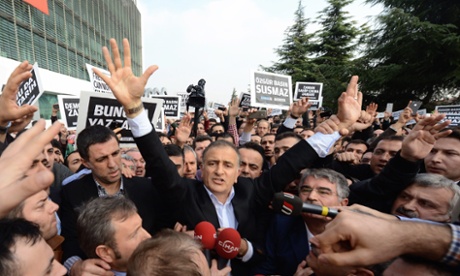
At 154th, Turkey occupies the lowest position on the RSF index; it is among the worst offenders globally for its number of imprisoned journalists and nationalist newspapers thrive. Article 301, a vague and controversial law, cracks down on those who insult “the Turkish nation” while journalists or media outlets suspected of links to the US exiled Muslim cleric Fethullah Gulen, a friend turned foe of Turkish prime minister Recep Tayyip Erdogan, face ongoing hostility. Two dozen journalists, as well as the editor of opposition paper Zaman, were arrested in raids last December.
Kaja’s family is part Kurdish and Armenian, both marginalised groups in Turkey. “I want to write about the Kurdish genocide,” she says. “Much of my grandmother’s family were lost, but I am aware of censorship. Writing against the government, about Ataturk, the Armenian genocide, on religion, sexuality for young people... You could get into big trouble.”
“It’s very hard to be an investigative journalist here,” says Tunc. “There are some independent news platforms but everything is opinion media. News journalism is expensive. There are no ethics, no rules, no codes; students decide they cannot compromise themselves that much.”
*Names have been changed to protect students
More like this
• Charlie Hebdo attack is an extreme example of the violence journalists face
• Let’s get over the whole ‘newspapers are dying’ thing
• Digital content trends for 2015
To get weekly news analysis, job alerts and event notifications direct to your inbox, sign up free for Media Network membership.
All Guardian Media Network content is editorially independent except for pieces labelled “Brought to you by” – find out more here.