Research on drugs and treatments that use antibodies from people who have recovered from infection with the novel coronavirus is making progress.
--Global competition
When U.S. President Donald Trump was infected with the new coronavirus in October, he was given an unapproved artificial antibody drug developed by the American pharmaceutical company Regeneron Pharmaceuticals Inc.
After leaving the hospital, Trump praised its effects, saying he felt better immediately.
Regeneron and Eli Lilly and Co., another U.S. drug company, have applied for emergency approval from the U.S. Food and Drug Administration for artificial antibody therapies under development.
The U.S. government intends to support both companies, such as by helping build production systems. A representative of the U.S. Health and Human Services Department said they want to secure 1 million doses by the end of the year.
Most of the drugs that have been approved worldwide so far are those that were developed to treat other diseases, such as Ebola hemorrhagic fever. These drugs have already been created, their doses and side effects are mostly known, and they can be put to use on the ground immediately, but their therapeutic effects are limited.
Antibodies produced by people who have recovered from infections target the new coronavirus directly.
In general, antibody drugs have few side effects, and because the technology for synthesizing them artificially is already in place, they take less time to develop than conventional drugs. However, there are a wide variety of antibodies and they have differing levels of effectiveness.
Developing artificial antibodies that can serve as a definitive treatment is expected to take several years, and companies around the world are competing to discover promising antibodies.
--New technology from Fukushima
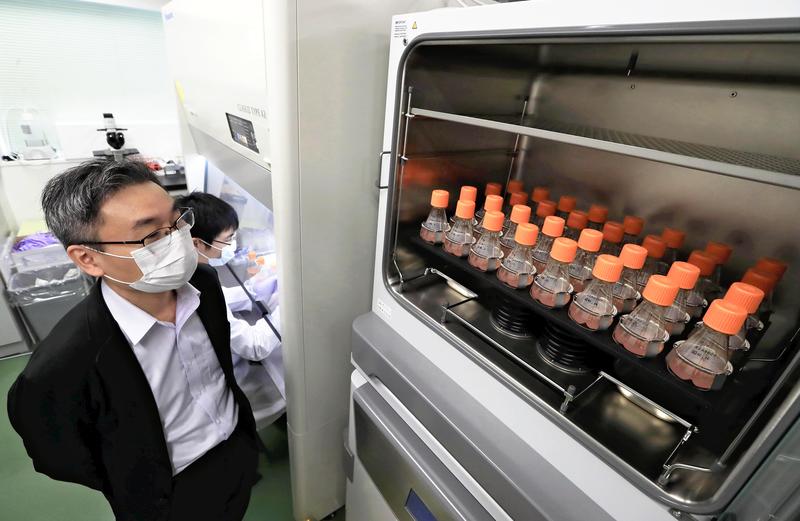
Fukushima Medical University is taking a unique path to drug development. The university is using new technology developed as part of a reconstruction project for the Great East Japan Earthquake to search for antibodies.
The university is focusing on a type of antibody called IgA. These antibodies not only exist in blood, but are also secreted by mucous membranes in the nose and throat of people infected with the new coronavirus.
If artificial versions of these antibodies are successfully synthesized, they could both treat and prevent new coronavirus infections.
More than 70 artificial antibodies have been developed worldwide to treat cancer and many other diseases, but there are no approved IgA antibody agents.
Prof. Motoki Takagi, an expert on drug development at the university, said, "Out of gratitude for all the support we've received, we want to start clinical trials in a few years and send Fukushima's achievements out to the world."
--Clinical planning
The National Center for Global Health and Medicine in Tokyo has launched a clinical study in which 400-milliliter plasma samples that include antibodies are taken from recovered patients and administered to people with moderate symptoms.
So far, samples have been taken from 90 donors and administered to four patients. The plan is to treat about 60 people.
Satoshi Kutsuna, medical director of the center's Disease Control and Prevention Center, said, "If the drug is administered within 3 days of hospitalization, we expect it to suppress growth of the virus."
Tens of thousands of people have received such treatments in the United States, but there is no track record in Japan. The first step is to verify its safety.
Takeda Pharmaceutical Co. has partnered with entities such as European and U.S. drug companies to develop an "advanced immunoglobulin preparation" that contains purified antibodies from recovered patients. They plan to administer it to 500 hospitalized patients in 18 countries, including Japan and the United States.
University of Tokyo Prof. Kohei Tsumoto, an expert in antibody engineering, said, "Antibody-based drugs are a pillar of pharmaceutical development alongside conventional drugs. Among them, the development of artificial antibodies to prepare for unknown infectious diseases needs support from national policy."
【Antibodies】
A type of protein manufactured by immune cells. There are five types, including IgA and IgG, which have different roles. Antibodies bind to specific pathogens and act to neutralize their pathogenic nature. Artificial antibodies produced using cells and other substances can be used as pharmaceuticals.
Read more from The Japan News at https://japannews.yomiuri.co.jp/