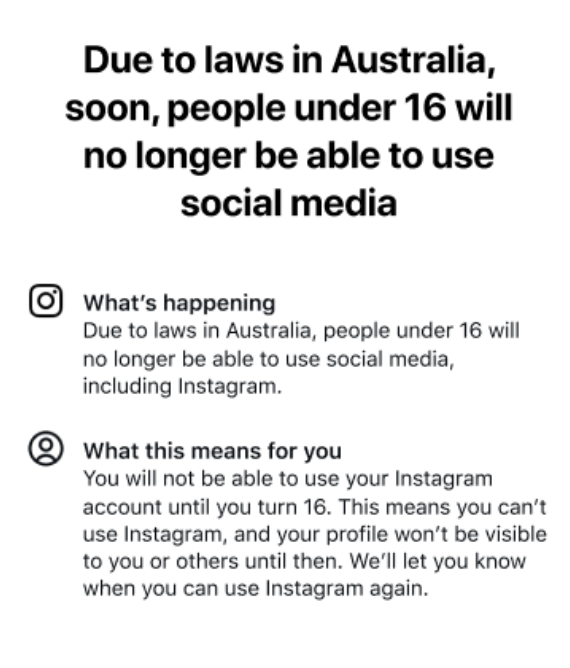
Meta has announced it would start deactivating the Instagram and Facebook accounts of its Australian users under 16 from 4 December, a week before the government’s law to ban social media for teens takes effect.
The tech giant had previously indicated it would begin removing access to accounts for those under 16 only as the law was enacted on 10 December.
With just two weeks left before the ban is enforced, Australian teenagers are reportedly receiving notifications on Instagram and Facebook to save their data before access to their accounts is revoked.
“For all our users aged 15 and under, we understand the importance of the treasured memories, connections, and content within your accounts,” Meta’s regional policy director Mia Garlick said in a statement.
“When you turn 16 and can access our apps again, all your content will be available exactly as you left it,” Ms Garlick said.
Meta said it is following a “data minimisation” approach, seeking additional information if the platforms have reason to doubt a user’s stated age.
From Thursday, users will receive in-app messages, text messages, and email before they lose access, with the company to remove accounts of its under-16 users by 10 December, it said.
There could be an estimated 150,000 Facebook users and 350,000 Instagram users aged between 13 and 15 in Australia, according to the country’s internet regulator.
“While we are working hard to remove all users who we understand to be under the age of 16 by 10 December, compliance with the law will be an ongoing and multi-layered process,” said Antigone Davis, Meta’s global head of safety.
Meta’s move is in line with one of the most comprehensive efforts by any government to police minors’ access to social media.
A recent study revealed that daily social media use among young people in Australia has jumped from 26 per cent to 85 per cent in a span of just four years, while youth participation in almost every other “enriching” activity, such as sports, reading, music, and art, declined rapidly.
Experts hope the social media ban for teenagers under 16 could push youth to interact more in the real world.
“If we want to support young people’s wellbeing, we need to help them rebalance their time – encouraging them to reconnect with real-world activities that build skills, confidence and social connection,” said Dot Dumuid, a behavioural epidemiologist from the University of South Australia.
However, experts are unsure how the law would be properly enforced.
Australia’s new law puts the onus on social media platforms to take “reasonable steps” to block minors from having accounts.
“The restrictions aim to protect young Australians from pressures and risks that users can be exposed to while logged in to social media accounts,” the country’s internet regulator said.
Platforms found to breach the law may face fines of up to $32.09mn (A$49.5mn).
“While there’s broad support for age verification, our research shows young people and parents doubt it will work and worry about privacy and data security,” said Catherine Page Jeffery, a digital media use expert from the University of Sydney.
Due to complexities involved in determining age online, Meta says it expects some margin of error.
“We believe a better approach is required: a standard, more accurate, and privacy-preserving system, such as OS/app store-level age verification,” Ms Davis said.
“This, combined with our investments in ongoing efforts to assure age and verify that signal and age-appropriate experiences like Teen Accounts, offers a more comprehensive protection for young people online,” she said, according to Australian local news.